

(Jon Margolis writes political columns for VTDigger.)
[T]he business of the Senate Finance Committee is money, not abstract philosophical discourse.
But this is Vermont, where even a typical politician sometimes likes to dabble in deep-think, and at a hearing the other day the conversation veered into abstractions even before one of the witnesses asserted that the matter before the committee was “not about money. It’s a policy debate.”
Policy is not the same thing as philosophy. But there is a connection.
Perhaps one reason the discussion grew theoretical is that the hearing was held to consider a bill with no chance of passage this year. The senators might have figured that since there would be no consequences to what they said, they might as well have some fun.
The bill is S.28, sponsored by Sens. Anthony Pollina, P/D-Washington, and Chris Pearson, P/D-Chittenden, and – speaking of philosophy – it’s about the escheat.
No, that has nothing to do with cheating. It’s from the Latin ex-cadere, to “fall out,” and in England some centuries ago it meant that if someone died without an heir, his property would revert to the crown. In modern, democratic America it means (in the words of the Free Dictionary) “the power of a state to acquire title to property for which there is no owner.”
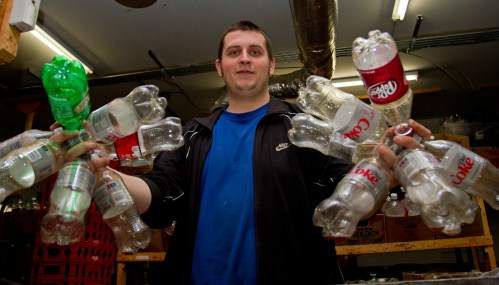
In England some centuries ago, that property was land. In modern, democratic America it’s money. S.28 deals with the money that piles up in the coffers of the beverage industry when people don’t bother to return their deposit bottles.
For almost 45 years, Vermont law has required a deposit of 5 cents on beer and carbonated soda bottles and cans, and 15 cents on liquor bottles. Customers pay the deposit when they buy, then get it back if and when they return the container.
Most do. Or at least most of the containers are returned, if not by the customer then by one of the Boy Scout, Little League, church or other groups that conduct bottle collection drives as fundraisers. The cans may net only a nickel each (it would be 29 cents if adjusted for inflation), but those nickels add up, and as economists never tire of declaiming, incentives work.
But not perfectly. Some beverage buyers neither redeem their containers nor toss them on the roadside so Scouts can collect them. Those bottles and cans remain unredeemed. The uncollected money remains somewhere in the beverage industry, and according to Paul Burns of the Vermont Public Interest Research Group, there is somewhere between $1.5 million and $3 million of it.
“It’s a significant amount of money going to the beverage companies,” said Burns, arguing that the state should use it for the benefit of all Vermonters.
That’s where things got philosophical, thanks to Sen. Dustin Degree, the Republican minority leader from Franklin County.
“What’s our right to take this money?” Degree asked. “Why can the state sweep in and take it?”
Interesting questions, to which Burns had no answer.
Committee Chair Ann Cummings, D-Washington, did.
“Because we can,” she said, and that seems to be the case. At least when it comes to deposit bottles, the escheat is one of those general powers of governments. Other states do it, and the courts have upheld it.
Vermont, though, is not on the verge of following that path. That could help explain why Andrew MacLean, the lobbyist for the Beverage Association of Vermont (it was he who said policy, not money, was at issue) could ignore S.28. Instead, he made clear that the real goal of the beverage industry was repeal of the deposit law.
By all available evidence, that law is as popular as motherhood and apple pie. Burns cited a 2010 poll showing that 93 percent of Vermonters approve of it. The redemption rate is high. No one denies that the roadsides are cleaner because people (and all those Scouts and Little Leaguers) return cans and bottles. Persuading legislators to repeal the law would appear to be a formidable challenge.
Still, MacLean and his clients have a case, which he made at the hearing and in a subsequent interview. That case rests on the fact that, thanks to passage of the more comprehensive recycling law in 2012, the deposit law has become “a parallel recycling system” which “diverts the most valuable material away from the solid waste districts.”
That’s true. Because people return their soda and beer cans to get those nickels, almost no aluminum cans – the most sellable of recycled products – get to the solid waste districts. Without a deposit law and that “parallel system,” the solid waste districts would have more revenue, which could benefit both consumers and taxpayers.
Maybe, but the available numbers in the Agency of Natural Resources 141-page 2013 analysis of the solid waste system don’t really make the case. In fact, the figures in that report don’t really qualify as data; they are estimates, many from the industry.
Then there’s the complication that comparing those “parallel” solid waste systems seems invalid. Both nationally (in the 10 states that have deposit laws) and in Vermont, people are twice as likely to return deposit containers for a nickel as to recycle stuff for nothing. Incentives work.
Charles Schwer, the director of the Department of Environmental Conservation’s Waste Management and Prevention Division, while carefully not taking sides in the debate — “We’re neutral,” he said — noted that “one of the real advantages we see in the bottle bill is that the collection rate is quite a bit higher.”
Meanwhile, it may be relevant to the discussion that the anti-deposit campaign is financed by the beverage industry, dominated by Coca-Cola and PepsiCo. Both are profitable firms but not without their troubles, starting with the fact that Americans are drinking less soda every year. When sales decline, cost-cutting becomes especially appealing, and recycling returned bottles and cans represents a cost to beverage companies.
As a philosopher once noted, “When somebody says it’s not about the money, it’s about the money.”
