

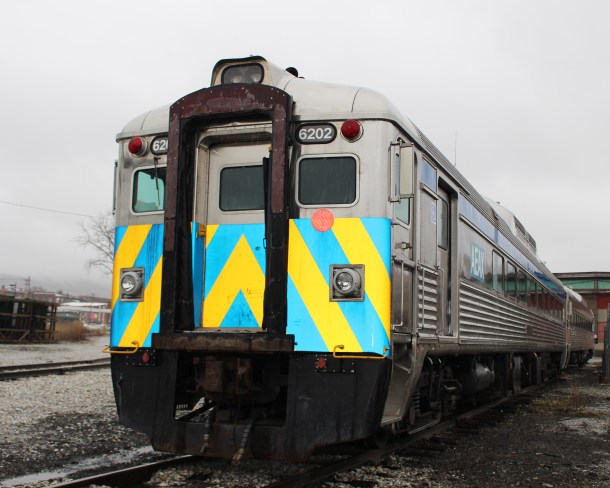
David Blittersdorf, founder of AllEarth Renewables, has already spent roughly $5 million to purchase a dozen train cars for the transit system he envisions, which he said many Vermonters may be able to ride with no fare.
Blittersdorf said he hopes to have trains making test runs as early as this fall, although it would take longer to get the full system in operation. Several hurdles remain, including gaining the right to use the tracks.
He and others have been at this project for two years, Blittersdorf said. One of the biggest obstacles was acquiring train cars. A commuter rail service in Dallas recently upgraded its own cars, and Blittersdorf made the move. Two other cars were bought from a Canadian railroad interest.

“We said to the state, ‘We’re going to buy this stuff,’” Blittersdorf said. “They said, ‘Good. If you want to come to the table with hardware and a plan, we’re going to react. Otherwise nothing’s going to happen.’”
Nothing will almost assuredly happen based on what the Vermont Agency of Transportation depicts in its recent rail study, said Christopher Parker, former executive director of the Vermont Rail Action Network. Parker said he is not involved in Blittersdorf’s project.
“It’s got some real problems,” Parker said of the study, which projects a cost of $300 million for a system that would stop twice each morning and evening in Montpelier, St. Albans and several communities in between. The study estimates it would cost $360 million for a system that would stop four times each morning and evening at the same locations.
The study projects annual operating costs of up to $9 million.
That kind of money “is a nonstarter” for most people, said Carl Fowler, a train advocate who for decades sold train tours and who today sits on the Vermont Rail Advisory Council.
But the study “dramatically overstates the cost. … At that kind of price, nobody in their right mind would support it,” Fowler said.
‘Different way of doing things’
Both men said the study contains problematic assumptions.
“Their idea of a cost structure is based on a big-city model,” Parker said. There are cheaper ways of building a commuter rail service in Vermont, he said.
What the study should have considered are called rail diesel cars, Fowler said, instead of the traditional locomotive that the study’s costs are based around.
A locomotive has an engine in front, and it pulls cars behind it. Locomotive cars can run in only one direction, Fowler said, so to reverse course they must turn around, and turning a train around requires lots of time, land and infrastructure. Locomotives also require several crew members, Fowler said.
A rail diesel car, on the other hand, includes two engines on each car and can run in either direction. They also can operate singly without a separate engine in front.
Rail diesel cars are also low to the ground, Parker said, which means they’re cheaper to structure a rail system around.
VTrans estimated a commuter rail system would need $50 million to build three stations and refurbish three others to provide high-level platforms for locomotive trains. Using rail diesel cars, a train stop would require nothing more than a wheelchair ramp, Parker said, “and that could be built by a carpenter in an afternoon.”
The 12 train cars Blittersdorf has purchased are rail diesel cars, and they’re used.
“That’s radically cheaper, from a capital perspective,” Parker said. “It’s not that VTrans is wrong, but it’s a completely different way of doing things.”
Since the cars can hold more than 100 people and cover 3 miles for each gallon of fuel, “they’re very efficient,” Blittersdorf said.
They’ve been refurbished to meet modern safety and emissions standards, he said.

“Yeah, they’re vintage, but like any stuff built in the ’50s, this was a very successful and robust design,” he said.
“That’s the whole trick with [doing things] the Vermont way. We’ve got to do it at a lower price,” Blittersdorf said.
“There’s sort of this myth that you can’t run a passenger rail without millions of people,” he said. “In Vermont, we’ll show … that you can do it in a lower-density, rural state, if you do it the right way.”
His ‘right way’
Realistically, a meaningful portion of the cost can’t be collected from fares, Blittersdorf said.
The service must be state-subsidized to work, he said.
But those subsidies would be more than compensated for through economic activity the service will stimulate, Blittersdorf said.
“Economic activity around rail stations skyrocketed” in Dallas once the commuter line was put in, he said, and that city’s experience wasn’t an isolated phenomenon.
“People now want to live near transit,” he said. “Twenty-somethings — they hate cars.”
A train station will be a big attraction in towns where they’re located, once commuters can depend on the service to get to work, Blittersdorf said.
Stations will attract housing, restaurants and other amenities, he said: “Every town with a station is going to be revitalized.”
As more housing and commerce is established around rail stations, the state’s tax base will expand, and the additional revenue should pay for whatever investment in the service the state is willing to put forward, Blittersdorf said. He estimated hundreds of millions of dollars in additional value the stations would bring.
“The tax revenue will cover the subsidies to make it work at the lowest cost to riders,” he said.
Plus, the space saved from parking will open up downtowns to still further income-generating development, he said.
In downtown Montpelier, for instance, 60 percent of the area is taken up by parking, Blittersdorf said.
Developers are eager to take advantage of the opportunities a commuter rail will present, he said.
“Developers are very interested in, where do we build the next housing, retail, services. They want to be on the inside,” Blittersdorf said. “We know it’s not going to be on an exit on [Interstate] 89.”
As for the business that runs the train, Blittersdorf said, “We might invest in real estate [as well]. It might be where we get the return.”
But he said that’s not his primary focus. “My personal interest is just getting the rail up and running,” he said. “If we can make this thing break even … other people can invest for profit around it.”
Financial and environmental returns are just some of the benefits associated with a commuter rail system, Parker said.
“People like transit,” he said. “If you can live in Waterbury, and not have a car, that’s a lifestyle benefit.”
“That translates into higher home values,” Parker said. “But the economic benefit is just another way of quantifying what’s really a lifestyle benefit — something that’ll make Vermont a better place, a better culture.”
What remains to be done
Blittersdorf said he doesn’t yet have firm commitments from owners of the rails he hopes to use but has been in discussions with them for two years.
The routes the rail line would follow haven’t been pinned down yet, Blittersdorf said, but one of them is likely between Burlington and Rutland.
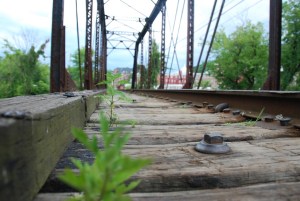
The Genesee & Wyoming line in Vermont runs 324 miles down the length of the state, through St. Albans and Brattleboro, with a spur to Burlington, on a rail corridor called the New England Central Railroad, according to the company’s website.
That company has not committed to any passenger service other than Amtrak’s Vermonter line, said Genesee & Wyoming Vice President of Corporate Communications Michael Williams.
“New England Central Railroad management has been aware of a general interest in expansion of passenger services over the railroad, but other than the extension of Amtrak Vermonter service from St. Albans to Montreal, no discussions have been based on firm details, and no proposals for such new services have been received by the railroad in recent history,” Williams said.
The state of Vermont owns the Western Corridor, which runs between Burlington and Rutland. That line, like the NECR, was recently refurbished. The state has been working to extend Amtrak service from Rutland to Burlington.
Stations along part of that line were renovated for the short-lived Champlain Flyer rail service, Blittersdorf said, and could be easily put back into use. “Those stations just have to be turned back on,” he said.
The heavily subsidized commuter train ran between Charlotte and Burlington from 2000 to 2003.
Blittersdorf envisions another route between Essex Junction and Montpelier, with at least a stop in Waterbury.
“The Waterbury station is just sitting there,” he said. “It’s a beautiful station — it just needs people getting on and off there.”
State officials have given encouraging signs so far but no commitments yet, Blittersdorf said.
“The whole thing is a little different than what most people thought would happen to get commuter rail going in Vermont,” he said. “Since it is different, it takes a little time for everyone to think about how to make it work. I’m encouraged by the feedback so far, which is: People want to make it work.”
Two of the rail cars Blittersdorf purchased currently sit in St. Albans, and the others are scheduled to arrive from Dallas Area Rapid Transit in June, he said.
Blittersdorf said the Canadian cars cost $500,000 each and the 10 Texan cars, along with $400,000 worth of parts and equipment, cost $4 million.
The state’s study
The state Transportation Agency analysis — which started as a directive from the Legislature — lays out another scenario for St. Albans-to-Montpelier commuter service.
The system the VTrans study envisions is estimated to carry as few as 135 riders a day, based on only the estimated number using public transit today, to as many 2,850 riders a day if the state embarked on an aggressive policy and promotion campaign.
Those numbers estimate ridership if the service were in operation today. By 2030, VTrans estimates, those projections could grow to between 150 and 3,320 daily riders.

The study assumes that six new or renovated train stations would be required, costing $8 million each.
As for the type of platform required, the study says conventional trains can and do use low-level platforms, but the analysis is based on the assumption that high-level platforms will be mandated because federal and state initiatives are moving in that direction.
New trains would be required as well. A trainset with six passenger cars and a locomotive would run $27 million. Between existing stock and new trainsets the service would require, VTrans estimates between $163 million and $189 million for train purchases.
Signals, track rehabilitation and safety equipment make up the remainder of the estimated cost.
Federal funding could pick up some of a rail system cost, according to the study. Other recent commuter rail projects have received as much as 80 percent of a project’s total cost from federal coffers. Others split the cost equally with the federal government, and several received no federal funding.
With tickets estimated at between $1.03 and $4.67 for a one-way journey on such a commuter line, the system could generate between $1.2 million and $2.4 million in annual revenue.
Other funding sources could include local jurisdictions; an increased gas or sales tax; reallocation of monies currently spent on commuter buses; parking fees; and private partnerships, according to the study.
