


Elevator Co. says it was an ax. Wiki Commons image
(“Then Again” is Mark Bushnell’s column on Vermont history.)
[P].T. Barnum needed a way to drum up business. Attendance had dropped off at the Crystal Palace Exposition the showman was managing at the New York World’s Fair. The show had opened in 1853 and drawn crowds interested in seeing the world’s newest technological wonders. Now, a year later, those innovations were old news.
Fortunately for Barnum, Elisha Graves Otis, a Vermont inventor, approached him with an idea. Otis, who was working as a master mechanic in a nearby bedstead factory, wanted to demonstrate a device he had recently invented. He believed in the product, but was having trouble marketing it, so where better to turn than to Barnum, the king of American marketing?
Once Otis explained the device to Barnum, the marketer agreed to pay Otis $100 to demonstrate it in public. We’ll never know whether Barnum understood that this device would change the way we live, but it seems safe to assume he realized that demonstrating it would be good theater.
So it was that a crowd gathered at the Crystal Palace on May 30, 1854, to see the new wonder Barnum was proclaiming. In place of the statue of George Washington that had stood at the center of the exhibition hall, the crowd found that Barnum had positioned Otis’ machine, an open-ended wooden platform that could be hoisted between two rails by a steam-powered rope cable. It looked like nothing new. Sure, steam power was relatively new, but hoists themselves had been used to lift heavy objects for millennia, dating back perhaps 5,000 years to the Egyptians.
This looked like an old, and notoriously dangerous, bit of machinery. The trouble with hoists, the crowd knew, was that the rope that lifted them sometimes snapped, injuring or killing the person operating the machine and anyone unfortunate enough to be catching a ride on the hoist’s platform.
But these dangers would soon be a thing of the past, announced Otis. Dressed elegantly for the occasion and sporting a long, square beard, Otis climbed onto the platform, which was also burdened by a load of barrels and crates, and had himself hoisted high above the exhibition room floor. Then he called down to an assistant to grab an ax and cut the lone rope that held the box aloft.
A shiver went through the crowd. People gasped. Had the man on the hoist assembled them here to witness his suicide?
The ax severed the cable, and the platform fell. Then, a split second later, it stopped. Otis doffed his top hat and yelled down to the audience, “All safe, gentlemen, all safe.” And with that — perhaps the most dramatic 2-inch fall in history — Otis set in motion the transformation of the world’s cities.
Just try to imagine a world without elevators, where people’s willingness to climb stairs determined the height of buildings. (At the time, buildings rarely rose more than six stories.) Rather than have densely populated cities dotted with skyscraping office towers, the world’s urban population would have spilled across the landscape.
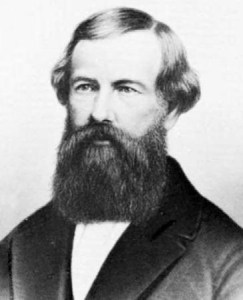
Otis is sometimes wrongly remembered as the inventor of the elevator. What he created was in fact the elevator safety brake, which made freight elevators safe and passenger elevators possible. The brake system involved a mechanism built around a steel wagon spring that sat atop the elevator. The cable was attached to the spring, keeping it stretched. If the cable broke, the spring would compress, shooting iron teeth or “safety dogs” into notches cut into the elevator shaft.
It is ironic that the reordering of the urban landscape resulted from the invention of a man from the backcountry of Vermont, where relatively few of Otis’ inventions are in use even today.
Some would argue, however, that it is hardly surprising a Vermonter invented the elevator safety brake. After all, Vermonters had created such critical devices as the platform scale, the electric motor and the steam paddle-wheeled boat. Perhaps their isolation spurred their innovation; so many Vermonters became inventors, the argument goes, because they had to learn to make do and find ways to reduce their heavy workload. Or perhaps this discussion ignores the countless vital objects not invented by Vermonters.
Otis’ early years seem quite typical for a boy growing up in early 1800s Vermont. He was born in the town of Halifax in 1811, the youngest of six children. He worked as a carriage maker, sawmill owner and mechanic for a time and started several businesses, none of them particularly successful.
Like many young Vermonters, Otis left the state seeking opportunity.
He moved with his wife and children to Albany, New York, where he worked as a mechanic for a bedstead manufacturer. While there, Otis invented a train brake and a device to run rails for four-poster beds. He is said to have worked out his innovations in his mind, rather than developing them on paper.
Next, Otis and family moved to Yonkers, New York, where he had found work at another bedstead maker, whose operation was growing. As part of the expansion, Otis was in charge of moving heavy equipment to the second floor. He wanted an efficient way to do the work. Safety was also of the essence; 12 workers had been killed in elevator accidents over the previous four years in Yonkers alone.
The result of Otis’ tinkering was the elevator safety brake. Otis saw a business opportunity, though he seems not to have understood how drastically this innovation would change the urban world.
Otis invented his automatic braking system the year before his spectacular display at the Crystal Palace. He had sold his first safety elevator on Sept. 20, 1853. (The fee: $300 installed. Otis accepted a cannon and its carriage as partial payment.) But when further sales failed to materialize, he decided he would follow the Gold Rush west. He changed his mind after receiving two unsolicited orders and went into business with his sons, Charles and Norton.
Hoping to boost sales, he approached Barnum. It is unclear whether it was Otis or Barnum who dreamed up the dramatic demonstration. Whoever conceived of it, the scheme worked. The publicity generated by the stunt attracted buyers. The company sold seven more devices in 1854 and 15 in 1855.
Three years later, the company installed the first-ever commercial passenger elevator, in the E.V. Haughwout and Co. department store in New York. Most of the company’s growth, however, came after Otis’ death in 1861 at age 50 from diphtheria.
Today, the Otis Elevator Co. is the world’s largest maker of elevators. Its lifts have been installed in the White House, the Washington Monument, the U.S. Capitol, the Kennedy Space Center, the Empire State Building, the Chrysler Building, the Eiffel Tower, the Vatican and the Kremlin. And Otis installed 57 elevators in the building recognized as the world’s tallest, the 2,717-foot Burj Khalifa in the United Arab Emirates.
These buildings all can trace their origins to a conversation between P.T. Barnum and a Vermont inventor.

