

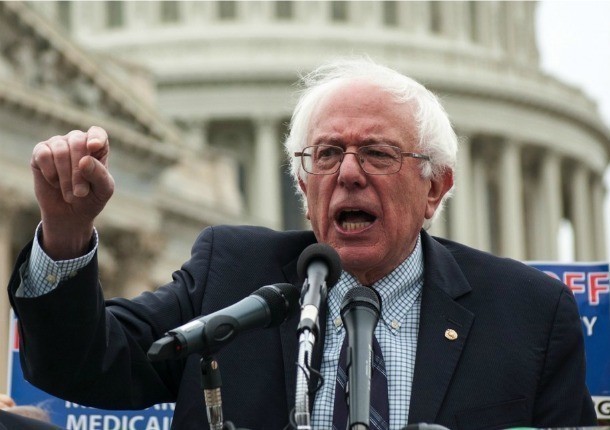
In a Tuesday letter to Chairman Mike Enzi, R-Wyo., Sanders said he was “very concerned that the Budget Committee has not scheduled a single hearing on the president’s preliminary budget request for fiscal year 2018.”
Sanders, who is the ranking member of the committee, pointed to past hearings held shortly after presidents of both parties submitted proposals.
Sanders wrote that the Senate Budget Committee held a hearing on President George W. Bush’s budget just one day after it was unveiled in 2001, followed by six more meetings. The same practice held during President Barack Obama’s tenure, Sanders said.
Under Section 300 of the Congressional Budget Act, legislators are required to complete a budget by April 15, a deadline that is often missed.
“I don’t see how that deadline could possibly be met,” Sanders wrote. “It is incumbent upon us to start scheduling hearings on the budget as soon as possible.”
Enzi has not responded to the Sanders letter, but the chairman’s office said hearings on the budget would be announced soon, likely after Trump submits a fleshed-out proposal in May.
Sanders blasted Trump’s budget proposal when it was released in mid-March, and he reiterated his criticisms in Tuesday’s letter. Citing drastic cuts to a host of programs — from heating assistance for low-income Americans to early education programs — Sanders deemed the proposal “morally obscene and bad economic policy.”
In a news release, Sanders’ office said public hearings would “shed light on the White House proposal.” Sanders likely could attract renewed national news coverage of the proposal by aggressively questioning White House budget staffers.
The budget, in effect, slashes domestic spending in order to boost military spending by $54 billion.
Sanders’ office contends that the Trump cuts would jeopardize home energy assistance for more than 6.3 million Americans, revoke after-school programs for 1.1 million students and reduce Head Start education services for 90,000 children.
The Vermont senator also argued in the letter that military spending is not in need of a boost, with the United States spending more on defense than the next 12 countries combined. He pointed to a Washington Post investigation from December showing that the Pentagon buried an internal report documenting $125 billion in administrative waste. The senator also said the Defense Department currently suffers $469 billion in cost overruns on federal contracts.
“The last thing we should be doing is increasing the already bloated Pentagon,” Sanders wrote to Enzi.
In the last congressional session Enzi and Sanders served together as the top two senators on both the Budget Committee and the Health, Education, Labor and Pensions subcommittee on primary health and retirement services.
Asked in early January about the senators’ relationship, Enzi’s budget spokesman, Joe Brenckle, acknowledged there are a lot of “ideological policy differences” between the two men but said the Wyoming senator is “always willing to look for common ground with members of both parties.”
Brenckle said in January that even though the two had served together on two committees last year, “due to Sanders’ time on the presidential campaign, Sen. Enzi hasn’t worked with him a lot lately.”
Two Sanders spokesmen did not answer emails seeking comment on the budget process.

