

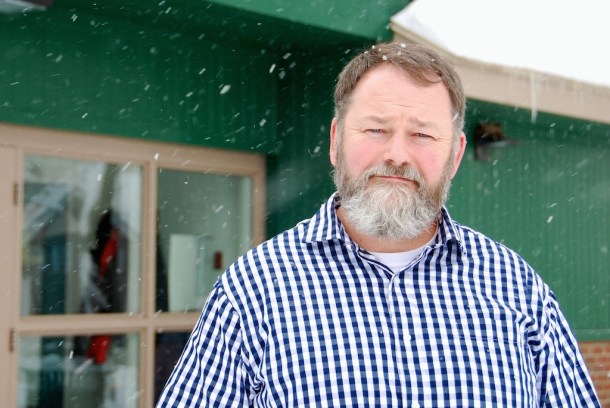
ESSEX — Jay Simons knows prisons.
Before he became director of Woodside Juvenile Rehabilitation Facility, he ran three different correctional facilities. But as he walked past a mural painted on cinderblocks between locked doors in the secure facility one recent Monday morning, he called the prisonlike design out of step with the treatment-oriented work done there.
“It’s meant to keep people in,” he said. “I’d like a building meant to get people out.”
From lawmakers to advocates to facility administrators, there is broad agreement that the time is ripe for the three-decades-old facility to change. But with short-term budgetary issues an immediate concern, the long-term plan — including whether to replace the facility completely — is unclear.
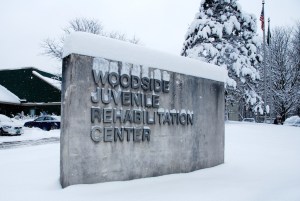
Built in the 1980s to hold Vermont’s juvenile offenders, Woodside is down a wooded drive in Essex off Route 15 near the former Fanny Allen Hospital.
In 2011, the facility was designated as a clinical treatment program center, a categorization that allowed the state to draw on federal money through the Medicaid program to pay for services there.
However, the federal Centers for Medicare and Medicaid Services, known as CMS, determined in October that the facility does not qualify for Medicaid funds because, by its analysis, the residents are “inmates” at a public institution, according to Commissioner Ken Schatz of the Department for Children and Families. DCF disagrees with that assessment, he said.

The federal decision came as part of a broader negotiation with CMS about Medicaid services in Vermont. According to Schatz, there was little DCF could do to appeal the Woodside funding question because it was part of a more comprehensive package.
Because the federal funding change happened partway through the state’s fiscal year, the department asked for an increase of $1.5 million from the state general fund to Woodside in the Budget Adjustment Act. The Legislature fully funded that request.
Shortly after the negotiations with CMS and the state were finalized last year, the state approached CMS to open a conversation specifically about Woodside’s categorization. The talks have stalled amid the change in presidential administrations, according to Schatz.
“We’re kind of in a holding pattern,” he said.
Schatz, however, is optimistic that the state will work out a deal to restore federal funding to Woodside. The state budget counts on it — Gov. Phil Scott’s budget proposal for the next fiscal year factors in Medicaid funding for Woodside.
By Schatz’s assessment, there is no question about what type of facility Woodside is.
“It is clearly a clinical treatment program,” he said.
Simons, the facility director, agrees. A former correctional officer and superintendent of Department of Corrections facilities, Simons said Woodside is “vastly different” from a prison.
By law, Woodside serves youths between age 10 and 17, though Simons said it is rare to have anyone 13 or younger. The teenagers there have been charged with delinquency offenses or have been adjudicated, and are determined to be a risk to themselves or others. The average length of stay is 129 days, according to Simons. As of last week, there were 10 kids at the facility, he said.
The facility is focused on reducing kids’ criminal risk so they can leave Woodside and get treatment in a less restrictive setting, Simons said. Staff at Woodside not only work with the youths, they also work with their families to build up supports for when the resident returns home.
According to Simons, youth at the facility follow a structured daily schedule that includes multiple sessions of group therapy and schoolwork. When residents move through the facility to classrooms or the gym, a staff member always accompanies them, he said.
The 30-bed facility is split between two wings. Each has a spacious common area with a circle of large, block-shaped blue chairs, designed to be too heavy to throw, set up for group therapy sessions. A few round tables with built-in stools have game boards including backgammon and checkers painted on.

Residents have their own narrow, cinderblock-walled room, some with built-in bunks, with a window about 5 feet wide and shorter in height. A foot-wide bar runs across the middle of the window to prevent escape attempts.
Doors to the rooms are locked from the outside at night. Residents who need to use the bathroom, located off the common area, knock on the door and a staff member lets them out. Even in rooms where occupants have decorated with photos of family and magazine clippings, there is the feeling of a cell — a quality Simons notices.
“It would be nice if a room looked like a room,” he said.
According to Marshall Pahl, of the juvenile division of the defender general’s office, one problem with Woodside is the facility itself, which, he said, has not been substantially updated since its construction.
“It’s just an old, crumbling, crappy facility,” he said.
Pahl said conditions at Woodside are better than they once were, and that the state has made improvements in the level of treatment provided there. However, he said, the facility, originally built as a detention center, falls short compared with other modern adolescent mental health treatment facilities.
“There is no confusion in real life,” Pahl said. “When you actually go look at the real thing, you don’t get confused about what’s a prison and what’s not.”
However, other challenges are the result of a lack of alternatives to serve young people.
“A lot of the problem with Woodside isn’t really Woodside itself, it’s not having any other resources in the state,” Pahl said.
Youths who end up there really belong in a therapeutic mental health treatment environment that Vermont does not have, he said, such as nonsecure residential group homes.
There are not that many juvenile offenders who need to be locked up, he said. The state would benefit from having more therapeutic foster homes and small-scale residential treatment providers distributed around the state, he said.
Linda Cramer, of the group Disability Rights Vermont, said there have been persistent concerns about issues at the facility, including the quality of education, the lengths of stay for some young people, and the use of an “intensive stabilization unit,” a separate area where youths in crisis are temporarily placed.
Cramer, who has been working with Woodside since 2001, said there have been many improvements.
“They need to get much clearer on the purpose and goals of Woodside, and I think that’s what they’re in the process of doing,” Cramer said.
Cramer visits the facility regularly and reviews incident reports. When she has concerns, she raises them with Simons, who she said is receptive to her points. She recently began holding regular sessions with young people there to help them understand their rights.
One issue with the juvenile justice system is the lack of accommodations to serve young people in less restrictive ways than Woodside, she said. She sees a need for more community-based treatment capacity also.
“They all end up just being there,” Cramer said.
She also raised concerns about the oversight of Woodside. The licensing for the facility is handled within DCF. She would like to see more independent oversight.
Like others, Cramer said there are issues with the current facility.
“They aren’t good conditions,” she said.
“Everything about the design of the facility is like a jail,” Cramer said.
Rep. Charles “Butch” Shaw, R-Pittsford, who is vice chair of the House Corrections and Institutions Committee, said lawmakers on the panel are waiting to see concrete plans for moving forward with Woodside.
DCF did come forward with some conceptual plans, but he and others feel a new juvenile facility should be designed in concert with other mental health accommodations, like a replacement for the temporary secure residential facility in Middlesex.
“It’s going to take some long-range planning,” Shaw said.
There is no funding in the governor’s proposed capital bill to pay for major upgrades or a replacement for Woodside.
Shaw said designing a replacement for Woodside as part of a broader overhaul of Vermont’s mental health facilities will help ensure that “we don’t make a false step.”
“We’re better to wait and make the right step,” he said.
He hopes to see the state move forward soon with planning.
“Having a plan put together is important right now,” he said.
