

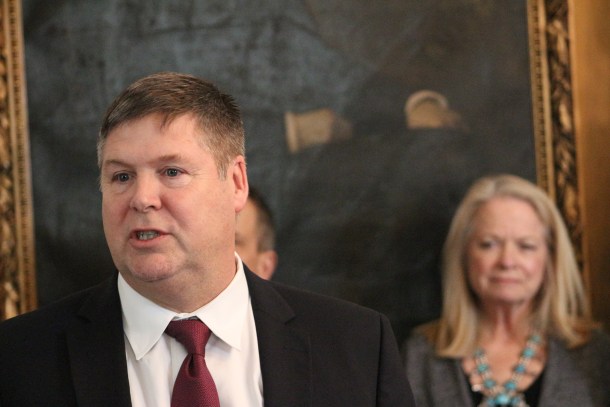
Al Gobeille told the Senate Appropriations Committee on Feb. 9 that he and his staff would begin working with others this week to look at how to improve treatment.
Gobeille has scheduled a meeting Friday with hospitals, mental health providers, independent doctors and others with a stake in the system. He will divide the work into four categories — flow, workforce, facilities and funding — and ask groups to report back with potential solutions.
Gobeille said the meeting will require all stakeholders to get in a room and agree on what problems are plaguing mental health care before they solve them. He said the full review will need to be complete within a few weeks, but he warned there is no “silver bullet” to fix mental health care.
“My take on it is that a long time ago we deinstitutionalized mental health, but we have never properly funded where we expected them to go to,” Gobeille said Feb. 9. “They have to go somewhere, and where do they go? Is that properly funded? And I would say no.”
The Agency of Human Services spends more than $300 million annually funding 11 nonprofit organizations dedicated to treating mental health and providing disability services, according to Gobeille. Those so-called designated agencies consistently report that they’re underfunded.
In a 2016 report, the designated mental health agencies reported an annual staff turnover rate of 27 percent. The same year, the Green Mountain Care Board, with Gobeille as chair, said the state’s largest designated agency did not have enough money to “adequately fund the institution’s desire to accomplish” its goals.
Gobeille told the committee that the issue goes back to the law that created the designated agencies. The agencies are not funded as an entitlement — a social service program that requires the state to pay for services for any eligible person who needs them.
Instead, the law tells the Department of Mental Health and the Department of Disabilities, Aging and Independent Living to ensure services for people with mental health issues and disabilities “within the limits of funding designated by the Legislature for this purpose.”
“It doesn’t say that it’s going to take all comers or anything,” Gobeille said. “And so the designated agencies have responded by sort of taking the money and taking all comers and trying to cover everyone but have not come back and said, ‘This is the specific issue where I’m struggling with money that’s causing us to not have enough here or over there.’”

Lawmakers asked Gobeille to move swiftly. Sen. Richard Westman, R-Lamoille, referenced workers who said at a joint hearing Feb. 8 that they were in danger of being assaulted by patients who were being held involuntarily because they represent a danger to themselves or others.
“The first time somebody really gets hurt or something like that happens, we’ll rush to do something in a way that might not be the best thing to do,” Westman said. “So I want a plan. I want us to move. But this is something that — something bad’s going to happen.”
“We have patients in the emergency room assaulting sheriffs,” said Sen. Jane Kitchel, D-Caledonia, the chair of Senate Appropriations and a former human services secretary. “This is not a new problem. It’s just a problem that hasn’t been solved.”
Gobeille said: “It’s a multifaceted, community-based problem that is not going to be solved by just one thing. If you had 25 more Level 1 psych beds” — such as the ones at the Vermont Psychiatric Care Hospital that serve the most acute patients — “you would do that and you would still have a whole host of problems.”
Kitchel agreed: “I can’t decide how to spend that first dollar or redistribute what we have in the system without that examination of the entire system.”
