


Donovan followed through on his pledge, making what he said was a “reasonable offer” after taking office a month ago to reach a “global resolution” of all the cases involving Corren — both state and federal. Corren’s side has rejected the offer, as Seven Days first reported.
The two sides appear far apart. Still, “I’m optimistic,” Donovan said of the prospects for a settlement.
According to attorneys involved, Donovan offered to dismiss the state’s case in return for a settlement well short of the $72,000 initially sought. Corren would have to agree to drop a federal lawsuit against the state that challenges the constitutionality of parts of Vermont’s public campaign financing laws.
“We’ve made a reasonable offer seeking a global resolution in terms of not only the state’s case but the federal lawsuit they brought,” Donovan said. “I want to hit the reset button, and I think the public financing questions can be and should be addressed with the Vermont Legislature.”
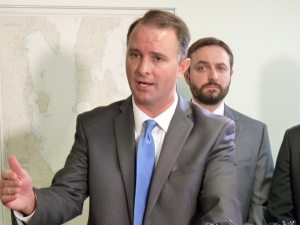
Corren’s attorney, John Franco, said it would be foolhardy to count on the Legislature to make the necessary changes. Until the federal courts do, he said, no candidate will risk using public financing for fear of running afoul of the too-tight restrictions.
“No one’s going to want to touch it with a 10-foot pole,” Franco said.
The stakes on the penalties are too high, despite a major change in the law, according to Franco. Even if the Corren case is dismissed, Franco said, a future candidate could be prosecuted “and put through the same hell the Corren family has gone through.” So far, Franco said, Corren has racked up $30,000 in legal bills.
Corren, a Progressive/Democrat, [was accused] of running afoul of the public campaign finance laws when he ran for lieutenant governor in 2014. According to the complaint, Corren improperly received an in-kind contribution — an email supporting his candidacy from the head of the state Democratic Party.
Under the laws on public financing of campaigns, Corren received about $180,000 in public money. As part of the deal, candidates are not allowed to seek outside money other than a small amount they raise to qualify. The restriction on outside fundraising includes in-kind contributions.
Under the law at the time, a candidate was required to return the public money that had been at hand when the alleged violation occurred. In Corren’s case, that penalty was pegged at $52,000. There were two additional fines of $10,000 for the actual violations, bringing the total sought by Attorney General William Sorrell, Donovan’s predecessor, to $72,000.

In addition to the amounts that can be raised — Donovan said the Citizens United court case unleashed spending and makes the current public campaign amounts inadequate to compete — both Donovan and Franco said the restriction on raising money to qualify until February of the election year is untenable given how long campaigns run.
One of the key areas of dispute between Donovan and Franco is where changes to the public financing law are made. Franco wants the federal judge to gut the law and the Legislature to enact a new one. Donovan wants to go straight to the Legislature instead and change the current law to include more reasonable requirements and limits.
“I’m not sure the expending of more resources is in anybody’s interest. Let’s get this done, let’s hit the reset button and let’s change the law,” Donovan said.
Failing to have the federal court decide the issues, Franco contended, would “leave the madness unresolved for another victim.”
The Democratic Party agreed to pay a $10,000 penalty. Its executive director said it was a question reasonable minds could disagree on and that the party wanted to move on and avoid costly litigation.
As for Donovan’s appeal to reach a settlement and take proposed changes in the law to the Legislature, Franco said he couldn’t agree to dismiss both suits and “give up the federal court claim to go hold hands and sing kumbaya in front of the Senate Government Operations Committee.” Instead, he said Donovan should dismiss the state case and join him in making changes to the public financing system through the federal case.
Franco also said his client had no interest in paying a penalty, even one less than the $10,000 maximum on each violation that Sorrell sought.
Donovan said he was trying to be “creative and fair” in seeking an amount but also said he would not require Corren to admit guilt. Donovan would not say how much he was seeking or if he would attempt to collect it through seeking lawyer’s fees for his office.
Franco said Corren won’t pay a dime in fines. He insisted Corren broke no laws and that the courts have found the email was an allowable contribution. Corren lost the 2014 race to Republican Lt. Gov. Phil Scott, who is now governor.
“Dean did nothing wrong, nothing illegal, and he’s not prepared to do anything that looks, quacks or smells like capitulation. He’s just not prepared to do that, particularly not after spending 30 grand in defense of the case,” Franco said.
Donovan hesitated when asked if Sorrell pursued the case too aggressively but noted prosecutors have the choice to pursue a case and how hard.
“I think the case is now my responsibility, and I’m doing what I think is right,” Donovan said. “I think as a prosecutor you always have discretion, and restraint is an incredibly important quality for a prosecutor.”

