



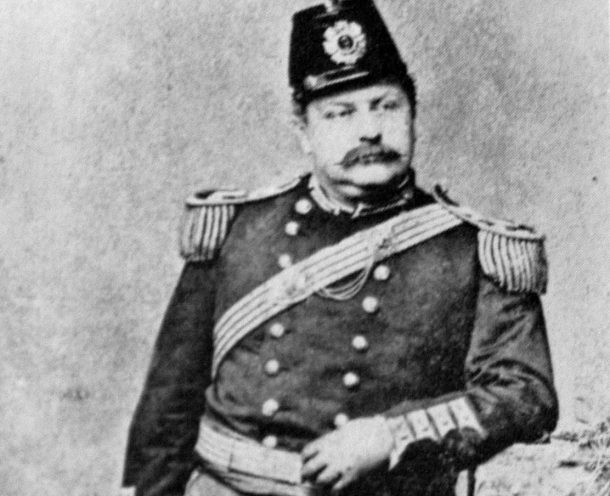
[M]eeting an outrageous character like James Fisk, you would have to wonder: Where do people like this come from?
We know the answer in the literal sense. The financier, whose tremendous wealth and questionable business practices earned him a place among fellow “robber barons” with famous names like Morgan, Carnegie, Vanderbilt and Rockefeller, was born on April Fool’s Day 1835 in Pownal. His family then moved to Brattleboro, where he grew up.
But where does a personality like Fisk – who at the time of his murder was widely adored and perhaps as widely despised – really come from? As with all questions about character, the answer seems to be part nature, part nurture.
Fisk’s greatest skill – to sell, sell, sell, by any means possible – seems to have been inborn. His father was a clever peddler in Brattleboro. Once, according to lore, the elder Fisk was selling shawls to women along his route when he ran out. That didn’t stop him, though. He had a surplus of small tablecloths, which he folded and then touted as the latest fashion in shawls from Boston.
As a young man, Jim Fisk waited tables at the Revere House hotel, which his father had started at the corner of Elliot and Main streets in Brattleboro. Fisk was remembered as a smooth talker who was always quick with a quip. But he soon tired of the ordinariness of his life.
When Van Amberg’s Mammoth Circus and Menagerie came to town, Fisk saw his way out. For several years, he traveled with the show, but not as a clown or fire eater. His work was behind the scenes – taking tickets, feeding animals and doing odd jobs. The work had its share of drudgery, but Fisk made the best of it. In fact, he enjoyed the circus’ glamour, spectacle and flair, which helped shape his personal style. For the rest of his life, he would conduct his affairs with all the subtlety of a carnival barker.
Fisk returned to Brattleboro at about the age of 18, full of ideas about how his father could improve his peddling business. The ideas involved buying more horse-drawn wagons to carry more goods on longer sales routes. And to attract more buyers, Fisk suggested his father paint the wagons bright colors and dress in fancy clothes. His father rejected the advice; that is, until the son demonstrated with his own wagon how much these changes would help business.
Soon Fisk & Son became a five-wagon business. Much of their goods came from Jordan, Marsh & Co. of Boston. Eben Jordan, the company’s president, noticed how much merchandise the younger Fisk was selling and offered him a job in Boston. Fisk quickly accepted and moved to the city with his young wife, whom he loved “tenderly, though not exclusively,” as one biographer put it. His wandering affections would later get him in trouble. In fact, they would get him shot. But that was in the future.
Spoils of war
The job with Jordan Marsh had gotten Fisk to the big city, and he intended to make the most of his opportunity. The new job itself proved boring; Fisk felt like an anonymous drone among Jordan Marsh’s countless salesmen. He wanted to be the star.
He saw his chance when the Civil War broke out in 1861. He talked Jordan into sending him to Washington to drum up contracts to produce textiles for the Union Army. Fisk booked the best suite at the fashionable Willard’s Hotel, set up an open bar and lavish buffet, and invited congressmen and military officers to talk business. Government orders came rolling in for uniforms, underwear, socks, blankets. Demand outstripped supply. Fisk wired back instructions for Jordan to buy more mills. Fisk knew he was making the company rich and asked to be made a partner. Jordan immediately agreed.
The goods Fisk was selling the government were of good quality. They might have been in colors unpopular with shoppers or had the scent of mildew, but they were structurally sound. “The man that will take the upper hand of a soldier in the field is worse than a thief,” he declared.
Despite his declarations of honesty, Fisk began trading with the enemy. Perhaps the money was too much to refuse, or perhaps – as he would have argued in his own defense – he was actually looking out for his country. The onset of war had cut the North off from its main cotton supplier, the South. What cotton could be found in the North was selling at exorbitant prices. So Fisk discharged agents to the South to buy massive amounts of the contraband and hired shippers to sneak it through the North’s blockade.
One of those agents was his father, who suffered heatstroke in the South and returned to Brattleboro with his mind permanently damaged. As a good son, or at least a guilty one, Fisk paid to have his father cared for during his declining years.
Whether or not Fisk’s reasons for dealing in cotton were selfless, the cotton helped keep Northern mills operating. Fisk’s wartime dealings, which also included selling Confederate bonds to European investors, made him rich.
No honor among robber barons
When the war ended in 1865, Fisk, then just 30, launched into the portion of his career for which he is best known. He became a major force on Wall Street, winning and losing huge fortunes in the market. He was dubbed a robber baron, as unscrupulous financiers were known during the mid- and late 19th century.
Having bested Vanderbilt, Fisk joined Drew and Gould at the Erie’s offices in New York to count their loot. They didn’t dare leave it in a bank for fear a judge would order it seized. While they were counting, the three learned that a judge had ordered their arrest. They debated fleeing to New Jersey, outside the judge’s jurisdiction.
“Up in Brattleboro in my kid days,” Fisk told his accomplices, “I used to see people avoid interviews with the sheriff by crossing the bridge over the Connecticut (into New Hampshire), and once there they would let the Vermont sheriff whistle for them.”
Not eager to be arrested, Fisk added: “I always did like the air of Jersey.”
Fisk bribed members of the New York Legislature to retroactively legalize the scheme they had used to bilk Vanderbilt and make it safe for them to return to New York.
The next year, Fisk was back at it with Gould’s help. Together, they attempted to corner the gold market. The pair feverishly bought gold to drive up the price. For the plan to work, however, it was essential that President Ulysses Grant not sell government gold to the public, which he was considering doing to strengthen the dollar.
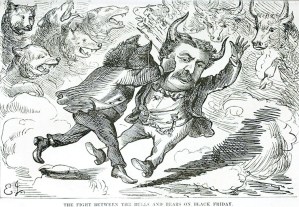
Grant got wind of the scheme and, outraged, dumped federal gold on the market, causing the price to collapse. Fisk and Gould sold out in time to save their fortunes, but many average investors were ruined on Black Friday in 1869.
Fisk used his great wealth to live lavishly, if garishly, and feed his self-image of grandeur. Never having served during the Civil War, he bailed New York’s 9th Regiment out of bankruptcy. When the regiment thanked Fisk by electing him colonel, he paid $2,000 (roughly $36,000 in today’s dollars) for a uniform laden with gold trim. When he bought a fleet of ships, he reportedly began using colorful, if unconventional, nautical language: “Well, shiver my mizzen-mast and rip my royal halyards!”
A fatal affair
Not everyone was amused by Fisk’s antics.
When he bought the Grand Opera House in New York, it was unclear whether he was more interested in acting or the actresses. He took Josephine Mansfield, an aspiring but by all accounts ungifted actress, as his mistress. His wife continued to live in Boston and seldom saw her husband.
Fisk decided he’d rather fight than pay up. He apologized to his wife for his infidelity and sued the pair for blackmail. Stokes was humiliated when his treachery became public. In revenge, Stokes stalked Fisk and fatally shot him on the stairs of New York’s Grand Central Hotel.
Fisk’s death at age 37 drew mixed responses. Some recalled his philanthropy. Even before the ruinous Chicago Fire of 1871 had burned itself out, Fisk had sent a train full of relief supplies to the city. A song written in his honor contained the chorus: “If a man was in trouble, Fisk would help him along to drive the grim wolf from his door. He strove to do right, though he may have done wrong, but he never went back on the poor.”
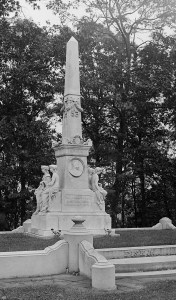
Fisk’s hometown of Brattleboro commissioned a statue in his honor by famed sculptor Larkin Mead to mark his grave. The monument in Prospect Hill Cemetery features four barely clad women holding symbols of his achievements involving railroads, steamships, finance and the stage.
Others were less forgiving. A respected member of the New York Stock Exchange died the same day as Fisk, but exchange directors delayed lowering the flag for him in fear people would think Fisk was being honored.
Perhaps most scathingly, The Burlington Free Press wrote that the best way to mark Fisk’s passing was to recall a line Mark Twain had written about a villain’s death: “He made a nice, quiet corpse.”
