

[M]embers of the State Board of Education have found some common ground as they consider proposed changes to draft rules for private schools wanting to receive public tuition dollars. But open enrollment and special education continue to be contentious.
Representatives from the private school community sent their suggestions to the board Jan. 3.

The rules in question guide the process for approving private schools to accept students through Vermont’s town tuitioning system.
The Agency of Education proposed language that the board adopted in July. The changes would require more fiscal accountability, open enrollment, and the offering of all categories of special education.
The changes as written proved controversial. The board has been gathering input from various interested parties in preparation for revising and considering them again.
In their letter, the private schools said they do not want to have to institute open enrollment or get approval to teach all categories of special education. “Mandating open enrollment and special education policies will have a tremendously negative impact on independent schools across Vermont. If schools cannot comply due to cost, or misalignment with mission, they will not be able to accept publicly funded students,” the letter says.
It was signed by Mark Tashjian, headmaster at Burr and Burton Academy in Manchester and chair of the Vermont Council of Independent Schools; CJ Spirito, head of Rock Point School in Burlington and chair of the Vermont Independent Schools Association; and Tom Lovett, headmaster at St. Johnsbury Academy.
When the board asked the agency to draft the rules, it specifically asked for language that would focus on equity. “It is the view of the state board that equal opportunities must be available to all in admissions, program availability and discipline, and that the rules explicitly address these issues,” according to the November 2015 memo.
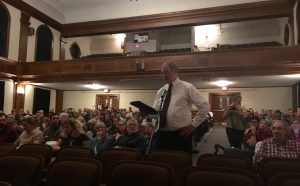
Chris Leopold, the attorney for the state board, told members Friday that the current draft rules do not capture that intent, but instead use nondiscrimination language found in state and federal law that private schools already have to implement. Groups representing school boards, superintendents and special educators have proposed changes that would go further.
Morse said the board asked Nicole Mace, executive director of the VSBA, and the other public school advocates to propose new language but that the private school representatives were not engaging on the issue.
“It is a tough choice for this committee. There are one of two ways we can go: Do you want to take it on or leave it alone?” Morse asked at Friday’s meeting.
Mace said the current draft rules only reiterate state and federal law and are missing procedural safeguards that would make sure every child has a fair shot.
To deal with enrollment access, the group suggests that private schools announce by February how many publicly funded students they plan to accept for the next school year. If more students apply than that number, then the school could use a lottery system. The rule is based on Vermont’s rule for public high school choice and on national charter school laws.
This same rule would include special education students. “If an accepted student is eligible for special education services, then the (individual education plan) team will meet to make a determination regarding whether the independent school can provide the services required by the student’s IEP,” the group proposes.
On the flip side, she said, the group’s proposal includes more special education flexibility.
The draft rules say private schools need to get approval in all special education categories. There are about a dozen categories; some capture many of the students with special education needs, while other categories serve very few students. Getting approved is expensive and time-consuming, and private schools have argued that they may go through the process and then never have a student with that disability show up.
Mace’s team recommended a different way to handle it. The schools could wait and get approval only after enrolling a student with a disability, and the local education agency would be required to help. (LEAs are responsible for the education of special education students.)
The headmasters’ letter did include the first public statement from the private schools recognizing what the state board has said was its true intention with one of the most contentious draft rules.
“It is our understanding that the board does not intend to require independent schools to comply with all state and federal laws and regulations that apply to public schools, such as teacher licensure. Rather, the goal of the ‘catchall provision’ as we understand it is to ensure independent schools provide a safe and healthy environment for students,” the letter says.
The confusion around the rule caused the state board to issue a memo Nov. 29 to clarify it. Yet private school representatives had continued to portray the rule as they read it.
Leopold, the state board’s lawyer, offered a 17-page draft with all the proposed changes to the subcommittee for consideration. The private schools offered changes to the fiscal accountability section; a change to what schools could be called “approved” instead of “approved” and “recommended”; suggestions on accreditation matters; and tweaks to the federal and state health and safety rule.
