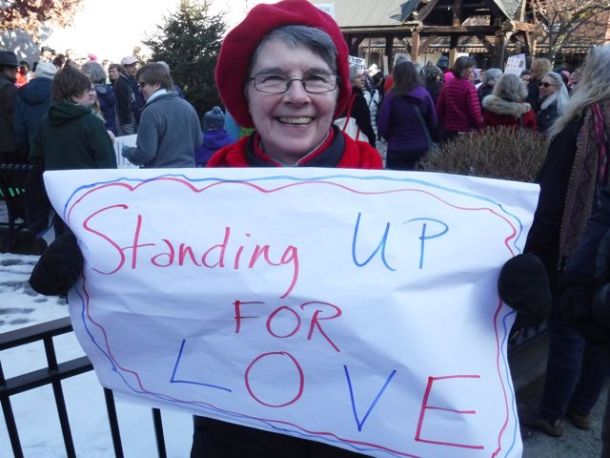
But ask Braus about this month’s round-the-clock reporting on President Donald Trump and you may be surprised to learn she hasn’t tuned in to even a minute of national television or radio news.
“I just get too upset and feel sick to my stomach,” the longtime progressive activist says. “I’m also enraged the corporate media handed Trump the election by giving him so much exposure.”
Braus isn’t alone, but instead one of many otherwise well-read Vermonters aiming to insure their domestic tranquility by cutting back on coverage of the new commander in chief.
The Republican businessman turned politician received a national low — 30 percent of the vote in the state — home to Democratic presidential candidate Bernie Sanders, who reaped 86 percent of primary ballots. The billionaire’s popularity is even lower in Brattleboro, where just 15 percent of the electorate supported him.
For townspeople troubled by Trump, no news is good news. Take Betsy Gentile, workforce development manager for the Windham Regional Career Center. She cites a New Yorker cartoon with the caption, “My desire to be well informed is currently at odds with my desire to remain sane.”
“I’m a huge Bernie supporter and kept thinking this Trump thing was going to die on the vine,” Gentile says. “I didn’t watch the inauguration, and I’m so done with talking heads. I’m a sustaining member of Vermont Public Radio, but I can’t even listen to that anymore. I’m just trying to take a deep breath and ask, ‘What can I do locally that counteracts what’s going on nationally?’”
Joe Rivers, a social studies teacher at Brattleboro Area Middle School and head of the town Historical Society, is limiting himself to the international Reuters News Agency and state press.
“In the past I thought I was well informed, but obviously the national media didn’t present the whole picture,” Rivers says of what for many was an unexpected Trump win. “What’s happening is still happening, so I want to have a sense of it, but there’s a loss of trust there.”
Connie Baxter, bereavement coordinator for Brattleboro Area Hospice, found her long-scheduled public program on grief was set for the same hour that Trump took office. As participants lamented the news — “I’m grieving for the change in leadership in the nation,” one man said — Baxter reassured those who, as a handout noted, “need to ‘dose’ yourself when experiencing your pain.”
“I personally think it’s a very healthy step,” she says of what Dr. Andrew Weil calls a “news fast.” “I tell people who are grieving that part of taking care of yourself is figuring out what you need.”
Claire Stanley, guiding teacher at the Vermont Insight Meditation Center, is reading fewer headlines for spiritual reasons.
“I’d like to be able to respond to media with a more enlightened mind,” the Buddhist practitioner says, “but everything I read strengthens the polarization in me rather than moving me forward.”
And so Stanley is focusing less on the press and more on pursuits such as astrophysicist Neil deGrasse Tyson’s documentary series “Cosmos: A Spacetime Odyssey.”
“It just goes big, very big,” she says, “and puts the whole history of the universe and us in perspective.”
Back at Everyone’s Books, Braus says that “checked out from the media does not mean checked out,” having just joined her daughter at Saturday’s Boston Women’s March for America.
Environmental writing teacher Fred Taylor, for his part, organized a local Inauguration Day Vigil for the Earth.
“Rather than political,” Taylor says, “we’re trying to emphasize a positive statement of our moral, ethical and spiritual values.”
For the Vermonter, that philosophy extends to the press.
“I feel I want to know what’s going on, but I don’t want to get too caught up in it,” he says. “How do you not put your head in the sand or get bogged down in a sense of despair, but just be aware? I’m trying to figure that out.”