

The circumstances surrounding this change of administration and the one that occurred in 1923 could hardly be more different. On the night of Aug. 2, the vacationing Calvin Coolidge, then vice president of the United States, was sleeping soundly in his father’s home in Plymouth Notch.
It was an ordinary hot summer night, until shortly after midnight, when an automobile could be heard fast approaching. The car, a Ford Model T, pulled up in the center of the sleeping village. Anyone watching would have seen the driver, Wilfred Perkins, a telephone company employee in nearby Bridgewater, hop out quickly. Accounts differ on where Perkins went first. One version has it that he knocked at the door of Cilley’s Store, in the center of Plymouth, waking the proprietor, Florence Cilley, who escorted the man across the road to the Coolidge homestead. Another version has Perkins heading directly to the homestead.
Perkins was carrying an urgent message: The president had died that night in San Francisco, apparently of a stroke or heart attack, and the man sleeping upstairs in the Coolidge home was now president.
Knocking at the door, Perkins managed to rouse Coolidge’s father, who upon hearing the news reacted with strong emotions, for a Coolidge anyway. Coolidge recalled being awakened that night by his father calling his name: “I noticed that his voice trembled,” he wrote in his autobiography. “As the only times I had ever observed that before were when death had visited our family, I knew that something of the gravest nature had occurred.”
Coolidge believed his father’s emotions were a mix of sorrow for the death of a man he had met and liked, and the realization that his son was now president of the United States: “It was the culmination of the lifelong desire of a father for the success of his son.”
Coolidge and his wife rose and dressed. Before heading downstairs, Coolidge knelt and said a prayer for the people of the United States and asked for the strength to lead them.
Despite the drama of that night, Coolidge was characteristically terse in his autobiography, providing few details of the events that followed or insights into his thoughts. Fortunately other eyewitnesses recorded their memories. Though these accounts vary somewhat, they provide a rough sketch of what happened.
Vermont Rep. Porter Dale had been in Springfield on the night of Aug. 2. At about 10:30 p.m., he was standing on Main Street, talking with his friend L.L. Lane, president of the Railway Mail Association of New England, and Joseph Fountain, the 22-year-old editor of the Springfield Reporter newspaper. A policeman walked up to the group to say that he had heard a report, delivered via telegram, that President Warren Harding had died. Another man, a World War I veteran whom Dale identified as Capt. Barney, offered to drive Dale, Lane and Fountain to Plymouth.
They got lost along the way, so they stopped at a house to ask directions, despite the late hour. A man holding a kerosene lamp answered Fountain’s knock. After asking the way to Plymouth, Fountain said, “It may interest you to know why we are going there. The president is dead, and Calvin Coolidge is president of the United States.” As they drove away, Dale watched as the shocked man remained rooted in the doorway, holding the lamp high.
When they reached the village, they saw lights on in the Coolidge homestead and realized the news had already arrived. Coolidge’s father greeted the men on the veranda and shook Dale’s hand. Neither man spoke.
Inside, they found Calvin Coolidge standing by a table in the sitting room. The new president seemed stunned. Shaking Dale’s hand, Coolidge quietly said, “This is serious, isn’t it?” At the sound of cars approaching, Dale realized that no bodyguards had accompanied Coolidge on this trip. He told him that Lane, as part of his job, carried a revolver and suggested he guard the house. Coolidge agreed.
A second telegram, this one from the U.S. attorney general, urged Coolidge to be sworn in as soon as possible. Coolidge asked Dale whether he knew the wording of the oath of office. Dale responded that the oath was in the Constitution, which was printed in copies of the Revised Statutes of Vermont. Coolidge plucked a copy from a nearby bookshelf and the men soon found the relevant page.
Then Coolidge had the idea that his father, who was a notary public, could administer the oath. His father went to the kitchen to heat some water and prepare to shave before doing the honors.
In the meantime, Calvin Coolidge, Dale, Lane and perhaps several others crossed the street to Cilley’s Store. Various federal officials were trying to reach Coolidge, and the store had the only telephone in town. According to one version of the story, upon reaching the store, Coolidge and the others asked for cold bottles of Moxie, the slightly bitter soda that he favored. Coolidge, who was caricatured as a skinflint, paid the nickel for his soda, leaving Fountain fishing around for change to cover the rest of the tab. But that last detail is perhaps a bit too perfect, more like folklore than reality.
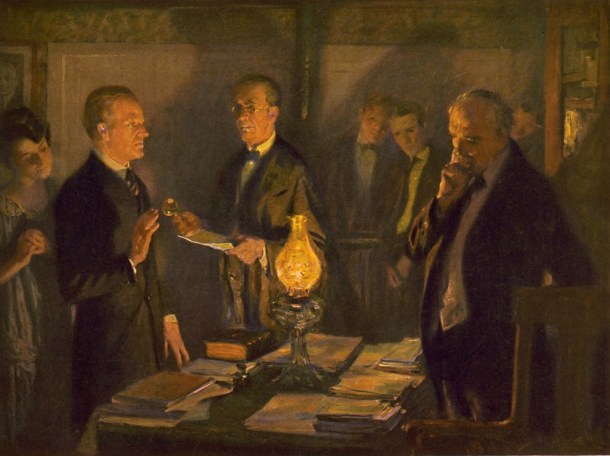
Upon returning to his father’s home, Coolidge and the rest got down to the serious business. “The oath was taken in what we always called the sitting room by the light of the kerosene lamp, which was the most modern form of lighting that had reached the neighborhood,” Coolidge later wrote. The room held great significance to him. It was there that his sister had died of a childhood illness and his mother had spent her final months. On the table lay his mother’s Bible, though he noted it wasn’t used in the ceremony, since that wasn’t done in administering oaths in Vermont.
People have long debated who was in the room during the ceremony. Was it five witnesses, six, perhaps seven? Coolidge recalled that his father, wife, stenographer and chauffeur, and Rep. Dale were present. Alternate versions of the story bulk out the room with the likes of Lane and Fountain. Other people were apparently milling about on the porch or peering in from the kitchen. Suffice it to say, it was a rather sparsely attended affair.
By the clock on the wall, Coolidge took the oath of office at 2:47 a.m. on Aug. 3, 1923. The new president and a small retinue left later that morning for Washington. After his arrival, at the insistence of U.S. Chief Justice William Taft, Coolidge took the oath again, this time administered by a federal official. Taft wasn’t sure of the legality of having Coolidge’s father, who derived his power from the state, administer a federal oath.
The federal ceremony got little play in the press. The Plymouth ceremony, soon dubbed the “homestead inaugural” in the papers, was a better story.

