[W]ASHINGTON — On the second and final day of confirmation hearings for U.S. Sen. Jefferson Sessions, the nominee for attorney general, a flurry of witnesses offered divergent portrayals of the Alabama Republican’s record.
The witnesses called by Republicans depicted Sessions as a civil rights hero, highlighting his legislative work on the Fair Sentencing Act, which reduced sentencing disparities for drug offenders caught with crack cocaine.
A number of Sessions’ black conservative friends attested to his impartiality and sharp legal mind.
Former deputy attorney general Larry Thompson, who served under President George W. Bush, said Sessions would “vigorously but impartially enforce our laws.” Former U.S. attorney Willie Huntley, who served alongside Session in Alabama, said that “at no point in the time that I’ve known Jeff has he demonstrated any racial insensitivity.”
Supporters said Sessions backed a number of civil rights resolutions, including a 2009 Senate apology acknowledging the failure of the federal government to enact anti-lynching legislation. They also pointed to a resolution he introduced in 2015 granting Congressional Gold Medals to civil rights activists who participated in Bloody Sunday and the Selma march for voting rights.
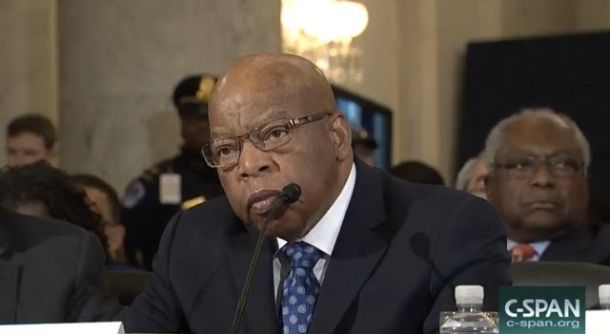
This portrayal of Sessions was deeply challenged Wednesday afternoon by U.S. Rep. John Lewis — a civil rights icon who was beaten by police during his participation in the 1965 Selma march.
Lewis, who entered the Kennedy Caucus Room flanked by members of the Congressional Black Caucus, told the Senate Judiciary Committee that the confirmation of Sessions would signal “a return to the dark past.”
“It doesn’t matter how Senator Sessions may smile, how friendly he may be, how he may speak to you,” Lewis told the panel. “But we need someone who is going to stand up, speak up and speak out for the people that need help. For people who have been discriminated against. And it doesn’t matter whether they are black or white, Latino, Asian American or Native American, whether they are straight or gay, Muslim, Christian or Jews. We all live in the same house. The American house. We need someone as attorney general who’s gonna look out for all of us, not just some of us.”
Lewis was not the only one to offer dire warnings on Wednesday.
U.S. Sen. Cory Booker, D-N.J., became the first senator to ever testify against a colleague, accusing Sessions of lacking the “courageous empathy” to hold the job of attorney general.
“The arc of the moral universe does not just naturally curve towards justice, we must bend it,” Booker said, invoking a famous quote by Martin Luther King Jr. “If one is to be attorney general they must be willing to continue the hallowed tradition in our country of fighting for justice for all.”
Cornell Brooks, president of the National Association for the Advancement of Colored People, warned that with president-elect Donald Trump poised to take office “not only is democracy in a perilous place, but the Justice Department is in a perilous place.”
David Cole, the national legal director of the American Civil Liberties Union, said his organization rarely opposes nominees for federal office. Sessions’ nomination, however, justified an exception, Cole said.
“He has shown blindness or outright hostility to the concerns of the people whose rights he will be responsible to protect,” Cole said.
While Sessions has supported certain civil rights legislation, witnesses said he has more often opposed bills protecting the rights of citizens to political and social freedom and equality.
Sessions, for example, has opposed Section 5 of the Voting Rights Act — which required federal approval of any election-related changes in nine Southern states with a history of voting discrimination.
After the Section 5 provision was struck down in a 2013 Supreme Court case, Sessions cheered the decision, and later declined to work with U.S. Sen. Patrick Leahy, D-Vt., and others to draft new enforcement mechanisms.
Since Section 5 was removed from the federal statute, southern states have passed laws requiring voters to show ID at the polls. In his confirmation hearing Tuesday, Sessions said he supports voter ID laws. Democrats say the mandate is unnecessary because there is no evidence of widespread voter fraud in America.
Two voter ID laws were recently struck down by courts in North Carolina and Texas. A unanimous ruling by the U.S. Court of Appeals Fourth Circuit found that the North Carolina ID provisions “target African Americans with almost surgical precision.”
Sessions has also opposed recent bipartisan efforts to reform the criminal justice system. He voted against the Sentencing Reform and Corrections Act, of which Vermont’s Leahy is a lead sponsor. The bill would, among other things, reduce mandatory minimum sentences for nonviolent offenders and give judges more sentencing discretion.
At Tuesday’s hearing, Sessions laid out a case for a “law and order” approach to justice, advocating for more vigorous prosecutions of criminals. He also vigorously defended police officers, saying law enforcement as a whole has been “unfairly maligned and blamed for the unacceptable actions of a few.”
Sessions is also skeptical of the Department of Justice practice of using consent decrees to oversee and reform police departments accused of wrongdoing.
“I think there is concern that good police officers and good departments can be sued by the Department of Justice when you just have individuals within a department that have done wrong,” Sessions said.
Chuck Canterbury, president of the Fraternal Order of Police union, hailed Sessions’ approach to criminal justice. “I have never testified with more optimism than I do today with Senator Jeff Sessions,” Canterbury said.
U.S. Rep. Cedric Richmond, D-La., who currently chairs the Congressional Black Caucus, asserted that by scheduling black leaders to speak last “is the equivalent of being made to go to the back of the bus.”
“Let’s think about this logically: If he were, in fact, a champion for civil rights, wouldn’t the civil rights community support his nomination instead of speaking with one voice in near unanimous opposition?” Richmond asked. “In closing, each and every senator that casts a vote to confirm senator Sessions will be permanently marked as a co-conspirator in an effort to move this country backwards.”
Sessions’ civil rights record was the main focus of the hearings. The Senate panel also took testimony on women’s rights and protections for gay, lesbian, transgender and bisexual Americans.
Sessions voted against the Lilly Ledbetter Fair Pay Act of 2009, which allows women to challenge pay inequity in the workplace. He also voted against the 2013 reauthorization of the Violence Against Women Act, as well as the 2009 Matthew Shepard and James Byrd Jr. Hate Crimes Prevention Act.
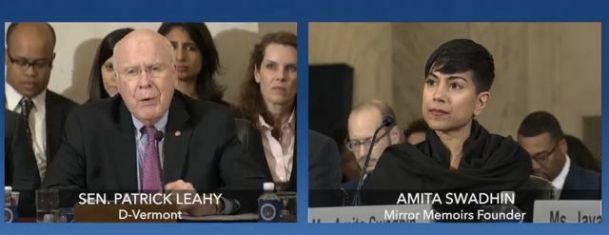
Leahy worked with Democratic Ranking Member Dianne Feinstein, D-Calif., to identify the witnesses for the Wednesday panel, which included Amita Swadhin, a survivor of childhood rape.
Leahy grilled Sessions Tuesday for his defense of Trump after an archived “Access Hollywood” tape of Trump boasting that he had groped women was published in The Washington Post.
On Wednesday, he was one of the few senators to question Swadhin.
“What does it do for victims’ willingness to come forth if they see people empowered [and] trivialize something that might be a lifelong trauma for them?” Leahy asked her.
Swadhin said Trump’s history with women made it hard for survivors to trust the government in reporting sexual assault.
“We are looking at an administration led by a man who who, not only does not seem to prioritize helping sexual assault survivors heal and come forward and be able to trust the state, but he may have actually engaged in sexual assault himself,” Swadhin said.
After the Wednesday hearing concluded, Leahy thanked witnesses, including his longtime friend Rep. John Lewis.
Sessions is expected to be confirmed by the Senate Judiciary Committee and by the Republican-controlled Senate.
Leahy suggested that he would be speaking with Senate colleagues ahead of the final vote, but said it was up to the public to exert pressure on Congress.
“What I hope the hearings will do, if they’ve been covered, will be to speak to the conscience of the public,” Leahy said, as he left the chamber.