Editor’s note: Elizabeth Hewitt spent a week in Colorado last month to report on lessons learned in the state that first opened recreational marijuana sales. Some impressions from that trip lingered.
[D]ENVER — Gabriel Hernandez moved from New York to Colorado two years ago.
“I came out here to be part of the industry,” he told me.
About an hour earlier, I had gotten off a plane a Denver International Airport, rented a car and driven less than 20 minutes to Medicine Man — a dispensary and marijuana grow operation in east Denver — for a tour of the cultivation warehouse. The peppery, skunky smell of fresh pot was still in my nose. It seemed to be wafting off my wool winter coat.
The 27-year-old Hernandez stood behind the medical dispensary counter — across the room from the recreational counter — in east Denver. The glass case was lined with dozens of mason jars containing different strains of weed. Some jars were emblazoned with a snake-entwined rod of Asclepius, the Greek god of medicine. Others carried a marijuana leaf.
Hernandez is a believer in the medicinal qualities of marijuana. He said he held that view long before he became part of the new green gold rush to Colorado. He participated in activism back in New York to loosen restrictions around pot.
He finds the attitudes toward weed in Colorado refreshing. Back in New York, Hernandez said, it was “hippie knowledge.” In Colorado, it’s legitimate, he said.
Some customers who have come in plagued with longtime health issues have been in tears at the relief they got through marijuana products, he said.
“I love my job. I’ve been doing this a long time for a reason,” Hernandez said.
As the debate over legalization in Vermont has heightened, the Rocky Mountain State has often come up as a sort of template. I went to learn about the successes and the challenges. Hernandez was the first of many people I encountered through several days of exploring Colorado’s medical and recreational pot industry who extolled bud’s health properties.
The medical marijuana system and the recreational system require different licenses and are managed separately, though they parallel each other closely. Many dispensaries — including Medicine Man — offer recreational and medicinal sales in the same room, and products are virtually the same. The major difference is at the cash register.
Medical product, which requires a card issued by a doctor, is taxed statewide at the counter only at the 2.9 percent sales tax, while recreational carries an additional special 10 percent tax. Municipal taxes could be levied on top of that.

But questions of health, pain and mental well-being are common at the recreational counter, many report. In Colorado, you don’t need a medical card to seek green relief for your ailments.
According to the Dec. 1 tally put out by the Marijuana Enforcement Division of the Colorado Department of Revenue, which is tasked with licensing and enforcement of both systems, the number of medical operations outnumbers the recreational outfits. There are 528 licensed medical marijuana sellers in the state, compared with 454 recreational shops. Medical pot cultivation operations total 791 — 166 more than the licensed recreational ones.
On a sunny Thursday at midday, about 70 miles south of Denver, Andrew Heaton sat on a sofa in the corner of a large windowless dispensary room, in front of a bright mural showing a Colorado mountain landscape. Looming over Heaton, a huge black-and-white likeness of Bob Marley, eyes closed, drew on a fat blunt.
The mural was already there when he opened his medical marijuana dispensary in the property, Heaton said, left by the previous tenant. He decided to keep it. He has a thing for wall art.
The splashy art contrasts with the otherwise clinical atmosphere of the dispensary. Heaton and an employee at the shop wear scrubs as they serve the clients, many of whom are older, at the L-shaped glass counter in the dispensary.
By his own description, Heaton was an unlikely figure to join the marijuana industry. He was a conservative Republican who stayed away from drugs (he can’t use pot, he said, because he’s allergic to it). But when his girlfriend was diagnosed with breast cancer, Heaton began growing medical marijuana for her in 2005. He found it easy enough to pick up. Before that, he grew orchids.
“Orchids are a lot harder,” he observed.
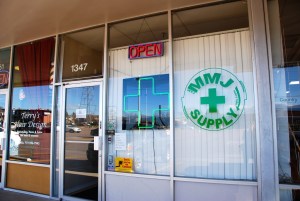
Now, more than a decade later, Heaton owns a medical marijuana dispensary in a strip mall in western Colorado Springs (where recreational sales are banned) and a grow operation a couple of miles away.
“There’s a lot of very sick, elderly people in this neighborhood,” Heaton said. Many of their regular customers live within walking distance. Some report they have significantly reduced their use of opiate painkillers by using marijuana, he said.
Still, Heaton would like to see the city open up recreational sales. As he sees it, one of the biggest shortfalls of Amendment 64, which ushered in legal recreational sales, was the control it gave to local governments to determine their policies regarding marijuana.
He is looking to expand into the recreational market himself. He has a marijuana-infused products business, which could include things like edibles and beverages, in the works in Denver, where recreational pot is legal.
Later that afternoon, a couple of miles to the west, commuters stopped in at Maggie’s Farm in Manitou Springs, less than half a mile from the Colorado Springs city line. From the outside, the recreational and medical dispensary looks a bit like a diner. It stands in the shadows of Pikes Peak, the pyramidal 14,115-foot pinnacle that juts out from the rest of the Front Range and looms over the city.
Inside, the shop’s white interior with a few red accents gives the mixed impression of a clinical doctor’s office and a 1950s malt shop.
A middle-aged man in a red sweatshirt asked a budtender for recommendations. The customer said he served in Vietnam and suffers from pain in his legs and back. The budtender recommended two varieties, and the man asked for an eighth ounce of each.
One budtender later described having moved to Colorado from Oklahoma shortly after legalization. He said he was a veteran who struggled with post-traumatic stress disorder and found that pot helped him cope in a way opiate painkillers or other treatments did not.
However, Dr. Larry Wolk, executive director of the Colorado Department of Public Health and Environment, said the use of marijuana as medicine raises concerns.
“As a physician I’m much more comfortable dealing with marijuana in the context of the recreational use rather than the medical use,” Wolk told me.
There are simply too many variations of marijuana for it to meet the standards applied to other prescription medicines, he said. Pot can be smoked, eaten or rubbed on the skin as an oil. The properties vary tremendously between different strains, he said. Additionally, he said, many doctors have not been trained in marijuana as medicine.
“To me it’s a plant, and it can be manipulated in a way to try and address health concerns, but it’s not medicine,” Wolk said. “We don’t have the research and the body of literature to support its use.”
The state put about $9 million toward research into the efficacy of medical marijuana in treating several conditions, but researchers confronted challenges with how to approach marijuana in its myriad forms, he said.
“It’s a little bit like the snake oil salesmen days,” Wolk said.
Though health comes up often in discussions about weed, recreation is also a driving force. If you look for it, pot is clearly and openly a part of pop culture in Colorado.
The sun sank behind the craggy facade of the Front Range of the Rockies as I drove the flat expanse to Denver from Colorado Springs one afternoon. The radio station I listened to in the car had a daily “4:20” break. The DJ read a factoid about the Sex Pistols’ Johnny Rotten and played the Neil Young song “Hey, Hey, My, My.”
Travel guides point Denver visitors to a seemingly endless well of marijuana-infused activities. The crafty might enjoy the cannabis equivalent of a “paint and sip” class, where, for about $50, you get a two-hour smoke session and a piece of artwork of your own making, under the tutelage of a local artist.
Foodies might select a sushi, sake and joint rolling class or attend a cooking-with-cannabis workshop. The wellness-inclined could find a pot-friendly yoga session or enjoy a cannabis-infused massage.
One budtender told me the perfect Christmas gift this year is “The Cannabis Kitchen Cookbook: Feel-Good Food for Home Cooks” and an eighth ounce of pot.
Before I drove to the airport at the end of my week in Colorado, I stopped by a busy street in northern Denver where people hobnobbed in trendy bars and restaurants.
Wandering down the street that evening, I nipped into a dark storefront that advertised “glass” “vaporizers” and “gifts” in green fluorescent lights.
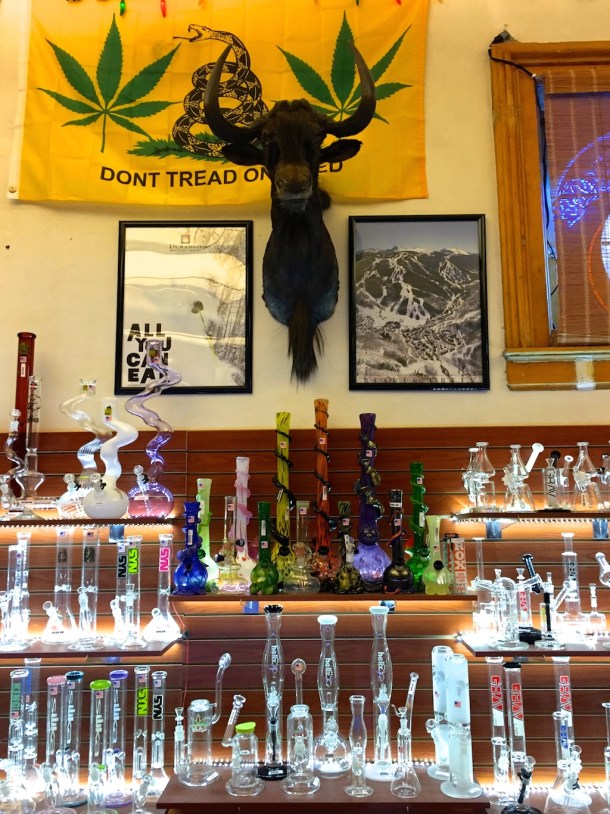
Inside, a shopkeeper named Joe stood behind one of three counters displaying a dizzying array of pipes. More intricate specimens were displayed on shelves on the shop’s wall, underneath three horned animal heads.
The shop, Meadowlark 64, was in the glassware business before legalization took effect, Joe said. Since Amendment 64, some things have changed. It used to be more of a gift shop, not unlike the chain store Spencer’s common in many malls across the country.
After legalization, the shop embraced the glass aspect of the business and moved away from the gifts. There’s still a wall of shelves stocked with novelty T-shirts and flags.
The biggest change, Joe said, was the clientele. The shop deals with more tourists than it used to. A lot of people, like me, are drawn in by the novelty of it.
Driving to the airport after dark, I zipped past the exit I used a few days earlier after my arrival to get to Medicine Man. The distinctive odor of marijuana hit me again.
I couldn’t tell if it was coming from my coat.