


[V]ermont Gas won permission from the state Supreme Court Dec. 9 to complete the last 2,000 feet of a controversial natural gas pipeline through Geprags Park in Hinesburg. The justices put a stay on the opponents’ case before attorneys presented oral arguments. Vermont Gas representatives say they will now finish the last section of the 41 mile pipeline that runs from Williston to Middlebury. This last court victory for the company comes after months of legal fights at the Vermont Public Service Board and protests against the pipeline at construction sites.
VERMONT GAS GETS GO-AHEAD FOR PIPELINE CONSTRUCTION IN HINESBURG PARK

Congress pre-empted Vermont’s mandatory GMO labeling statute as it took effect in July. Instead of a simple label identifying genetically engineered ingredients, the new federal law allows food processors to print a 1-800 number or a digital code on labels that consumers can use to get more information. Consumers would need a smart phone and code reading application to find out if a foodstuff is genetically engineered. The law also preempts a 2004 Vermont law requiring companies to label GE seeds. Sen. Patrick Leahy, D-Vt., and Sen. Bernie Sanders, I-Vt., both adamantly opposed the Senate bill. A number of high profile manufacturers, including Campbell’s Soup, Frito-Lay, Kellogg and ConAgra had already begun labeling GMO foods nationwide to comply with Vermont’s law.
CONGRESS PRE-EMPTS VERMONT’S MANDATORY GMO LABELING LAW
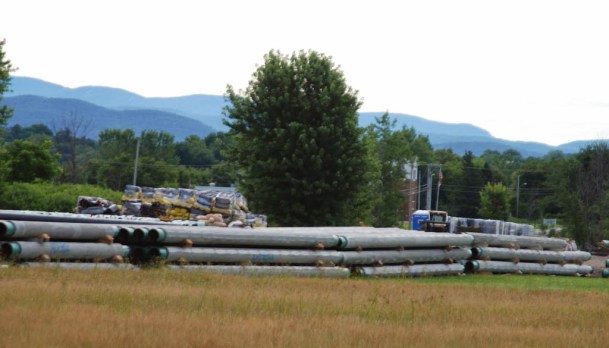
New England’s growing reliance on natural-gas fired power plants has outpaced the capacity of pipelines to carry the fuel, regulators say, and the deficiency could lead to problems if this winter proves especially cold. The gradual demise of coal-fired and nuclear plants around the country leaves few alternatives to fill the gap, officials said, and demand spikes caused by low temperatures could force utilities to buy electricity from whatever sources remain. The region’s dependence on natural gas is forecast only to increase through the next decade, but energy forecasters said the potential shortages shouldn’t last more than a few years, after which time pipeline companies are expected to have expanded capacity.
NATURAL GAS PRICES PREDICTED TO SURGE THIS WINTER

A Swanton couple is attempting to construct as many as seven wind turbines on their property, against objections raised by some of their neighbors — many of whom purchased their property from the couple, and at that time signed agreements acknowledging the likelihood of such a project. Although their fears find little support in mainstream scientific literature, opponents say they believe wind turbines could could lead to any number of harms, such as illnesses, or cracked home foundations, or the introduction of radioactive radon gas into their basements.
WIND ENERGY APPLICATION DRAWS MIXED REVIEWS

The Legislature placed restrictions on renewable energy siting. Properly crafted regional and municipal plans, according to the bill, will receive “substantial deference” when the Public Service Board considers renewable energy project applications. That means renewable energy projects must be sited in locations designated by local and regional energy plans. The new law also provides incentives for siting renewables in gravel pits, industrial parks and parking lots. Wind farms must use radar-activated obstruction lights that would turn on only when pilots when fly nearby. New sound standards were also put in place.
LEGISLATURE PASSES RESTRICTIONS ON RENEWABLE ENERGY PROJECTS
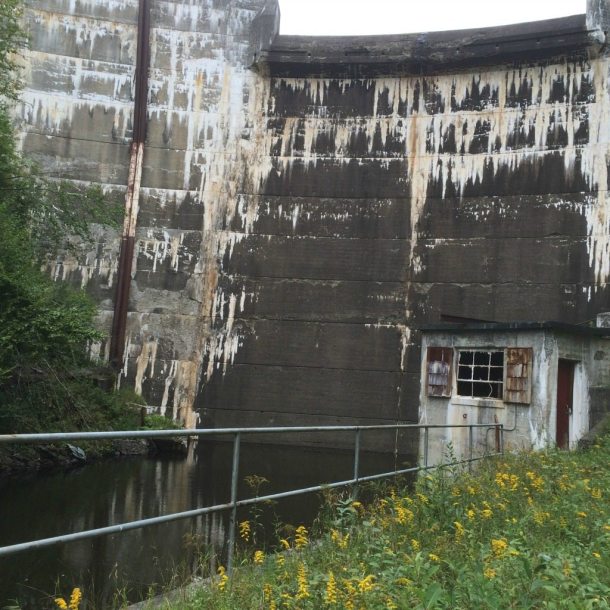
As the town of Morrisville attempts to renew its federal certification for dams the town owns, the Green River Reservoir one of them impounds came under scrutiny by state regulators as part of the recertification process. The town currently draws enough water from the reservoir through the winter to harm water quality, state regulators say, to damage aquatic plant life. Under federal law, Morrisville may be forced to end the winter draw-downs, which the operators of the town’s dams say could make the power plants on the reservoir unprofitable. Town energy officials say the town doesn’t want to keep the dam if it’s a liability.
CONFLICTING GOALS CREATE DILEMMA AT GREEN RIVER RESERVOIR
Swanton officials say they don’t want to fix a leaky dam that state biologists say is killing rare fish immediately downriver. The dam leaks in such a way as to divert water that would otherwise flow over the dam’s crest, and into the river below, some distance downstream instead. As a result of the leak, the river immediately below the dam occasionally dries up, and kills large numbers of fish. Instead of fixing the dam, Swanton officials are installing hydroelectric generators.
STATE FRUSTRATED WITH SWANTON VILLAGE’S INACTION ON LEAKY DAM
A report this year found that 60 percent of male fish in the Missisquoi River bear eggs. Normally no male fish bear eggs, biologists say, as that’s one defining characteristic of the female sex. Water-quality advocates say the cause is likely agricultural pesticides, which have been proven to disrupt animals’ endocrine system, and thus the hormones involved in determining sexual characteristics. An official at Vermont’s agency of agriculture disputed the link between widespread use of endocrine-disrupting agricultural pesticides and the Missisquoi River’s egg-bearing male fish.
SCIENTISTS SAY 60 PERCENT OF MALE FISH ARE BEARING EGGS

A challenge raised by water-quality advocates to the method Cabot Cheese uses to dispose of its wastewater led state officials to require additional monitoring of affected land. The wastewater-disposal method entails spraying the fluid on farmland to supply plants with what nutrients it contains. Opponents of the practice say the wastewater contains a range of harmful solvents and other industrial chemicals that Cabot introduces into state waters by spraying it onto farmland. Those opponents include Lake Champlain International, a group that sought to lead state regulators to re-evaluate and end the program allowing such wastewater to be sprayed untreated over Vermont fields and crops. Despite their efforts, regulators re-approved Cabot’s wastewater-disposal methods, but demanded that the company keep better tabs on the water’s effects.
CABOT CHEESE COOP TOLD TO BETTER MONITOR WASTEWATER SPRAYING
A group of farmers and farm supporters are pushing for a new dairy model in Vermont. The group hopes to distinguish milk produced within the state as “Vermont” dairy, in order to associate it with widespread public perception among New Englanders and others that Vermont represents health, environmental stewardship, and other desirable qualities. The advocates say they’d establish standards for worker treatment, environmental protections and animal welfare. The change would likely raise the price of milk products somewhat, but could also free Vermont dairy farmers from a national dairy market that takes advantage of small farmers and forces them into degrading husbandry behaviors. Governor-elect Phil Scott opposes the idea because it could lead to a statewide transition to organic farming.
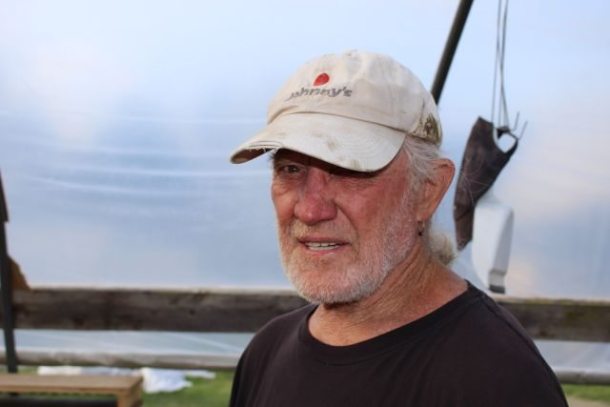
A group called Regeneration Vermont issued a report this year showing that farmers who plant genetically engineered corn are using twice as much herbicide now than they did a decade ago. About 8 percent of corn grown for dairy cow feed was genetically engineered in 2002. Today that number is 96 percent. Monsanto promised that farmers using GMO corn would use less atrazine and other herbicides. While that turned out not to be true, use of toxic herbicides is down dramatically, according to data from the Vermont Agency of Agriculture. The agency says Regeneration Vermont “cherry picked” the herbicide data.

