


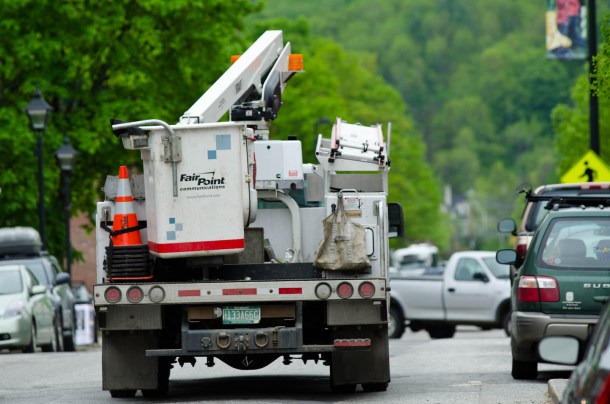
The Public Service Department, whose job it is to advocate for utility customers, agreed to participate in a new case in front of the utility-regulating Public Service Board when the department settled the majority of the original service quality investigation in August 2015.
At issue in the new case is whether regulators should relax some of FairPoint’s service obligations to its landline phone customers, particularly if the customer in question has the option of switching to another company.
FairPoint has been seeking less regulation for more than a year and has already been substantially deregulated in Maine and New Hampshire. The Public Service Department has said in testimony it may agree to relax some service quality standards but only in exchange for strengthening others.
As the case unfolds, FairPoint and the Public Service Department largely agree the company should not have to report data on meeting service quality benchmarks to the Public Service Board for customers who have the ability to get the same type of phone service through another provider.
But while FairPoint does not think a requirement to repair nearly all telephone outages within 24 hours is appropriate, the Public Service Department is advocating additional fines for not providing quality service to some customers, and additional rebates for outages that last more than three days.
Department proposes fines, credits
Carol Flint, director of consumer advocacy and public information for the Public Service Department, testified Oct. 20 that the company is making “steady progress” in resolving service issues within 24 hours.
But the company was able to resolve only 49 percent of cases within 24 hours during the most recent quarter, she said, compared with a required 60 percent. “For the past four quarters, FairPoint has only met or exceeded the baseline for this metric twice,” Flint wrote.
Flint recommended FairPoint be held to higher standards for customers with vulnerable household members, such as those with medical conditions. If FairPoint cannot get service reinstated to those homes within 24 hours, Flint recommended fining the company and then giving that money to customers in the form of bill credits.
Additionally, Flint recommended that FairPoint develop an automated system for bill credits, instead of waiting for either a customer to report an outage or for the business to become aware of it. The proposal would mark a change from FairPoint’s current policy; during the 2015 investigation, the company had to manually credit bills for 22,700 customers.
Flint also recommended a $5-a-day bill credit for customers who are without phone service for three days or more — meaning the bill credit would be a minimum of $15 — provided that customer does not have the option of getting hard-wired, Internet-based phone service through companies like Comcast.
FairPoint says Vermont’s regulations outdated
Beth Fastiggi, the Vermont state president for FairPoint, argued on Nov. 23 that several of the Public Service Department’s proposals are inappropriate and would be unfair because no other phone company would need to follow them.
Fastiggi called the requirement to repair outages within 24 hours “out-of-date.” She said it “has the effect of failing to give a good snapshot of FairPoint’s service quality” when the company “should be focused on its customers’ highest needs across all of its product offerings.”
The company does not have to report any service quality measures in New Hampshire, she said, and Maine “recently reduced its reporting requirements significantly,” while Vermont’s regulations could “undermine the financial strength needed for the company to provide service.”
Fastiggi called the proposed fines inappropriate. She also called it inappropriate for the Public Service Department to seek to increase penalties and fines on the company using the same case that FairPoint is using to reduce service quality reporting.
She said of the proposed $15 fine: “Not only would that added burden cause additional systems and procedures expense to the company (along with the loss of revenue for required payouts), but this requirement would also fall upon no other telecommunications carrier in the state.”
Fastiggi also predicted that creating an automated technology process to give customers bill credits would be “extremely challenging to implement.” She said it would take one year to set up the technology and cost up to $300,000.
The technical hearing is scheduled for Thursday at 9:30 a.m. in the Public Service Board hearing room in Montpelier.
The board may hold an additional hearing Friday before deciding on the case.
