

One resolution expresses support for welcoming Syrian refugees, and the other seeks to affirm and further refine Burlington’s practices for dealing with unauthorized immigrants, a set of policies often associated with so-called sanctuary cities.
Both resolutions reflect post-election fears that refugees and immigrants are facing increased discrimination and violence, or that federal policies could curtail the admittance of refugees or lead to mass deportations of people in the country illegally.
Vermont is home to roughly 1,500 unauthorized foreign workers. And through the state’s refugee resettlement program, Burlington alone has resettled more than 7,000 refugees from more than 30 countries since 1980.
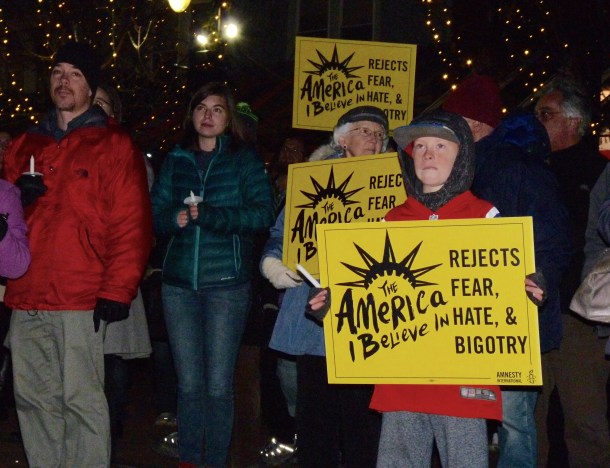
More than 200 people gathered outside City Hall before Monday’s council meeting as part of a vigil to recognize the ongoing humanitarian crisis in Syria and affirm that Burlington would welcome refugees from there. Many held yellow signs saying, “The America I believe in rejects fear, hate and bigotry.”
Kit O’Connor, the legislative coordinator for Amnesty International in Vermont, told the crowd that although municipalities can’t control federal refugee policy, “We can decide how we will welcome people into our community.”
One resolution declares “support for resettlement of United Nations registered Syrian refugees in Burlington.” It also calls on other municipalities to do the same as part of a larger campaign to spur a “stronger national effort to resettle the most vulnerable Syrian refugees.”
Half of Syria’s population has been displaced during the country’s civil war, either within its borders or as part of a flow of 4.8 million refugees into five neighboring countries. The United Nations has called for 450,000 of those refugees to be settled outside the region bordering Syria.
The United States had admitted just more than 14,000 Syrian refugees since the conflict began five years ago. More than 7,000 refugees have died trying to reach Europe by crossing the Mediterranean Sea since January 2015, according to the Burlington resolution.
Councilor Kurt Wright, R-Ward 4, introduced an amendment to insert language into the resolution stating that, in addition to welcoming Syrians, Burlington would also support the “review and potential enhancement of the vetting process to ensure the greatest protections possible for the United States in regard to homeland security.”
Wright said he’s heard overheated rhetoric on both sides of the Syrian refugee debate. He said proclamations such as Trump’s proposed ban on Muslims entering the country go too far but that it isn’t fair for people to be labeled a bigot for wanting to ensure national security in the vetting process for refugees.
He said that, despite what he called a “serious vetting process,” there are still terrorists interested in infiltrating the refugee resettlement program.
“So the question for me is the security issue,” Wright said. “That’s where the fair debate is.”
O’Connor, who wrote the resolution, said that “refugees are, bar none, the most vetted people who enter our country.” Those coming from Syria face further scrutiny, she added.
The resolution is nonbinding and could become moot if federal policy on admitting refugees changes, she said. Its purpose is to define how people will be welcomed into the community, and in her opinion, Wright’s amendment “negates that welcome.”
Rutland was selected earlier this year by the State Department as a resettlement site for 100 Syrian and Iraqi refugees, who are expected to begin arriving in December and January. Experts and officials have said it’s unclear what a Trump presidency will mean for those refugees or future resettlement efforts.
Trump said at a campaign rally in November that, if elected, he would suspend the country’s Syrian refugee resettlement program.
Wright’s amendment failed on a vote of 11 to 1, with Wright, the lone Republican on the council, the only vote in favor.
A second amendment he offered, asking that Congress appropriate money to support cities where Syrian refugees are resettled, passed unanimously. The resolution itself passed 11 to 1, with Wright voting no.
The other resolution passed Monday states that Burlington will “continue its longstanding and legal practice” of not inquiring about residents’ federal immigration status during the provision of city services. The resolution follows on the heels of the mayor’s pledge to make Burlington a so-called sanctuary city.
That resolution also creates a committee of three city councilors to work with the Weinberger administration to “create formal city policies consistent with our long-standing practices related to ensuring that Burlington is a welcoming and inclusive city for immigrants.”
“What this resolution will do … is show we are steadfast and committed to these practices and codify them,” said Council President Jane Knodell, P-Central District, the resolution’s sponsor.
The measure passed 10 to 2, with Wright and Dave Hartnett, I-North District voting no. Wright said he supports affirming current practices but that the new committee goes beyond that. He said he wouldn’t support Burlington declaring itself a sanctuary city.
Hartnett said he felt the post-election concerns articulated by other councilors were overwrought.
Will Lambek, with the advocacy group Migrant Justice, applauded the resolution’s intent. He encouraged the new committee to align the policies it codifies with Vermont’s recently created fair and impartial policing policy, which the Burlington Police Department has yet to formally adopt.

