

VITL, a publicly funded nonprofit that coordinates electronic health records across Vermont, has $66,000 in cash but needs to issue $135,000 in paychecks at the end of the month.
If the Department of Vermont Health Access does not pay some of its outstanding invoices to VITL, the organization may tap into a $500,000 line of credit to pay its 33 workers.
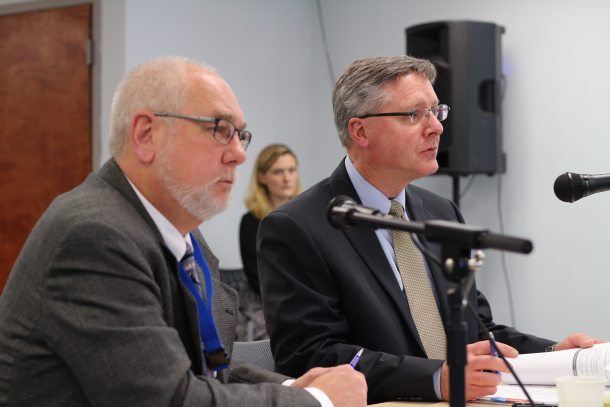
That’s according to John Evans, the chief executive officer of VITL, and Robert Turnau, its chief financial officer. They gave an update on their status to the Green Mountain Care Board on Thursday.
The board mainly regulates hospital budgets and health insurance prices. It became the main regulator for VITL in 2015 and receives regular updates on VITL’s financial situation.
The Department of Vermont Health Access enters into contracts with VITL to fund the organization using federal grant money. VITL also gets some money from Vermont’s umbrella Medicaid budget.
In June, the board told the Department of Vermont Health Access to improve its cash flow to VITL. The organization said in June it was having trouble getting paid, and the state said it was confident it could work out a new contract soon.
Now that the contract has been executed, VITL executives said again Thursday that trying to get paid is taking time away from meeting their other obligations.
The interest rate on the line of credit is a minimum of 3.25 percent, according to VITL. But that interest cannot be paid off using the federal money it gets through the state, Evans said.
Steven Costantino, the commissioner of the Department of Vermont Health Access, issued the following statement: “Of course we’re concerned with VITL’s cash flow. We’re concerned with the cash flow of all of our contractors.”
“We work to process all invoices promptly, provided that all documentation is complete and that it comports with federal guidance,” Costantino said. “As the recent audit underscored, it is crucial for invoices to be in compliance with contracts. It would be irresponsible for the stewards of taxpayer dollars to do otherwise.”
Georgia Maheras, the deputy director of health care reform for Gov. Peter Shumlin, said the state has four different contracts with VITL. One of those is called the “core” agreement, she said. The state is processing payments for August and September under that core agreement, she said, totaling around $160,000.
Maheras said payments are usually processed within three to five business days, but she is not certain how the Thanksgiving holiday on Nov. 24 will affect that.
Al Gobeille, the chair of the Green Mountain Care Board, told VITL executives at the meeting: “The concern I have is how is this impacting the operation of VITL and the ability to meet your operational goals. This is a problem, but the bigger problem is, are we accomplishing our strategic vision?”
Gobeille directed the VITL executives to write a formal letter to Shumlin and the Green Mountain Care Board saying they need to be paid. The board will then follow up with VITL on Dec. 9, he said.
Jessica Holmes, a member of the board, asked Evans and Turnau what the long-run solution is to VITL’s cash flow problem. “Maybe we can’t answer that today, but it’d be really helpful to put some time on the calendar to be able to do that,” she said.
Gobeille added, “I actually want to understand the effect of this because we were never supposed to be the cash flow oversight department of VITL. We were supposed to oversee your activities.”
Evans said he’d be happy to come back to the board and answer questions about long-run impacts in more detail.
He said health information technology is a competitive market and that the cash flow problems make it hard to recruit staff.
“I do try to protect my staff. They need to be focused on their work,” he said. “The more it becomes in the public eye, the more concerned they obviously get about this and their particular employment. I cannot afford to lose these folks.”
Turnau said: “Without real resolution of this issue, our long-term sustainability is affected. As a small nonprofit, we don’t have the (money) to be able to ride this out.”
Con Hogan, a board member who attended the meeting by phone, said the cash flow situation “is getting to be ridiculous.”
