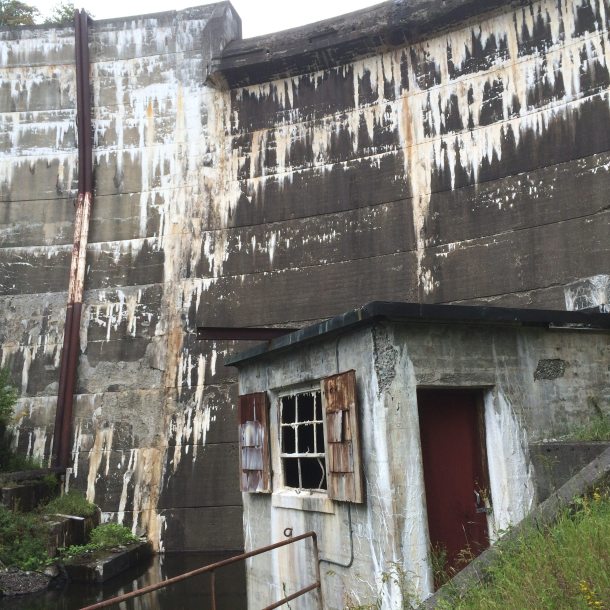
Environmental groups have asked the Vermont Environmental Court to uphold a finding by the state that a Morrisville utility is harming the water quality of Green River Reservoir.
Two environmental organizations — Trout Unlimited and Vermont Natural Resources Council — are seeking to block the Morrisville utility’s use of a hydroelectric generator at the reservoir.
The town’s electric utility, Morrisville Water and Light, last month appealed that finding to the Vermont Environmental Court. Trout Unlimited and VNRC on Wednesday both cross-appealed Morrisville’s appeal.
Jon Groveman, the policy and water program director for VNRC, says “We are very concerned that what Morrisville Water and Light is asking for is a certification that will not even come close to meeting Vermont water-quality standards.”
The Vermont Agency of Natural Resources issued the contested finding, called a Section 401 certificate, as part of the federal relicensing process Morrisville has undertaken to continue operating hydroelectric generators at the base of Green River Dam, which produces about a million kilowatt-hours each year.
Vermont must in its Section 401 certificate deliver a statement of the conditions under which the dam might operate without violating state water-quality laws, in order for Morrisville to win approval from the Federal Energy Regulatory Commission. Morrisville is seeking FERC licensing this year on the Green River Dam as it must do every 30 to 50 years for each of its four hydroelectric generators.
The ANR told federal energy regulators that Morrisville must draw less water from the Green River Reservoir than the town does currently. The state’s Section 401 certificate would allow Morrisville to draw the reservoir down by about a foot and a half over the winter. The utility currently draws down the lake by as much as 10 feet.
Morrisville officials say that the new restriction would drive up the cost of operating the generators by as much as $100,000 annually for the next 30 years.
State regulators say they’re not allowed under federal Clean Water Act rules to factor economic considerations into their recommendations on the Section 401 certificate.
“We intend to push back hard on the idea that you can be allowed not to meet water quality standards because it affects how much energy you can generate,” Groveman said.
The possibility that Morrisville can’t make as much power from Green River Dam shouldn’t sway regulators, Groveman said, because the law forbids it, but also because the Section 401 certificate the state issued doesn’t go far enough.
“The flows the agency put in the certificate are not sufficient to protect fisheries and other aquatic habitat,” Groveman said.
Vermont Natural Resources Council would like to see artificial drawdowns on the Green River Reservoir cease altogether, Groveman said.
A state study from 2015 concluded that deep drawdowns of Green River Reservoir over the winter stymies aquatic plant growth near the waterline. The study also found that at least one species of insect appears to have been adversely affected by the practice.
Despite their opposition to Morrisville’s management of Green River Reservoir, Groveman said VNRC’s members want to keep the dam in place. The group supports dam-removal in some instances, he said, such as in the instance of Swanton Dam, which prevents the passage of migratory fish.
“But it has to be a really extraordinary circumstance to argue that a dam has to come out entirely,” Groveman said.
Neither the Agency of Natural Resources, nor VNRC, nor any other entity but Morrisville Water and Light has seriously discussed the dam’s removal, Groveman said.
Morrisville Water and Light officials said last month that the ANR’s Section 401 certificate would force the town to operate the dam at a loss, and that the town would probably decommission (industry argot for “remove”) the dam instead.
Groveman’s organization will file later this week a statement of these and other issues they plan to raise in the case, he said.
Officials from the Agency of Natural Resources said they couldn’t yet comment on the questions Morrisville raised in its appeal, and said they’re still waiting to see what VNRC and Trout Unlimited file in support of their cross-appeal.
Morrisville’s appeal, filed Sept. 28, alleges that ANR didn’t strike the proper balance between competing uses of Green River Reservoir’s impounded waters, and states that the agency “failed to adequately consider any public benefits or detriments” that might result from its decision.
The agency should also have given greater consideration to economic and social issues connected to the dam, as well as to protection of the navigability of state waters, Morrisville claimed in documents filed as part of its appeal.
Both Trout Unlimited and VNRC have until Oct. 26 to file a statement of issues they intend to raise, and the court has scheduled an initial status conference on Nov. 21.
The Agency of Natural Resources won’t comment publicly on its responses to the appellants or the cross-appellants until then, said ANR litigation attorney Leslie Welts.
“The Agency of Natural Resources is confident in its decision in the 401 [certificate], and we’ll be responding consistent with that position,” Welts said.
The agency is open to negotiating with Morrisville as litigation proceeds, to see whether a mutually-agreeable solution can be reached outside the court, Welts said, but the two governments are not currently in discussions toward that end.