

(This story was updated and expanded Oct. 6 at 9 p.m.)
[B]URLINGTON — Prosecutors say a Franklin County sheriff’s deputy was justified in shooting and killing a man last month after a foot chase through a Winooski neighborhood and will not face criminal charges.
Deputy Nicolas Palmier, 31, fired on Jesse Beshaw behind a community center on Malletts Bay Avenue on Sept. 16. Beshaw, 29, of Winooski, was shot seven times, according to Maj. Glenn Hall of the Vermont State Police. Beshaw was unarmed.
Officials said the two men, who lived not far apart in Winooski, did not know each other before the events that led to Beshaw’s death.
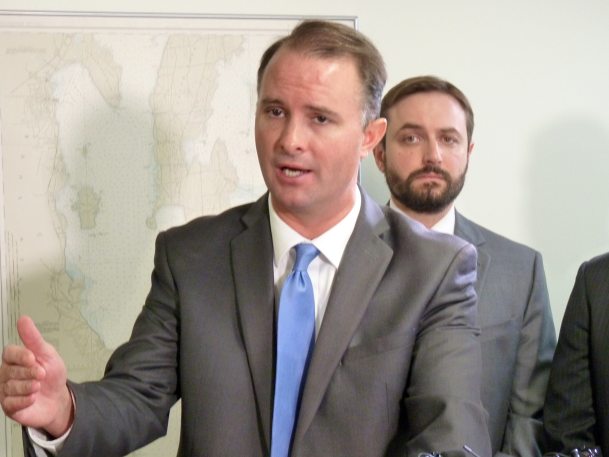
“Deputy Sheriff Palmier was acting in lawful defense of himself,” Chittenden County State’s Attorney TJ Donovan said at a Thursday news conference.
Attorney General William Sorrell agreed that the shooting was justified.
State police, who investigated the shooting, released roughly 25 minutes of video Thursday that Palmier’s body camera recorded during the incident.
Palmier is on paid administrative leave and is receiving mental health counseling, said Franklin County Sheriff Robert Norris. Palmier’s attorney, Craig Nolan, said this was the outcome they were expecting.
“Deputy Palmier is doing well. … It’s a traumatic event for any officer involved in one of these events,” Nolan said.
Mental health counseling is required after an incident like this, according to Nolan, and both Norris and Nolan said they expect Palmier will return to duty soon.
Officials said Thursday that Beshaw was a suspect in three August bank robberies, and officials had already said he was known to carry a gun.
Palmier was returning to his home in Winooski when he saw police outside a Union Street home where Beshaw, who was wanted on a burglary warrant, was holed up, according to officials. Palmier stopped to help Winooski officers, who briefed him on the situation before he joined the response.
When Beshaw fled the home, Palmier gave chase, leading to the deadly confrontation behind the O’Brien Community Center.
Officials said the shooting was justified because Beshaw shouted that he would pull out a gun, ignored Palmier’s commands and throughout the confrontation kept a hand behind his back at waist level “in a manner consistent with holding a firearm.”
According to state law, police in Vermont are allowed to use lethal force if they “reasonably” believe that a person presents a threat of serious bodily harm to themselves, the officer or others present.
Donovan said he had spoken with Beshaw’s family before the news conference. They reviewed the video footage together, he said, and he told them of his decision not to prosecute. He said they were understandably upset by the video and his decision.
Donovan said he offered them the opportunity to address the media, but they declined.
A call for better ‘tactics and strategies’
Thursday was the third time in 10 months Donovan stood before a podium in his office and announced to reporters that an officer who shot and killed someone was justified.
In December police and federal agents killed Kenneth Stephens, 56, a suspected drug dealer who they said pointed a muzzleloading rifle at officers as they executed a no-knock search warrant at his Elmwood Avenue home.

In March police killed Ralph “Phil” Grenon after a five-hour standoff. Grenon had retreated to a shower in his bathroom, where police confronted him while he was holding two knives.
“We have to look at our tactics and our strategies,” Donovan said. “If you look at these last three shootings, if there’s a common theme there, it’s these questions about tactics.”
Donovan, who is running for attorney general, said he did not believe that Vermont police agencies need to review their use-of-force policies, but he said he agreed with Burlington Police Chief Brandon del Pozo that Vermont needs to change the training that officers receive when it comes to de-escalating confrontations.
When it comes to evaluating police tactics, Donovan contrasted the danger a person presents to public safety against the possible deadly outcome that could result from their pursuit.
“What we have to re-evaluate is the analogy to the high-speed chase with a motor vehicle: Do you pursue? Do you not pursue when there’s viable information that this person is armed and is a public safety threat?” Donovan asked.
“These are all the decisions you’re making in a split second, and so to de-escalate the situation would probably be not to pursue,” he added.
Lia Ernst, an attorney with the Vermont chapter of the American Civil Liberties Union, said that’s precisely why the state needs to reform its use-of-force policy.
In each of the last three fatal police shootings in Chittenden County, police used tactics that forced extremely tense confrontations that could have potentially been avoided if police were guided by a policy with “the preservation of human life as its central goal,” she said.
“We very strongly believe that what we need is a statewide use-of-force policy that looks at more than just that moment when the trigger is pulled and takes a larger view of what led up to that moment,” Ernst said.
Body camera footage released
VTDigger was among several media outlets that had requested the police video, which is a public record.
Donovan urged media to exercise caution in publishing the footage, which he described as “horrific.” He said he believes “common sense and decency” dictate it should not be fully shown.
Ernst, with the ACLU, said she believed it’s important for the video to be published, because “people can’t decide if this use of force was justified without seeing the evidence for themselves.”
VTDigger is publishing a portion of the video that depicts events leading up to and including the moment when Palmier first fires his weapon.

Donovan said Vermont needs a policy dictating the release of body camera footage. He said he hopes law enforcement, media and advocacy groups like the ACLU can work collaboratively on such a policy.
“Going forward we’ve got to find common ground that strikes a balance between the public’s right to know and maintaining the integrity of an investigation,” Donovan said.
State police had declined to release the video, citing a public records exemption that allows records pursuant to an active investigation to be withheld until it’s completed.
Ernst said that exemption is typically used when suspects may not know whether they’re being investigated or what evidence police have against them, and should not be applied to police shootings when the person being investigated is aware of it.
Donovan defended the decision not to release the video until state police finished their investigation and he completed his review, saying that releasing it sooner could have compromised the investigation. Its distribution could color witnesses’ recollection and taint a jury pool, he said.
Ernst said Donovan and other law enforcement haven’t given a compelling reason why, after initial witness statements were taken, the footage couldn’t be released before the investigation and review were complete. Courts have procedures to ensure impartial juries, she said.
Vermont’s Law Enforcement Advisory Board is drafting recommendations for a body camera policy in a report due to lawmakers in December. A body camera video policy is likely to be a hot topic in Montpelier when the Legislature reconvenes next year.
Events leading up to the shooting
The video shows Palmier pull over and get out of his vehicle where Winooski officers already have the Union Street home surrounded.
Donovan said police did not edit the footage in any way except to blur out license plates and people who were not involved in the situation.
Officers had seen Beshaw enter the house earlier, but his girlfriend, who lives inside, would not let them enter and claimed Beshaw was not there, according to the state’s attorney’s report.
Winooski police had already called for backup, and when Palmier asks, they say they could use his help.
Officials at Thursday’s news conference said it’s not uncommon for police to offer help to fellow departments, a practice known as mutual aid.
Palmier, who had just finished a shift in Fairfax, was wearing his badge and uniform and had his Glock 9mm service weapon on him.
Winooski Police Officer Brenda Davis can be heard on the video telling Palmier, “So we’ve been looking for Jesse Beshaw. He’s wanted on a warrant. He’s wanted for a bunch of burglaries. He’s always been armed with a gun.”
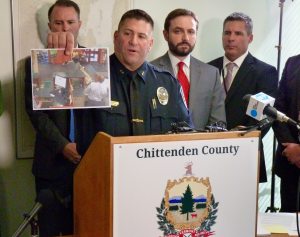
At Thursday’s news conference, Winooski Police Chief Rick Hebert told reporters that Beshaw was involved in a Sept. 2 burglary. During that burglary an officer who knew Beshaw was able to clearly identify him holding a pistol.
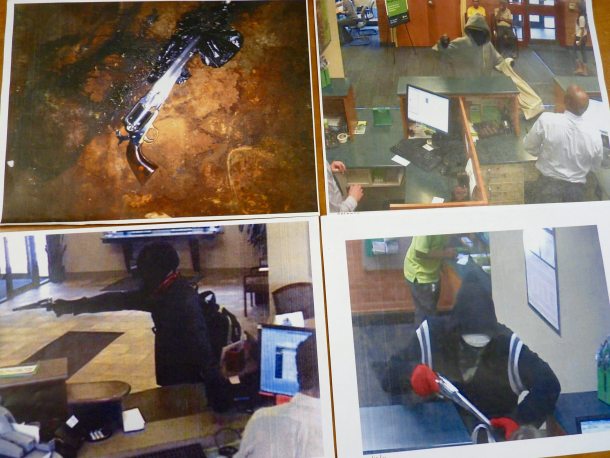
Police said they later recovered a silver-colored black powder revolver from a nearby dumpster. Hebert, holding up photographs of the bank robberies and the weapon recovered, said, “I’m not going to say it’s an identical gun, because we’re looking at pictures, but it is a similar size and finish,” and both were black powder revolvers.
Hebert said Beshaw was a suspect in those robberies but that the investigation is ongoing.
On the body camera video, another officer, James Charkalis, tells Palmier about the Sept. 2 burglary, saying, “He had a gun in his hand. He ditched it and threw it into a dumpster, so we got the gun but he definitely is, you know …”
“OK, he carries?” Palmier responds.
“Yeah, he’s definitely carrying,” Charkalis says.
Maj. Hall, with the state police, said officers’ assertion that Beshaw was definitely carrying a gun, despite having recovered the one they believed they’d seen him with last, was reasonable and appropriate because Beshaw could own or have access to other guns.
Beshaw, a felon, was federally disqualified from owning a gun and could not purchase one legally.
Moments later, Beshaw leaves the Union Street home on foot, and Davis alerts the other officers that he’s making a run for it. On the video, Palmier can be seen immediately giving chase.
A deadly encounter
Palmier chases Beshaw west on Union Street and then south down Malletts Bay Avenue, then through the driveway and backyard of a home and along the north side of the O’Brien Community Center.
Palmier passes a young girl, who is blurred out in the video. He asks which way Beshaw went, and the girl says he ran behind the community center, where there’s a stretch of blacktop with a chain link fence at one end.
Beshaw can be seen at the far end of the blacktop on the other side of the fence by a dumpster.
As Palmier approaches, he radios his location. Beshaw can be heard saying, “I’ll pull a gun out.” Police estimated the distance between them at 88 feet at this point.
Palmier immediately responds, “I’ll shoot you. I’ll shoot you,” and draws his gun. It is the first thing he says to Beshaw as he closes the distance between them.
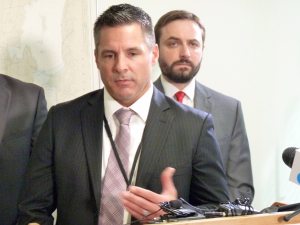
Donovan said at the news conference that Palmier had “no chance to de-escalate the situation.”
Palmier’s first words to Beshaw are his warning, not a command.
Beshaw, who is standing on the other side of the shoulder-height chain link fence, responds, “Let’s get it.” His body is angled away from Palmier, and his hand is behind him at the waist of his basketball shorts.
Palmier yells, “Show me your friggin’ hands!” Beshaw is still talking, but what he’s saying can’t be heard over Palmier until Beshaw says, “What’s up?” as he advances through an open gate in the fence toward Palmier.
Then Beshaw begins to advance more quickly in what police describe as an “aggressive manner,” with his hand still behind his back, and repeatedly shouts, “Do it!”
Palmier begins to back away, giving the command, “Step back!” multiple times, as Beshaw continues to advance. When Beshaw is what police estimate to be 9.5 feet away, Palmier opens fire.
The deputy fires the remaining shots as Beshaw falls to the ground.
Palmier immediately begins shouting, “Shots fired!” Seconds later another officer appears on the video and says he saw the altercation and asks Palmier if he’s all right.
Palmier is breathing heavily and appears shaken but is able to respond and go through police protocols, reminding the other officer to check Beshaw for a weapon before handcuffing him and providing emergency aid.
The other officer begins performing CPR. Emergency responders arrived shortly after, and Beshaw was pronounced dead at the scene, according to the report.
Blemishes on Palmier’s record
Palmier had been fired from two Vermont police departments in the past. His current boss, Sheriff Norris, who hired Palmier last year, said he was aware only that Palmier was “released” from one other police department.
Palmier served in the U.S. Marine Corps from 2003 to 2007 and did two tours in Iraq in 2004 and 2005, according to a Seven Days report. In a Burlington Free Press article from 2008, where Palmier was interviewed, he expresses concern about finding a policing job after seeking mental health counseling following his service.
In 2010, Palmier was hired by the Winooski Police Department. He was let go before completing his probationary period, and Chief Hebert said there is no record of why. Hebert worked for the department at that time but was not chief. He said he does not recall why Palmier was fired.
Then in 2011, Palmier was hired by the St. Albans Police Department and fired again eight months later for leaving important information — that he’d left someone handcuffed in an emergency room without supervision — out of his report on the incident.
Community concerns persist
Thursday at the news conference, several activists and community members who have protested Beshaw’s killing and police violence were initially turned away but later allowed into the event.
They expressed frustration with Donovan’s decision and claimed Winooski residents were living in fear of Palmier, who they say was known in the neighborhood to have acted violently in the past. One woman called for “systemic change” in how police protect communities.
Beshaw’s friends, concerned residents and community activists have held several protests at the site where he was killed, calling for justice.
Donovan said he wants to listen and work with them on reforms to ensure police get better training and help officers regain the public’s trust, but he affirmed to them that Palmier’s actions were justified.
