

(“Then Again” is Mark Bushnell’s column about Vermont history.)
[T]he biggest name in the “birther” movement, Donald Trump, has succumbed to the weight of documentary evidence that President Barack Obama was born in the United States. For Vermonters, it seems a good time to examine the history of this type of political attack, since its roots can be tracked back to our state.
The tactic is straightforward: To undermine a president, or a presidential contender, claim that he or she is not a “natural born citizen,” as required by the Constitution, and is therefore ineligible to serve.
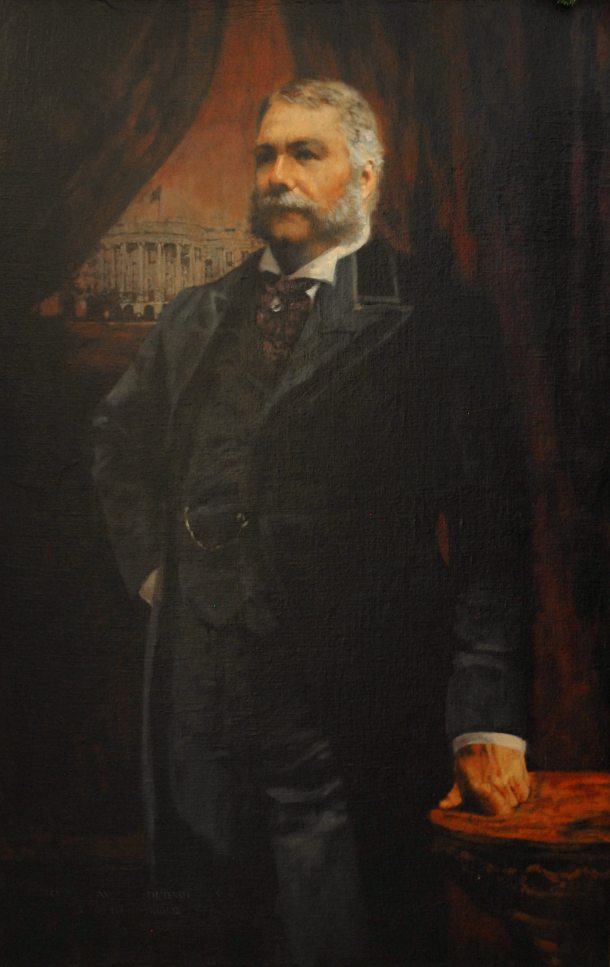
The ploy dates back at least as far as 1880 to Vermont’s own Chester Arthur. Or perhaps, if you believe the rumors that circulated about the man who would become the 21st president, he was actually Canada’s own.
When Arthur was accused of not being a natural born American citizen, he was at a disadvantage. Whereas politicians today have hard evidence they can produce, like state-issued birth certificates and decades-old newspaper birth announcements, Arthur had little but his word.
And given the location of his birth near the border, the fudging Arthur apparently did about his true birth date, and the hardball politics of his day, it is little wonder that some rivals claimed he had been born in Canada.
The official version of Arthur’s birth is that he was born in 1830 in Fairfield, Vermont, a couple of towns south of the Canadian border. He certainly spent his early years in Fairfield, but the question was where he drew his first breath. If he had been born across the border in Quebec, his rivals argued, then the Constitution would disqualify him to become president or vice president. (But worse yet, he wouldn’t even be a Vermonter, but a mere flatlander! Perish the thought.)
The alleged changing of facts surrounding Arthur’s birth was no mere accident, political opponents claimed, but a conspiracy to skirt the law. Arthur didn’t help matters by claiming, for some unknown reason, to have been born in 1830, although his family Bible, now housed at the Library of Congress, states that he was born a year earlier.
Arthur P. Hinman, a New York City lawyer and Democratic political operative, said he found proof of Chester Arthur’s alien birth. When Arthur was nominated to be the Republican vice presidential candidate in 1880 (James Garfield was the GOP’s presidential candidate), Hinman snapped into action, traveling to Franklin County to do some sleuthing. Hinman soon claimed he had discovered that Arthur had been born in Dunham, Quebec, at his grandparents’ home, not in Fairfield. (Hinman had previously claimed Arthur was actually born in Ireland and moved to the United States as a teenager.)
Hinman theorized that Arthur had taken as his own the birthplace of a brother who had died in infancy.
The politician had been born William Chester Alan Arthur, Hinman announced, the eldest of three boys in a family that apparently had little imagination for names. A second son, Chester Abell Arthur, died in infancy. When a third boy was born and named William Arthur Jr., the future president dropped the William from his name.
Having a deceased brother proved expedient for Arthur, Hinman claimed. When Arthur considered running for national office, he expropriated his younger brother’s birth records, which showed he was born in Fairfield. Chester Abell Arthur had no death records, Hinman alleged, because his father sold the infant’s body to a medical school. Immediately after the nomination, Hinman said, Arthur and some aides traveled to Fairfield and elsewhere to create a paper trail showing he was a natural born American.
The requirement that a president be a “natural born American” has been with us from the start. The prerequisite was included in the Constitution to prevent foreigners from holding office.
The Constitution doesn’t define the term “natural born citizen,” and the issue has come up several times in the last half century. Sen. Barry Goldwater, who ran unsuccessfully for president in 1964, was born in Arizona in 1909, before it was a state. Michigan Gov. George Romney briefly ran for president in 1968, though he’d been born in Mexico. And John McCain, the Republican presidential candidate in 2008, was born in Panama to U.S. citizens, so was considered eligible to run.
No one has yet been elected who was born outside the United States. Unless, of course, you believe that Hinman, despite his political motives, was right.
Rumors of a Canadian birth didn’t stop the public from electing the Garfield-Arthur ticket in the fall of 1880. But the talk refused to die, thanks in part to an uncharacteristic lapse of judgment by Arthur.
Afterward, people were left to wonder: Was he confiding the truth to his supporters, or just poking fun at a baseless rumor he just couldn’t shake?
Basking in the victory, and perhaps too many celebratory drinks, Arthur gave an indiscreet speech at Delmonico’s restaurant in New York City. Before a crowd of supporters, including millionaires John Jacob Astor, J. Pierpont Morgan and Jay Gould, Arthur joked about his origins.
“(W)hile I don’t mean to say anything about my birthplace, whether it was in Canada or elsewhere, still, if I should get to going about the secrets of the campaign, there is no saying what I might say to make trouble between now and the 4th of March (inauguration day).”
On July 2, 1881, an assassin shot President Garfield, who lingered for two months before dying, making Arthur president.
Hinman saw an opportunity to breathe new life into his pet cause. Either out of conviction or to weaken the rival political party, or to make a few bucks, Hinman published a book: “How a British Subject Became President.”
As much as Hinman tried to flog the issue, he failed. In the days before 24-hour cable channels, he had trouble spreading his partisan attacks, which were seen for what they evidently were, political fantasies.
