

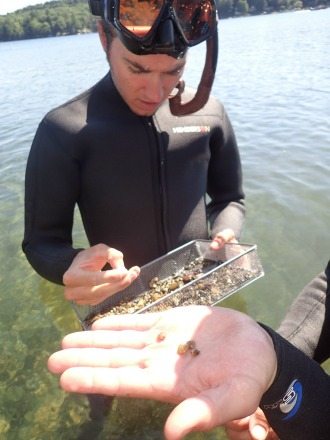
[I]nvasive Asian clams have established a population in one of the largest water bodies within the state’s borders.
The foreign bivalves have probably lived in Lake Bomoseen, which is in Castleton and Hubbardton, for at least a year, officials with the Vermont Agency of Natural Resources said.
State authorities are asking boaters to clean, drain and dry their equipment after use to halt the spread of the Asian clam and other unwanted aquatic species.
Asian clams have been found in locations near Lake Bomoseen, including Lake George, New York, but the Lake Bomoseen population is the first found in Vermont waters.
The Asian clam hails from the eastern Mediterranean and from temperate areas of Asia, according to the Vermont Department of Environmental Conservation. It has been found throughout the eastern United States, and populations are now being seen in western states as well.
The hermaphroditic creature needs only one of their numbers to start a population, and the species breeds quickly, scientists say.
The clams can crowd out native species, and in doing so could worsen the algae blooms that have grown increasingly common within the state, DEC scientists said in a release Tuesday morning. Like zebra mussels, they can also clog intake pipes to lakeside homes, industrial water systems and irrigation canals.
Lake Bomoseen’s Asian clams were found by a summer natural resources instructor at a conservation camp that Vermont’s Department of Fish and Wildlife has on the lake.
Agency of Natural Resources scientists surveyed the lake following the clam’s discovery and found the clam’s numbers limited to a single area in southwestern part of the lake. The affected area covers 14 acres, with water up to 8 feet deep.
Officials say they can’t determine precisely how long the clams have been in Lake Bomoseen, or who introduced them. Large adult clams of around an inch in diameter and high population density indicates their presence since at least last summer, ANR scientists said.
