

Editor’s note: This story by Rob Wolfe first appeared in the Valley News on Aug. 3, 2016. Valley News staff writer Matt Hongoltz-Hetling contributed to this report.
WHITE RIVER JUNCTION — Democratic gubernatorial candidate Matt Dunne on Wednesday defended his stance on the siting of large wind-energy projects, saying what critics have labeled a flip-flop was simply a “clarification” of his position.
Just days before the Vermont primary on Aug. 9, controversy is swirling around a statement Dunne made last week that some observers interpreted as a new and stronger endorsement of local control over wind siting. The kerfuffle has cost Dunne the endorsement of author and climate change activist Bill McKibben, and has drawn attacks from his rivals for the Democratic nomination, Sue Minter and Peter Galbraith.
On Friday, Dunne released a statement in which he voiced support for community votes on wind proposals — referendums that he said should be respected.
“If a town says no to a large industrial wind project, I would use all the power of the governor’s office to ensure that is the end of the project,” Dunne said in the statement. “I will ensure that no means no.”
What, exactly, that meant is up for debate. Dunne said that his position had not changed: as he told a Valley News reporter last month, “If a town votes to not have a wind turbine in their town, I’m not going to support (the turbine).”
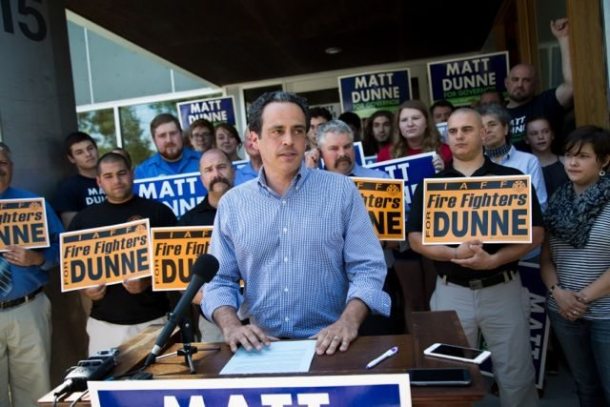
Dunne sought to put the matter to bed at a Wednesday news conference outside his White River Junction campaign headquarters.
He left much of the defense to his campaign manager, Thetford native Nick Charyk, who called the allegations “unfounded, unfair and outright false.”
Then, with an audible sigh, Dunne took the podium.
“We’ve been at this for over a year,” he said.
It has been a long campaign, one that he purposely began with a listening tour, Dunne told the crowd of supporters and reporters. Montpelier isn’t hearing local communities’ concerns, he said, and he hopes to correct that.
“And that’s how we need to embrace moving Vermont into the next era,” he said.
“Because if we are going to actually make Bernie (Sanders’) vision a reality here in the state of Vermont, it’s going to take having a governor who’s not going to always tell you what you want to hear, who’s willing to further and further clarify as people ask more and more questions about where you stand, and it’s got to be someone who you know will listen, to their core.
“That’s the governor that I want to be.”
Speaking to reporters afterward, Dunne lamented the confusion surrounding his policy, and said that he was “absolutely in favor of wind.”
“I did not deliver that message in the way that I would have liked to, in retrospect,” he said.
Early voting already has begun, and Dunne also expressed regret about the possibility that some people who cared about this issue might have cast ballots for him without understanding his stance.
“I feel badly about that,” he said. “I think that it is unfortunate that my position wasn’t made clear — clearly, even after I tried to make it clear, it wasn’t completely clear.”
He added that he was “glad” the clarification had happened before the primary, giving voters whose top issue is wind siting the chance to know his views.
He struck back against outgoing Gov. Peter Shumlin, a fellow Democrat who on Monday accused Dunne of not telling the truth when he said his stance was the same as Shumlin’s.
“I found his comments to be incredibly unfortunate,” Dunne said of Shumlin, adding later, “maybe he has flip-flopped or gone someplace else on that particular position.”
Shumlin this spring signed a bill that gives towns more say in where wind projects might be sited, but still gives final authority to the quasi-judicial Vermont Public Service Board.
Pointing back to prior interviews, Dunne said he had been clear that he does support wind power but that it should go forward only if a local community takes an affirmative vote.
“And you know what?” he added. “I had not been aware that it suddenly was a litmus test as to whether or not someone was committed to tackling climate change.”
Voters will decide the gubernatorial primaries on Tuesday. In the Republican field, Lt. Gov. Phil Scott and former Wall Street executive Bruce Lisman are jockeying for their party’s nomination.
