

Editor’s note: This commentary is by Dan Jones, of Montpelier, who is a managing partner of Net Zero Vermont Ventures and former chair of the Montpelier Energy Advisory Committee.
On July 11 we announced an independent citizens’ engagement effort to help Montpelier reach its laudable goal of having the city be net zero in carbon pollution by 2030. To do this, we have created a new initiative: Net Zero Vermont Inc., which is dedicated to helping create a carbon free future for Vermont. We have been able to mobilize resources to support a unique design competition which is offering a $10,000 prize for the best architectural design which can help citizens imagine a sustainable Montpelier in 2030.
This effort is one strategy to fight back against the 70-year-old silent invasion in which our automobiles have gradually occupied the majority of our city’s public spaces.
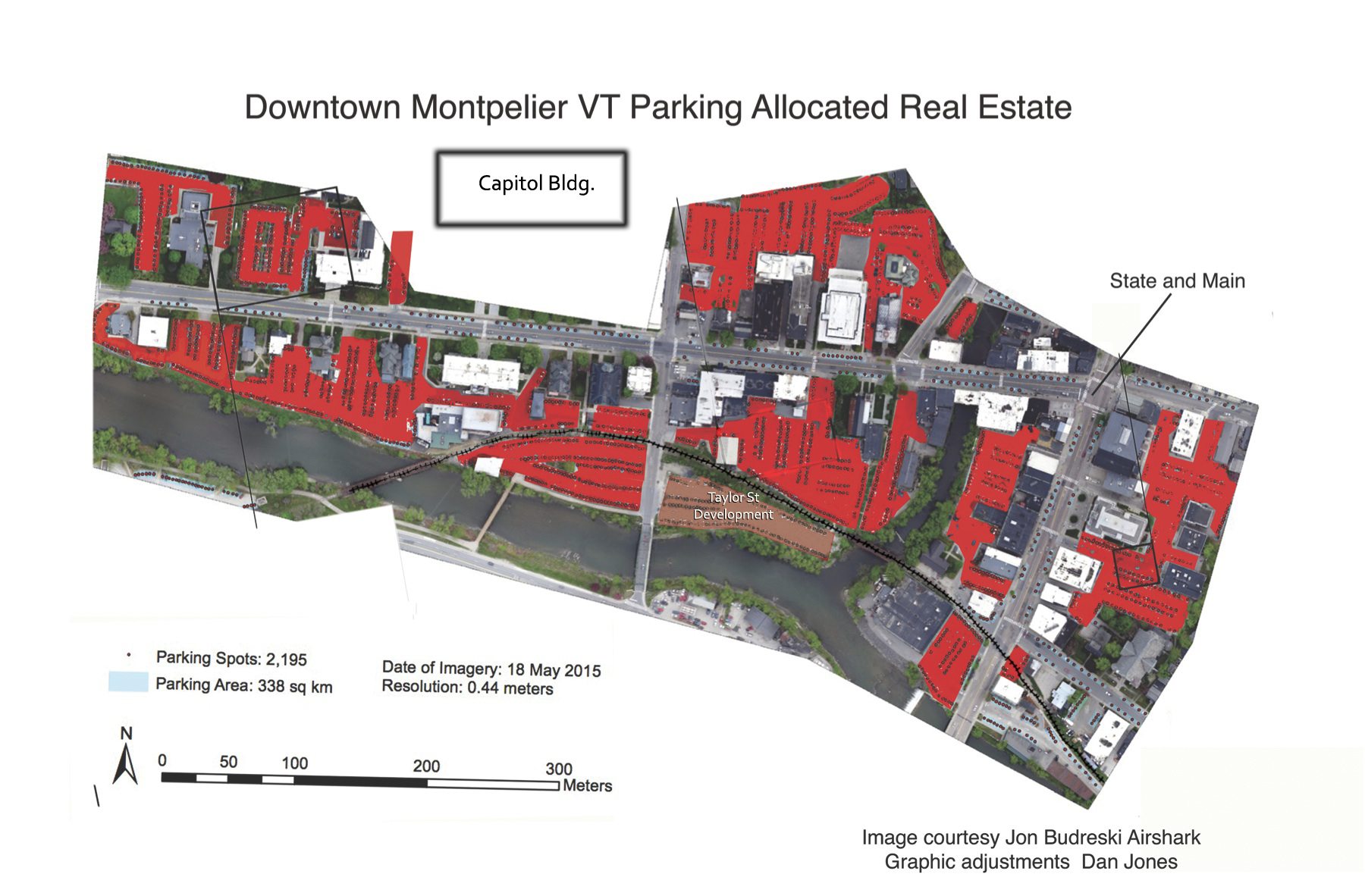
Below you can see aerial view of Montpelier where the red spaces show how a majority of our downtown real estate is dedicated to the care and feeding of parked cars. Besides convenience for their drivers, these parking lots provide little public benefit and a lot of toxic runoff to the river.
We believe there could be a smarter vision of using this wasted real estate to create a livable center city. A new positive vision could help us all generate the energy needed to support a new way of living in our classic hometown.
In other livable cities, massive parking lots are located outside the town center which frees the downtown land for more productive uses such as — tax-generating, high-density housing and commercial space. Such cities also make use of their riverfronts for recreation rather than walling them up to support more parking.
The aerial view has been persuasive to so many folks who, once they see it, understand that so much prime real estate, dedicated to housing our carbon-spewing autos is not a wise use. So much parking needs is a product of a wasteful cheap energy past, which must be changed to make way for a low carbon sustainable new city center. We need to create a place where multiple generations can live together downtown for generations to come.
If we want to move to a sustainable future we are going to embrace change at some point OR we will find that we will have change forced upon us.
Our competition will go out to architects and designers throughout the state and the country who, we have been informed, would like an opportunity to imagine what a whole small city could look like in a post-carbon future. But that is the starting point.
Our real challenge is to help people to understand and accept that change in their current environment is difficult. We all tend to like what we know because, well, that is what we know. However, if we want to move to a sustainable future we are going to embrace change at some point OR we will find that we will have change forced upon us. A lot of research in social dynamics has shown that people need a concrete vision of what could be better in order to actually move to change the present.
If we want to have a Net Zero Montpelier, then a positive vision has to be presented in such a way that our citizens can see it and yearn for the improved lifestyle that would come with the needed changes. What better way of getting a powerful positive vision than to invite the best designers you can find to help you create it. That is what we are doing with this effort.
Visit our website www.netzerovt.org if you would like to know more about this competition and how it will operate.
Once we get the initial entries in September we will be organizing a public viewing and voting process to engage the community in embracing the best designs. We will even have Ben & Jerry’s ice cream available to those who participate. The competition will progress through two rounds of public participation and culminate with a final award in November.
An effort on this scale takes more than a village. Many members of our growing community have become engaged supporters. The Montpelier Energy Advisory Committee has been a key partner in thinking about the challenges since it is charged with leading the Net Zero Montpelier effort. Kate Stephenson, its chair, had this to say: “We are excited to see the creative designs that will result from the Net Zero Vermont Sustainable Montpelier Design Competition. The new ideas and innovative solutions will help define a positive path towards meeting our 2030 goal.”
One of our key corporate sponsors is David Blittersdorf of All Earth Renewables. He is also looking at some of the transportation business opportunities that would arise should we create our new sustainable city. He believes that this competition will “generate the new ideas and innovative solutions to help define a positive path towards meeting our 2030 goal.”
Even that ever popular Vermont brand, Ben & Jerry’s is on board. Not only are they providing a grant to the effort but they are providing access to their unique creativity and social media expertise to making this work. Imagine our excitement when we got this statement of support from their CEO Jostien Solheim: “Net Zero Vermont is the kind of leadership the world needs to move from good intentions to real action on climate. At Ben & Jerry’s, we are deeply inspired by this effort to redesign Vermont’s capital city to be cooler in every way. It’s going to benefit everyone with a stake in Vermont’s future – and far beyond. This gives me renewed hope that we can – and we will — win the fight against climate change.”
Admittedly, some people have suggested to me that we are more than a bit crazy to take on the parking issue in a city that is constantly complaining about the lack of parking. We are told that no one believes that Montpelier could change its transportation and land use habits to accommodate a real Net Zero future. I beg to differ. We have found a whole lot of supporting groups who share a vision for a low carbon livable future. We are launching this effort in complement to their work and commitments. I am sure you will be hearing from many of them in the future.
Whether it is the new urbanists creating pocket parks and arts streets to the environmental stewards at VPIRG or Vermont Natural Resources Council or the promoters of a climate change economy at the Vermont Council for Rural Development, there are a lot of folks who believe that we can and will create a sustainable future here. It really is a village commitment to this effort.
