

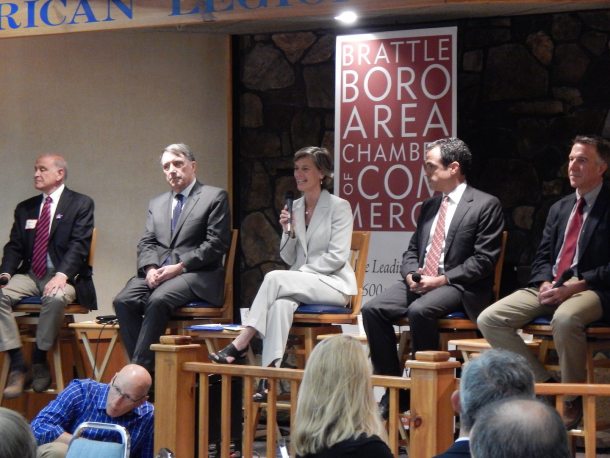
Phil Scott and Sue Minter tied with the highest favorability ratings in a new Vermont Public Radio poll that found Hillary Clinton will easily win Vermont in November and almost everyone knows someone who has been addicted to opiates.
Scott, a Republican, and Minter, a Democrat, both had 58 percent when their ratings for “very favorable” and “somewhat favorable” were combined. But Scott’s name recognition was significantly higher than Minter’s, 86 to 63 percent. Both also had unfavorable ratings of 13 percent.
Scott said he was “honored” by the results, which also showed Vermonters see the economy, jobs and the cost of living as the biggest issues facing the state.
Minter’s campaign said of the poll, “It mirrors what we see on the trail.”
Scott’s primary opponent, Bruce Lisman, had favorability ratings of 36 percent and unfavorables totaling 33 percent, while 31 percent had no opinion. However, 37 percent of those polled hadn’t heard of him, although he has poured hundreds of thousands of dollars into television advertising.
The Lisman campaign said the poll numbers indicated he was “closing the gap” with Scott and did well with Republicans polled.
Matt Dunne, one of four other Democrats running, had a 50 percent favorable rating and 16 percent unfavorable. He had the highest name recognition of the Democratic field at 73 percent. Peter Galbraith, another Democrat, had a 39 percent favorable rating and 24 percent unfavorable. A chunk of Vermonters had no opinion about either Dunne and Galbraith: 34 and 36 percent, respectively.
Only 8 percent of Vermonters polled had heard of Democratic candidate H. Brooke Paige. Of those, 16 percent viewed him favorably. Thirteen percent had heard of the other Democrat running, Cris Ericson; of them, 28 percent had a favorable opinion.
Dunne said the numbers showed he has the best chance to defeat Scott.
In the race for lieutenant governor, Shap Smith had the highest name recognition and favorability, with 59 percent name recognition and 51 percent approval. Following closely behind was Progressive David Zuckerman, who is running in the Democratic primary, who had 42 percent approval and 58 percent name recognition. The third Democrat, Kesha Ram, had the highest favorability rating at 58 percent, but her name recognition was only 16 percent, below the name recognition for gubernatorial candidate Bill Lee.
On the Republican side, lieutenant governor candidate Randy Brock, who does not have a primary, has 55 percent name recognition, favorability ratings of 31 percent and unfavorables of 30 percent. As with many of the candidates, “no opinion” was the leading category; in Brock’s case, that number was one of the highest, 39 percent.
Ram said the poll showed she had a lot of work to do before the Aug. 9 primary, while Zuckerman said it showed how close the race is between him and Smith.
“I’m the least known and the most liked” was Ram’s best interpretation of the numbers. Zuckerman said: “It shows the race is neck and neck.” Smith said the numbers were a good sign, particularly having entered the race only in May, months after the other two Democrats.
VPR partnered with the Castleton Polling Institute for the survey, where most questions were responded to by 637 people, half on landlines and half on cellphones. VPR News Director John Dillon said the organizations focused on measuring recognition and favorability, as opposed to asking how people planned to vote, because primaries, with so few voters, are more difficult to predict than general elections.
In the presidential race, Clinton held a comfortable lead over Republican Donald Trump, 39 to 17 percent. But 53 percent of those polled said they had supported Bernie Sanders in Vermont’s March primary, while only 8 percent said they had supported Clinton. Nine percent said they had supported Trump, who won the state’s Republican primary by a narrow margin.
In polling on the November presidential election, 26 percent said they would vote for “someone else” besides Clinton, Trump, Libertarian Gary Johnson or Green Party candidate Jill Stein.
According to the poll, Democratic Sen. Patrick Leahy is way ahead in his bid for re-election, outdistancing Republican Scott Milne 62 to 23 percent.
On issues, 94 percent of respondents said they “personally know someone who has struggled with opiate addiction,” in most cases either a family member, close friend or co-worker. Eighty-nine percent characterized opiate addiction as a “major problem” in Vermont.
More than half of those polled, 56 percent, said they would rather see the marijuana legalization question decided by referendum than through legislative action, which was supported by 29 percent. There was no direct question on support for legalization.
Sixty-five percent said the state needs an independent ethics commission; 22 percent say no.
A number of questions asked about refugee resettlement, with 58 percent of respondents saying they would support locating refugees in their community, while 27 percent were opposed. In another question, 77 percent said they thought their community would be welcoming to newcomers, while 11 percent thought it wouldn’t be.
Asked if refugee resettlement would have a positive or negative impact on Vermont, 45 percent said positive and 35 percent said negative. A drain on public resources was what those polled saw as the biggest drawback to refugee resettlement.
