

(Jon Margolis is VTDigger’s political columnist.)
[I]n this matter of the significance or lack thereof of the purloined Democratic National Committee emails, here is the fact to keep in mind: If your worst problem is opposition from the Democratic National Committee, if only the DNC stands between you and the realization of your hopes and dreams, you are the most blessed of men or women. All obstacles before you are easily surmounted.
If anything, this reality was confirmed when WikiLeaks released thousands of those emails just as the Democratic National Convention was about to begin in Philadelphia. The messages among senior committee staff left little doubt they hoped Hillary Clinton, not Bernie Sanders, would win their party’s nomination.
And we didn’t already know that?
But the emails left even less doubt that those staffers didn’t actually do anything to help Clinton or hurt Sanders.
Not because they had too many scruples. Only because they had too little power. They couldn’t have done anything that made any difference even had they tried.
Which probably explains why they didn’t try.
Consider the one truly objectionable comment found in the emails, the suggestion by Brad Marshall, the DNC’s chief financial officer, that it might hurt Sanders in West Virginia and Kentucky if “we get someone to ask his belief. Does he believe in a God. He had skated on saying he has a Jewish heritage. I think I read he is an atheist. This could make several points difference with my peeps.”
The email does not name Sanders, but no one else with a “Jewish heritage” was running.
Marshall, who apparently comes from that part of the country, was wrong when he said Sanders had “skated” about his Jewish heritage. He had in fact been quite open about it. But he had also avoided talking about his own beliefs, if any, and Marshall was probably right about Sanders being an atheist.
Whether that might have cost Sanders any votes in West Virginia and Kentucky seems doubtful. He won West Virginia and lost Kentucky by less than 2,000 votes, and the voters there, not being stupid, quite likely knew and didn’t care that he was not religious. What is important is that Marshall’s suggestion was ignored. Nobody in those states (or elsewhere) ever brought up Sanders’ religious convictions or lack thereof.
Nor does it seem that anybody acted on the suggestion of DNC communications official
Mark Paustenbach that reporters be urged to write stories saying the Sanders campaign was “a mess.”
And what difference would it have made had anyone acted on it? Stories like that appear frequently during political campaigns and rarely have any impact.
The released emails were composed in May, after Clinton had effectively wrapped up the nomination. Had the DNC been serious about trying to scuttle the Sanders campaign, it would have started plotting months earlier. The emails were also written during a time when Sanders and his supporters were regularly attacking the DNC. No wonder its staffers were miffed at him.
Not that starting earlier would have been very effective. Like its Republican counterpart, the Democratic National Committee doesn’t have much power. Its purpose is to raise money and issue news releases praising its own candidates and positions and excoriating the opposition.
It does establish the rules for conducting the nominating system, but it does that long before the campaigns begin. The rules for this campaign were adopted years ago, and while some of them may have been a disadvantage to Sanders (superdelegates, most of whom were for Clinton), others, such as caucuses that attract small numbers of the most ideological participants, helped him.
The DNC also has the power — or more accurately, asserted the power — to control the number and scheduling of candidate debates. In this case, the committee and its chair, Florida Rep. Debbie Wasserman Schultz, do seem to have tried to load the dice in Clinton’s favor.
Not only did the DNC arrange for only five debates, it scheduled them on weekend nights, as if designed to hold down the size of the audience. The assumption seemed to be that fewer debates watched by fewer people would help the front-runner, Clinton.
But there is no reason to think it did. To begin with, it turned out that Clinton is rather good at these forums. So is Sanders, but he was not notably better. Those who watched saw two capable contenders.
Besides, the political impact of candidate debates rests as much on the news coverage of them as on the reactions of those who watch them as they occur. The reason almost everyone can remember Sanders telling Clinton that “the American people are sick and tired of hearing about your damn emails” isn’t that almost everyone was watching the debate. It’s because that sound bite was repeated endlessly on TV news programs.
Clinton did not win the nomination because there weren’t more debates. She won it at the ballot box, primarily by piling up huge majorities — and hundreds of delegates — among African-American and Hispanic voters, and by winning almost all the big states: New York, Florida, Texas, California, Pennsylvania, Illinois.
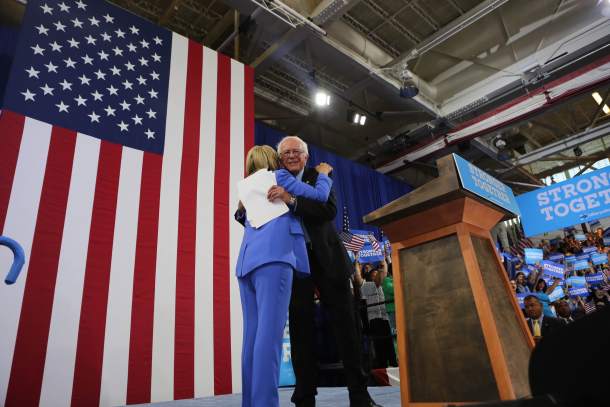
Sanders knows that. He knows he lost fair and square. That’s why he has endorsed Clinton and on Monday urged his supporters to elect Clinton and running mate Tim Kaine.
Most of his supporters seem to know it, too. Polls show large majorities of them are planning to vote for Clinton. But a few do not. Many of them have descended on Philadelphia, where some of them booed their candidate’s call to support Clinton.
Perhaps Sanders, who has lost elections before, understands that while losing can be honorable, whining about it is not.
Would that all his followers understood that, too.
The disclosure of the emails forced Schultz to resign, which she should have, and gave TV reporters the chance to revel in the problems of the Democratic Party created by what many of them called a scandal.
They’re setting a low bar for what constitutes a scandal. Nobody here stole any money, broke a law or was caught in flagrante delicto. This was an embarrassment caused by a few rather foolish people who put some of their sillier ideas in print, or in pixels that got printed.
And finally, there is one more nonscandal here, or at least a development that is not yet a scandal. This is the suggestions of the Clinton campaign and the DNC that the emails were hacked by Russians, perhaps in cahoots with the Russian government, indicating that Vladimir Putin is for Donald Trump and is meddling in an American election.
Few would put this past Putin, who — unlike the Democratic National Committee — does have real power.
So it’s possible. But it is also — at this point — speculation. Overreacting to one sliver of this flapette ought to be enough for one week.
