


(Editor’s Note: VTDigger is publishing profiles of the three lieutenant governor candidates in the Democratic primary Aug. 9. Republican Randy Brock isn’t included because he doesn’t face a primary. In addition, Boots Wardinski qualified for the ballot as a Progressive.)
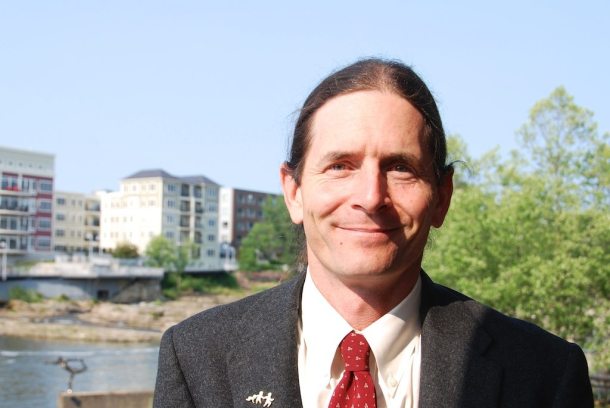
With his tall frame and long brown ponytail, Chittenden County Sen. David Zuckerman is instantly recognizable.
In the Statehouse, he stands out for his long-held Progressive stance. At the Burlington farmers market, he’s a consistent presence at his produce stand. And at Fourth of July parades, he’s the guy who hands out carrots.
Now the Hinesburg organic farmer is running against two others for the Democratic nomination for lieutenant governor.
Zuckerman says the job is “quite unique,” because it is positioned between the policymaking of legislators and the administration of the governor’s office.
The position, he says, offers an opportunity to facilitate greater public participation in the lawmaking process. If elected, he plans to focus on “making sure that the broader public is brought into the system more than it is right now,” he said.
If he is elected, Zuckerman says he will invite Vermonters into the lieutenant governor’s office and coach them on how to influence legislators. He would also travel to communities across the state to help people better connect to the legislative process, he said.
Zuckerman campaigned early in his political career for Bernie Sanders and his philosophy of political inclusion is strongly influenced by the Vermont senator and Democratic presidential candidate.
“People involved in the process can make the process respect and incorporate the people,” Zuckerman said.
Meanwhile, in fulfilling the standard duties of the lieutenant governor — presiding over the Senate and chairing the Committee on Committees — Zuckerman said he would focus on “respecting all members of the Senate and what they bring and who they represent.”
Zuckerman touts his record during 18 years in the Statehouse as evidence that he can effectively incorporate the broader public into lawmaking.
Zuckerman was first elected to the House of Representatives in 1996 as a Progressive and served there through 2010. During that time, he was on the Natural Resources Committee, the Ways and Means Committee, and the Agriculture Committee, which he chaired for four years.
He was elected to the Senate representing Chittenden County in 2012 and has served there since. He sits on the Education Committee and is the vice chair of the Agriculture Committee.
Through Zuckerman’s legislative tenure, he worked on several key and controversial issues, including labeling of genetically modified products, same-sex marriage and end-of-life choices. He has also been an advocate for legalizing marijuana.
Looking ahead, Zuckerman said that, among several key issues, one of his top priorities is developing the state’s rural economy.
“We are facing the same challenges as 35 other states, but I think we have a unique opportunity,” he said.
He said he sees real potential to build up economic development through agricultural and forestry products in Vermont, between “Vermont’s brand” and the proximity to large population bases in nearby states.
Expanding access to broadband is a key component of his plan to foster economic growth in rural areas. Zuckerman said he sees an opportunity to pay for the expansion of the state’s telecommunications network by using resources generated by marijuana legalization.
Zuckerman also said health care reform is one of his top priorities.
“We still have a broken system,” he said.
He supports implementing universal health care, which he says would improve the quality of medical care, save money and boost Vermont’s economy. Under the current system, he said, potential entrepreneurs may be dissuaded from striking out on their own because they will lose employer-based health care coverage.
Health care reform is “a big issue,” Zuckerman said. “We’re not going to have universal health care in two years.”
However, he emphasized that it is an iterative process and he has a record of effectively taking on long-term policy projects.
“I am not a two-year election cycle thinker,” Zuckerman said.
He supports some health care proposals that are already in early stages. One proposal, Dr. Dynasaur 2.0, would expand the childhood health care program to include people up to age 26.
He also wants to establish a system of universal primary care, which he said could be a big step toward a longer-term goal of universal health care.
Another top priority is tackling issues related to climate change, Zuckerman said. Changing weather patterns have big impacts on many aspects of life in Vermont, he said, including the tourism industry as well as maple and other agricultural production.
Zuckerman sees housing and transportation as key issues to address in the face of climate change.
He would like to look at implementing more public transportation options as well as working to cluster housing around transit routes. That could reduce both the number of vehicles on the roads and the fragmentation of forestland by housing developments, he said.
If Zuckerman were to assume the governorship, he said, he would not necessarily keep the full Cabinet in place — as Democrat Howard Dean did when he came in after Republican Gov. Richard Snelling’s death.
Zuckerman said he would look at each Cabinet member and weigh the person’s performance. “I think it’s a case-by-case basis,” he said.
“It ultimately really depends on the skill sets of those individuals,” Zuckerman said.
He has raised more than $150,000 so far in his campaign, including $85,000 in the last reporting period. He said he has “plenty of money to run an effective campaign.”
