

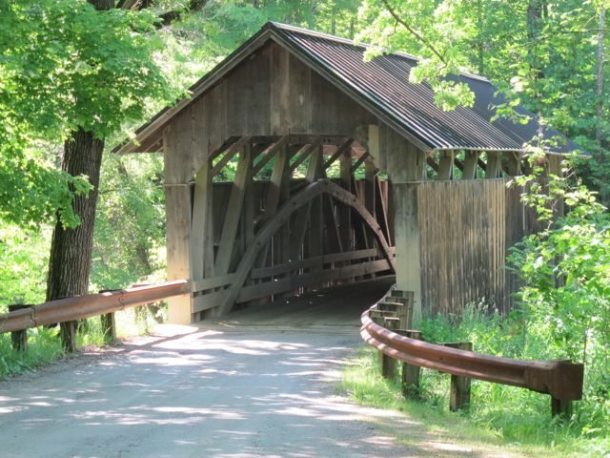
[V]ermont’s covered bridges were built to be used. The Rutland Railroad Bridge in Shoreham and the Fisher Bridge in Wolcott carried trains over rivers. Montgomery’s six surviving bridges bore the weight of logging trucks. The Holmes Creek Bridge in Charlotte, originally used for hauling hay across a creek, later allowed apples to be moved from the Holmes family’s orchard to a dock on Lake Champlain. From there – according to Charlotte’s 2016 Town Plan – the apples were shipped to cities throughout the United States, and to London.
In the 19th century, around 700 covered bridges were built in Vermont. Fewer than 200 survive, but more than half of those are still in use, says Mark Sargent, the project manager for many of VTrans’ covered bridge rehabilitation projects. (One of the oldest in use is the two-lane Taftsville Bridge, built in 1836, which spans the Ottauquechee River in Woodstock.)
Despite the losses over time, Vermont has the largest concentration of covered bridges in the country, according to the National Park Service. But preserving and maintaining these cultural icons as part of the state’s transportation system is complicated, expensive, and sometimes unpredictable, as recent examples show.
In March 2013, repairs began on the Quinlan Bridge, the “lower” covered bridge on Lewis Creek in Charlotte. The work was to be finished by late July, and the repairs were originally estimated to cost $872,000. The total came to $1,349,747. (The federal government typically pays 80 percent of the cost of covered bridge repairs and the state 20 percent, or less when towns assume a share.)
So what happened?
Serious structural problems became evident when the bridge was opened up. The concrete bearing seats that hold up the bridge were crumbling, and the backwalls – the top part of the abutments that connect with the road – weren’t attached to the bearing seats. And this was just the beginning. As work progressed, more and more problems were revealed. The bridge eventually reopened in November 2013.
Now repairs are about to begin on the Seguin Bridge on Lewis Creek, a few miles upstream from the Quinlan Bridge. The estimated cost of its rehabilitation is $881,650.
Here, too, there are unknowns. “We know the top (downstream) chord is completely rotted out,” Sargent said. “The carpenter ants like to get up there – they like a nice, warm spot with moisture.” He added that both upper chords will be replaced because “we just have to assume that if the downstream chord is compromised, the upstream chord is compromised.” Other damage may be found.
The Charlotte structures are two of the state’s nine remaining multiple kingpost Burr-arch bridges. The Quinlan Bridge, built in 1849, and the Seguin Bridge, built in 1850, are thought to have been made by the same builder, an unknown craftsman whom Joseph Nelson, president of the Vermont Covered Bridge Society, describes as “singularly talented.”
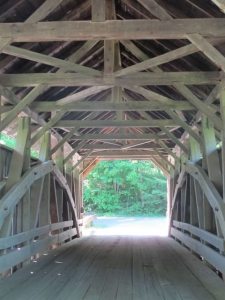
“Gilbert Newbury, a structural engineer trained in timber bridges, points out that very sophisticated and intricate construction details make these two the best built wooden bridges in the state,” Nelson says in his book, “Spanning Time.” Newbury says the “intricate ‘keys” used in the bottom chords, the “elaborate roof framing systems (that) include ‘birds-mouth’ notches in the rafters and beams,” and the “the top lateral braces … set in an elliptical shape, very difficult to do, and not copied elsewhere.”
Jan Lewandowski, one of New England’s premier timber framers, says he frequently visits the Seguin Bridge to admire “the crossing curved lines of overhead lateral bracing.” The bridge, he says, “is one of the most intact and beautiful, oldest, well-built and sophisticated bridges in the state.”
Another exemplary covered bridge, the Brown Bridge, spans the Cold River in Shrewsbury. A celebration will be held there on July 5 to celebrate its designation as a National Historic Landmark. National Historic Landmark.
Built in 1880, the Brown Bridge is an outstanding example of a very different type of design – the Town lattice truss. This design, patented in 1820 by Connecticut architect Ithiel Town, uses closely spaced planks fastened together with trunnels (wooden pegs) to make a diamond-like lattice of overlapping triangles. The lattices form the trusses – the framework that supports the bridge. Lattice trusses weigh less and could span longer distances than post and beam trusses, and they were cheaper to build because they required less skilled labor.
The Brown Bridge in Shrewsbury was built by Nichols M. Powers, a prolific, a self-taught builder born in Pittsford who constructed his first covered bridge at the age of 19. (Powers also built the longest single-span wooden bridge in the world, a 232-foot-long bridge in Blenheim, N.Y., now destroyed.) Slate roofs were once common on structures in the Rutland area, but today, the Brown Bridge is thought to be the only surviving covered bridge in the country with an original slate roof.
Some decay and structural problems were found in a 2008 VTrans inspection of the Brown Bridge, and in 2011 the siding suffered damage in flooding caused by Tropical Storm Irene. The bridge’s recent VTrans rehabilitation included repairs to the truss lattices and stone masonry abutments, replacement of the siding and some roof slates, and a few other repairs. Despite having been through a flood, only a small amount of additional damage was found when the siding was taken off: Some fixes were made to support a sag. The cost of repairs to this bridge was a modest $414,887.
The bridge dedication will take place Tuesday, July 5 from 4-6 p.m. at the Brown Bridge on Upper Cold River Road, near the intersection of North Branch Road. Parking is on Cold River Road west of the bridge. Among the dignitaries attending will be A. Nicholas Strom-Olsen, the great-great-great grandson of Nicholas Powers.

