

(Editor’s note: Jon Margolis is VTDigger’s political columnist.)
[O]K, it’s over.
Bernie Sanders has not formally conceded or “suspended” his campaign for the Democratic nomination for president. But he announced that he plans to vote for Hillary Clinton, a tacit acknowledgment that she — not he — will be the nominee.
That means he has conceded, if not yet formally. The suspension will come in due time.
For now, a look back at the improbable 13 months of the Sanders campaign is in order.
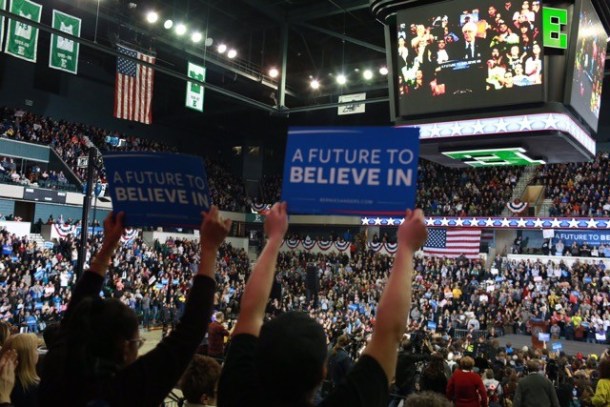
It was quite a ride, often a wild ride, with some of the candidate’s more avid supporters getting wilder than he. But for a few weeks — after the New Hampshire primary March 1, after the Michigan primary a week later — it appeared not all that foolish to speculate that Sanders could win the nomination, meaning he could win the presidency.
A dangerous development. It inevitably infects the candidate with “presidentialitis,” a disease for which the only known cure, as a fellow victim, the late Arizona Rep. Morris Udall said long ago, is embalming fluid. So Sanders, his campaign staff and his supporters spent March and part of April in a state of happy self-delusion.
That should have ended with Clinton’s big win in New York on April 19. But see above about presidentialitis and cures therefore, a pathology aggravated when Sanders won most of the contests in May. Maybe, thought his supporters (and probably he himself), just maybe, if he could win California, somehow enough superdelegates could be persuaded to abandon Clinton.
No, that was never going to happen, even had Sanders won California, and New Jersey to boot. He lost both of them.
And still he would not officially concede. By then, he seems to have figured out that one of his tasks was to channel the enthusiasm of his followers, some of whom had slipped the bonds of rationality. Consider the faction convinced that Sanders really won some of the primaries that he lost because the early exit polls had shown him ahead, so the official results must have been rigged by the Democratic establishment, because exit polls are close to perfect.
Yup, that’s why they showed that John Kerry had won the 2004 election.
But especially in an era when so many people read or hear only the accounts and analysis that confirm their prejudices, enthusiasm can be hard to contain. It extends now and then to journalists.
Thus, in a story widely promoted by Sanders supporters, the reliably leftish and often sprightly magazine In These Times earlier this month published “a secret history of superdelegates,” a revelation (or so it claimed) of the previously “unpublished” transcripts of the Hunt Commission, which rewrote the Democratic delegate selection rules in 1981.
The transcripts had indeed been unpublished, because there had been no reason to publish them. But they were always available to anyone who wanted to see them. And they were transcripts of proceedings held entirely in public. Every meeting of the commission chaired by then-North Carolina Gov. James Hunt was covered by a battalion of reporters (I was one of them). Every rule change was vigorously debated and voted on for all the world to see. Whether superdelegates are a good idea or a bad one is one of those many subjects over which people may legitimately disagree. They did not emerge as part of a secret cabal.
And good idea or bad, those superdelegates did not determine the outcome. Had there been no superdelegates, there would have been 4,052 delegates, rather than 4,766, meaning a candidate would have needed 2,027 for a majority. Clinton won 2,220.
One of the ironies of the Sanders campaign is that it attracted the support of a passel of intellectuals — some of them very impressive intellectuals — even though the literary quality of his speeches was … well, it wasn’t. A Sanders speech was full of tired cliches about “the billionaire class” and “what this country is all about.” No one could doubt his sincerity or authenticity. He meant every word he said, and most of it was accurate, or at least debatably accurate.
Gracefully expressed with some sense of the rhythm of the language? Not so much. Sanders can speak clearly, plainly and effectively, as he did in a C-SPAN interview last week when he talked about being moved by voters willing to discuss their economic distress in public. From the podium, though, he was all substance, not much style.
Perhaps the least impressive of the pro-Sanders intellectuals (except for Cornel West, once an intellectual but now just a celebrity) has been professor Seth Abramson of the University of New Hampshire, who wrote for the Huffington Post and other outlets. It’s not that Abramson has no credentials. In addition to being a professor, he’s a lawyer, a poet, an editor and, by his own description, a “metamodernist” (don’t ask).
In early April he wrote of Donald Trump that it was “clear he won’t be the Republican nominee.” A week later he proclaimed it a “near statistical certainty” that the Democratic convention would be contested.
Nobody’s perfect. Some are coherent. Those who are do not write that they “see in (Sanders’) political methodology evidence of the metamodern, just as I know for certain when I hear Clinton’s cynical incrementalism that I am in the presence of a postmodern political ethos.”
Translations into the English will be welcome.
Usually, when campaigns are over, they are over. This one may not be. The Washington Post reported Monday that Sanders, his wife and top aides have been talking about “launching a grass-roots organization to harness the energy of his supporters.”
Losing campaigns often lay similar plans. Usually, not much comes of them. But Bernie Sanders and his supporters have made a bigger splash than most campaigns that fail to win their nominations. He attracted millions of supporters, and because so many of them are young, they have a lot of energy that can be harnessed.
By saying he will vote for Clinton, Sanders appeared to be starting the process of persuading those supporters to follow his lead. They already seem to be. According to a new Washington Post-ABC News poll, Sanders voters are moving behind Clinton at a faster rate than her voters switched to Barack Obama in 2008.
The ride Bernie Sanders engineered last year may not be entirely over for another 27 days, when the Democratic convention opens in Philadelphia. The rest of it could include an obstruction or two, but the wild part is over.
The impact? That could last quite a while.
