

[W]hen Jack Hanson, a UVM senior who is president of one of the many environmentally focused student clubs at the school, went looking for money so club members could attend a solar panel installation class, the source seemed obvious.
Hanson says he and his club, the Renewable Energy Network, went to the Clean Energy Fund, a money pool they had used before. The fund was set up in 2008 after a massive student effort ultimately gained approval from the board of trustees. The trustees authorized the fund to take $10 every semester from each student — bundled in a comprehensive fee charged to every medical, graduate and undergraduate student — and in turn pay for campus sustainability projects.
Budget documents show that over the years the Clean Energy Fund has supported the installation of solar panels on UVM buildings, brought speakers like Al Gore to campus and helped students build a hybrid car from scratch, among other things. By the end of the 2014-15 fiscal year, the fund had taken in $1.6 million and expended $1.2 million.
Yet since May 2015 the fund has been under review by the university and hasn’t supported any new projects.
Its status has prompted the Renewable Energy Network to question whether the fund is remaining true to its founding principles.
“The leadership is no longer comprised of students and much of the funds, taken from student tuition, are sitting idly,” the group wrote to the fund’s leaders in a Nov. 10 email.
A draft review of the fund by UVM professor and public policy researcher Richard Watts found that roughly 20 percent of the Clean Energy Fund money has been spent administering it — primarily by students — despite a 10 percent limit on administration costs in the founding documents.
Richard Cate, the university’s vice president for finance and treasurer, disputes the finding. He said student time isn’t considered an administrative expense at UVM.
“In the case of the Clean Energy Fund,” Cate said, “what we do classify as administrative falls well below the 10 percent limit established by the fund’s founding documents.”
Although the fund has stopped taking new proposals from students, it hasn’t stopped collecting their money — or paying for its administration. Currently $585,000 of student money sits in its coffers, according to Cate. When students come back to campus in the fall, the fund will get another quarter million for that semester.
Gioia Thompson, director of the Office of Sustainability, which oversees the fund, was unavailable for comment due to a long-term illness, according to a university spokesperson. Her deputy, Mieko Ozeki, left in late April for a new job. University officials said the Clean Energy Fund is in transition and will eventually restart under a new office.
Student group asks for money
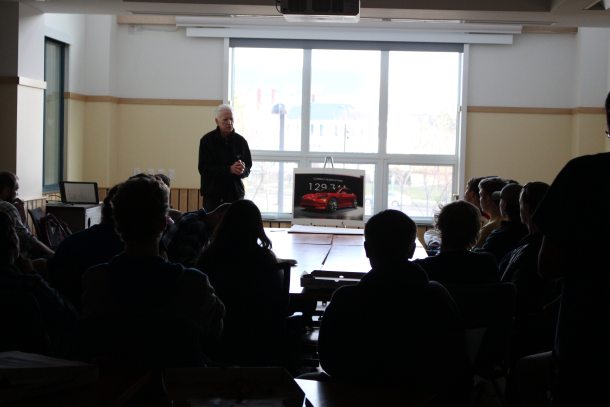
Hanson’s club, the Renewable Energy Network, connects students with professionals in the renewable energy field. It gets speakers to come to its events almost weekly. Oftentimes, these speakers will use the events to recruit. For example, club alumni work at companies like SolarCity and Tesla.
Hanson and his 400-member club submitted to the CEF a funding request for a proposal that would give students access to a solar panel installation course at Vermont Technical College — a class UVM doesn’t offer.

A committee vets the projects that are put forward for funding and works with applicants to refine them, then sends a work plan to Cate, who has the final say.
After months of reworking the proposal at the request of the fund committee, the club didn’t get the $12,500 it was seeking.
Frustrated, club leaders wrote to the committee Nov. 10:
“I think we can agree that a quarter of a million dollars accrued (each semester) is too much money to be left sitting around. We have ideas and we are ready to act on them. Please, let’s work together to achieve what the CEF was intended to be.”
Eventually they went up the administrative chain and took their concerns to Cate, who heard them out. He paid for their proposal out of his own discretionary fund, he said.
“I thought it was a worthwhile project, and it wasn’t that much money, so I told them to go ahead and I would fund it by other means,” Cate said.
No firm timetable for restart
Cate said he has rarely denied a project proposal that has come across his desk from the fund. Cate said that during the time the Renewable Energy Network was going through the proposal process, he had put the energy fund under review, in part because of the loss of oversight with Thompson’s illness and a change in her duties.
“It’s a transition time,” he said. “This past year, we’ve been thinking some of the infrastructure needs to be changed a bit.”
The fund is going to be moved next semester, Cate said, and will most likely fall under the Socially Responsible Investing Work Group. Responsibility will be transferred to the university controller, Claire Burlingham, one of Cate’s deputies.
The review of the fund is waiting on Thompson to complete, Cate said, but due to her health they can’t say exactly when that will be. Cate said he hopes to have the fund back up and running next semester. The work Watts completed is “one element” of the review process, Cate said.
Hanson and the Renewable Energy Network were previously awarded $5,000 from the fund, and Hanson said he has trouble grasping why no money is available now.
“I understand they are under review, but we didn’t get why that prevented them from granting a proposal from an established club,” Hanson said. “We had already proven we’re using the money for its intended use.”
“This is what the fund is supposed to do,” he added.

