

Editor’s note: This commentary is by Marty Richards, who is head football coach at Mount Mansfield Union High School, in conjunction with the Chittenden East Youth Football program.
[A]lthough concussions in football do occur and awareness is at an all-time high, the media can sometimes overdramatize the relationship between concussions with football. Many activities such as soccer, hockey, cheerleading, or the act of driving a car have an inherent risk for sustaining a concussion as the statistics below will demonstrate. The reality is, if we want our children involved in athletics and to acquire all the valuable life skills that children learn through sports, and maintain a healthy lifestyle, then there is a risk of injury.
According the Centers for Disease Control and Prevention, roughly 2.7 million children under the age of 20 were treated for “sports and recreation” injuries between 2001 and 2009. During this same time period emergency room visits for traumatic brain injuries (TBIs) for children under 10 rose 62 percent. Moreover, according to the CDC, football concussions in 10- to 14-year-olds more than doubled from 4,138 to 10,759. The increased number of diagnosed concussions is most likely a direct result of awareness about traumatic brain injuries by coaches, athletes, parents and trainers. Today’s awareness is the key to long-term safety.
More youth go to emergency rooms with TBIs from biking accidents than from football. In fact, the percentage for TBIs for football is lower than other sports such as soccer, baseball, hockey, ice skating, operating ATVs and riding dirt bikes. Furthermore, horseback riding accidents are almost twice as likely to involve a brain injury than football.
The table below, which was obtained from the CDC Morbidity and Mortality Weekly Report, gives a detailed breakdown of TBIs by various activities that our youth choose to engage in. I have taken the liberty of organizing the statistical data regarding concussions developed by the CDC in order from activities with the highest percentage of concussions to the lowest percentage of concussions.
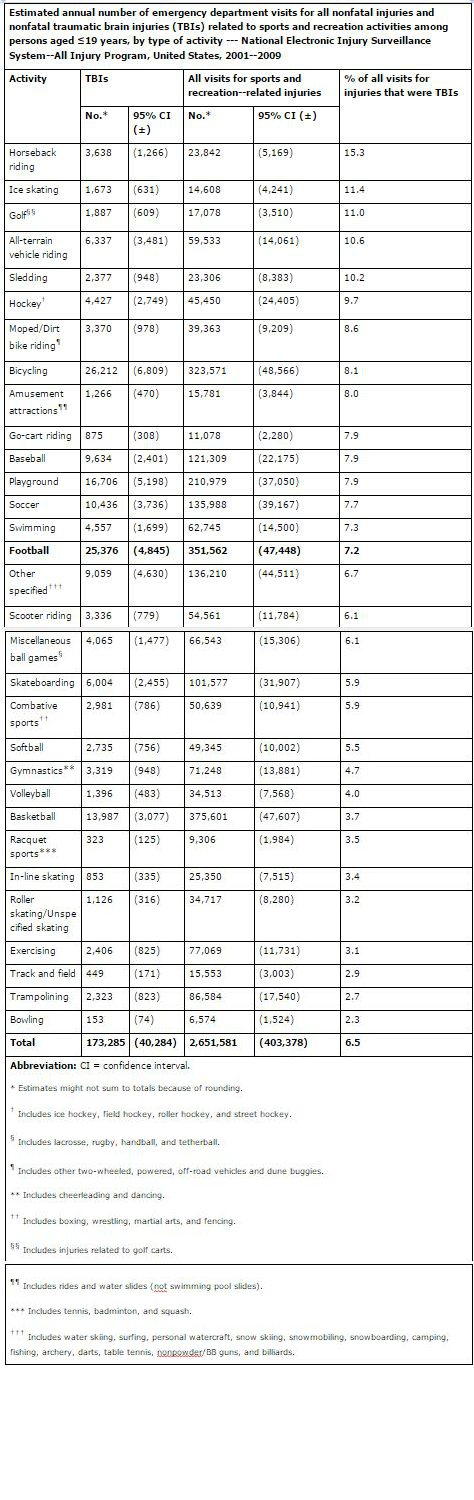
Football is not in the top five common activities associated with an ER visit for a TBI. In fact, according to the CDC automobile accidents is one of the leading causes of TBI at 14.2 percent, which is the leading cause of death for people age 5-24.
Lately, we have not seen a lot media coverage for the top five causes of TBIs and automobile accidents for our youth, but concussions in football is highly scrutinized, and dramatized in the media. We have also not seen a call to legislate these activities like as we have seen for football.
However, to better protect our players there have been many protocols and regulations that football has adopted to make the game safer. Due to the higher awareness regarding the effects of concussions the following steps have been implemented in the state of Vermont.
• For the past several years the Northern Vermont Youth Football League has implemented Heads Up Football, which focuses on proper tackling and blocking techniques that help prevent head and neck injuries. In 2015, every high school in Vermont implemented Heads Up tackling techniques as well.
• Many Vermont schools have also implemented the Seattle Seahawks tackling techniques, which also focuses on not using the head while tackling.
• Every coach in the NVYFL and every high school coach in Vermont must take an online course and be certified to recognize the signs of concussion along with other safety protocols such as sufficient hydration.
• The Vermont Principals’ Association has implemented a heat index protocol which mandates certain criteria are followed based upon temperature and humidity.
• Every high school coach in Vermont must pass an online course and be certified to prevent heat exhaustion and know how to treat the athlete until a trainer or medical professional arrives.
Based on all of the data, we as a society, need to keep our children active to combat obesity and football provides an opportunity for children, regardless of size, an opportunity to to get fit and learn valuable life skills that cannot be learned in the classroom.
• Every high school has implemented a return to play policy to ensure that a student-athlete who has suffered a concussion is healthy enough to return to play.
• Trainers and/or emergency medical technicians are present at every high school game, and youth games are starting to have medical professionals available during games as well. In fact, the Chittenden East Wolverines has a trainer available for every home game.
• During practice times, high school football teams are limited to 30 minutes of contact a day and not more than 90 minutes per week.
• Over the past three years some youth programs, such as the Chittenden East Wolverines, have limited contact drills in practice to better protect their athletes.
Vermont football organizers, coaches, administrators and officiating personnel have taken many steps to make football a safer game. Coaching techniques are constantly evolving and equipment is improving to better protect our children.
In a society that is becoming more sedentary, we need to encourage our children to be active. The most significant long-term health impact that faces our youth is obesity which can be seen in the following statistics provided by the Presidential Council on Fitness, Sports and Nutrition.
Obesity Then and Now:
• Prevalence of obesity for children ages 2 to 5 years – doubled: early 1970s: 5 percent; 2007-08: 10 percent.
• Prevalence of obesity for children ages 6 to 11 years – quadrupled: early 1970s: 4 percent; 2007-08: 20 percent.
• Prevalence of obesity for children ages 12 to 19 years – tripled: early 1970s: 6 percent; 2007-08: 18 percent.
Based on all of the data, we as a society, need to keep our children active to combat obesity and football provides an opportunity for children, regardless of size, an opportunity to to get fit and learn valuable life skills that cannot be learned in the classroom. Football provides our children for an opportunity to:
• understand the value of teamwork unlike any other sport;
• learn how to get along with people from all socioeconomic groups and races;
• set personal and team goals;
• experience how to do a job well and trust others to do their job;
• appreciate that every role on the team is important and in order for the team to succeed everyone must perform their role to the best of their ability;
• develops character and mental toughness;
• teaches leadership skills and other life lessons that are transferable to the “real world”;
• provides a positive physical outlet for our youth;
and our society gains from the lessons that our children learn by playing football.
Contrary to popular belief, football is not as dangerous as people may perceive it to be, and in many cases, it is safer than other sports or activities. We will continue to work diligently to make football as safe as possible for our youth.
Sources
“Injury Prevention & Control: Traumatic Brain Injury & Concussion.” Centers for Disease Control and Prevention. Centers for Disease Control and Prevention, 22 Jan. 2016. Web. 24 Feb. 2016.
Kelley, Bruce, and Carl Carchia 16. “Hey Data, Data — Swing.” ESPN. ESPN Internet Ventures, July 2013. Web. 24 Feb. 2016.
“Nonfatal Traumatic Brain Injuries Related to Sports and Recreation Activities Among Persons Aged ≤19 Years — United States, 2001–2009.” Centers for Disease Control and Prevention. Centers for Disease Control and Prevention, 07 Oct. 2011. Web. 24 Feb. 2016.
President’s Council on Fitness, Sports & Nutrition.” Facts & Statistics -. N.p., 17 Feb. 2016. Web. 25 Feb. 2016.

