


[B]URLINGTON — The City Council approved a preliminary agreement Monday for the redevelopment of the Town Center mall, a $220 million project that would transform downtown and is generating excitement and anxiety in residents.
Monday’s meeting drew a large crowd and voluminous public comment, as did last week’s when the agreement was merely a discussion item. The proposed mixed-use towers are forcing residents to consider their city’s future with uncommon immediacy.
Depending on whom you ask, the mall redevelopment is either a once-in-a-generation opportunity to reconnect the city’s street grid, spur economic development and bring density downtown — or it’s an ill-conceived, profit-driven boondoggle-in-waiting that’s out of scale with downtown and out of sync with residents’ values.
The project contemplates two buildings with the tallest towers in the state — one would rise to 14 stories, or 160 feet — and would offer housing, office and commercial space as well as an expanded parking garage. The project would also restore through traffic to Pine and St. Paul streets downtown, with improved streetscapes.
Burlington would reimburse the developer $22 million for his construction of the street-level improvements, using TIF financing. That mechanism lets the city borrow to fund the improvements, then pay off that debt with a portion of the increased property taxes generated by the redevelopment.
For its part, the City Council appears inclined to give the project a chance. Councilors voted 10-1 on Monday in favor of the preliminary agreement, which sets out the basic project elements, a construction schedule and the responsibilities of the city and developer Don Sinex, who owns the mall.
Councilors appeared leery about the project’s height, the mix of housing — many said they want less student housing — and the lack of an independent study of the project’s economic feasibility. They also lamented the lack of a three-dimensional model to help them and the public understand how the new buildings would fit into downtown.
However, as Councilor Joan Shannon, D-South District, put it: “We have this fortress that consumes the center of our downtown, and it’s worth something to me to open that up.”
Council President Jane Knodell, P-Central District, pointed out that the preliminary agreement calls for both a feasibility study and a three-dimensional model before voters will be asked to approve the tax incentives and councilors will have to vote on a final development agreement.
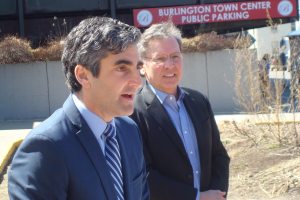
Sinex announced recently that he has an initial agreement with Champlain College to lease units for student housing. That agreement initially called for more than 100 units of student housing. Several councilors said Sinex’s willingness to come down to 80 units for students as part of eleventh-hour bargaining was enough to win their support.
Max Tracy, P-Ward 2, the project’s most vocal critic, was the lone no vote on the agreement. He said Sinex should go beyond the minimum number of affordable units required by the city’s inclusionary zoning ordinance, because the $22 million in public improvements the city is expected to pay for will directly benefit his project.
“I think we’re in a position to ask for more in this agreement when it comes to affordable housing,” Tracy said.
Tracy led an unsuccessful effort to postpone a vote on the agreement until May 16, arguing that the council was being asked to approve the agreement without complete information about its potential impact on the city. Sinex has said that waiting two weeks would not, on its own, scuttle the project, Tracy said. That would give the council more time to review the agreement and gather feedback from constituents, Tracy argued.
Mayor Miro Weinberger responded that this agreement is merely an “early step” in a process that has already involved more deliberation between the council and his administration than any decision they’ve made together during his tenure.
Weinberger falls squarely in the camp of those who see the project as propelling Burlington toward a brighter future.
The redevelopment still needs Planning Commission approval, a zoning change allowing taller buildings in a portion of downtown, the usual permits, City Council approval of a final development agreement, and voter approval of the tax breaks, which are expected to be on the November ballot.
Each of those steps will provide an opportunity for public input or official scrutiny, Weinberger said.
“The idea that there is no cost to delay is erroneous,” he said. Hesitating now could imperil steps that must be taken later, Weinberger said. Sinex echoed that sentiment in a response to a councilor’s question, saying delay could have “cascading consequences” for the project.
As an example, he said, his agreement with the UVM Medical Center to lease office space has timing components necessitated by the hospital’s expiring leases elsewhere. Sinex said his agreement with the medical center is contingent on hitting project milestones that will serve as assurance the offices will be ready when its current leases expire.
The next step, which is likely to be among the most contentious, is approval of the zoning changes to allow taller buildings downtown.

