

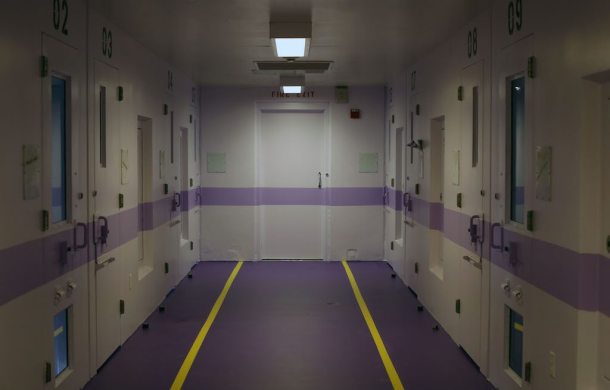
[T]he 60-year-old man, deemed incompetent to stand trial, spent 40 days in prison in 2014. A quarter of that time, he was held alone in his cell for most of each day.
Now, the Vermont Human Rights Commission says his case shows reasonable grounds to find that multiple state departments discriminated against the man based on his disability.
The commission says the departments of Corrections and Mental Health failed to ensure that the needs of the prisoner, identified only by the initials D.C., were adequately met.
“When all is said and done, it is abundantly clear that D.C. should never have been placed in a correctional facility at all, but as already discussed, there were no other viable option(s) under the circumstances,” says the investigative report, which the commission accepted late last month.
The report points to issues with the services D.C. received while in prison, the unit where he was housed, and the collaboration between the two departments around his case. The story links to larger questions of how well Vermont’s criminal justice and mental health systems work together.
The overlap of the two systems has been a concern of lawmakers and others for some time. In April 2015, Patrick Fennessey, an inmate at Southern State Correctional Facility who struggled with mental illness, killed himself.
A.J. Ruben, of Disability Rights Vermont, the group representing D.C., said Monday that the commission’s decision to find reasonable grounds against the Mental Health Department is a “big statement.”
“The (department) is not allowed to simply say, ‘It’s not our job,’” Ruben said.
The issues in D.C.’s case are “systemic,” he said. Similar issues have been the subject of Disability Rights Vermont cases in federal court.
D.C.’s background
Diagnosed with bipolar disorder in 1975, D.C. was long diligent about his medication routine, according to the commission investigation. He went to Alcoholics Anonymous for 26 years. He attended State University of New York at Stony Brook and was employed there at some point. However, a major stroke in 2008 pushed him into mental health crisis. He stopped taking medication and began drinking.
Records from the Brattleboro Retreat show that he had been hospitalized a number of times and spent time at the Vermont and New Hampshire state hospitals in recent years. The Human Rights Commission found no evidence that he had ever been in prison before.
In mid-October 2013, a police officer entered D.C.’s motel room while responding to a 911 call. D.C. spat on the officer, and was cited under a law that prohibits intentionally directing bodily fluids at law enforcement officers. His arraignment was scheduled for January 2014.
Two weeks after D.C. was cited in the fall of 2013, he was admitted for inpatient treatment at the Brattleboro Retreat. Medical records cited in the commission investigation say that in addition to bipolar disorder, D.C. was experiencing other neurological conditions, such as “mini” stroke activity and the possible onset of dementia.
He stayed there until mid-January 2014. But two days after his release, he was found in an ATM vestibule — covered in feces and without any shoes.
At that time, he was taken to Brattleboro Memorial Hospital and held for several days — missing his arraignment date. As a result, the court issued a warrant for his arrest.
On Jan. 23, 2014, a judge ordered the Department of Mental Health to take custody of D.C. to evaluate his competency. But there was no appropriate bed available for him, so the court put him in the custody of the Department of Corrections, to be held at Southern State Correctional Facility in Springfield.
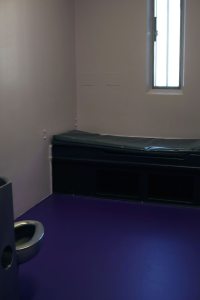
A doctor evaluated D.C. on Feb. 2, finding him “insane” and deeming him incompetent to stand trial. However, D.C. remained in the prison for more than a month after that because there was still no space for him in one of the acute care beds that house people in the care of the Department of Mental Health.
D.C. spent a total of 40 days at the Springfield prison. He spent the first 10 of those days in the Alpha unit, a “mental health stabilization unit” that is often criticized by those who oppose the use of segregation for people with mental health issues.
Alpha unit
The commission’s investigation comes down strongly on the placement of D.C. in the Alpha unit. Inmates there are kept alone in their cells, except for one hour of the day when they are permitted to come out.
After 10 days, he was transferred to Bravo unit — also a mental health unit, but one that allows inmates to move freely between their cells and a common area with a television.
The investigation charges that the Alpha unit is a “hybrid type of segregation” in which the DOC blends the rules governing the use of segregation for disciplinary purposes and administrative purposes.
“On one hand D.C. was locked up in a cell 23 hours a day, which fits into the definition of disciplinary segregation,” the investigation report states. “On the other hand, however, he committed no ‘serious (violation) of conduct regulations’ to get him there.”
The report says there is no evidence that a physician authorized segregation of D.C. according to DOC rules. There is also no evidence of a treatment plan for D.C., or that he was visited by mental health staff three times a week — both of which are required under DOC rules.
“The DOC broke its own rules and assigned him to disciplinary segregation — they essentially punished him for being mentally ill,” the investigation report states.
Ruben, of Disability Rights Vermont, has raised concerns about the use of segregation in Vermont prisons and the Alpha unit at Southern State in the past.
“We think it deserves a lot of attention that our tax dollars are paying for a unit that the Human Rights Commission determined not appropriate for people who are sick,” Ruben said Monday.

Corrections Commissioner Lisa Menard said in an email Monday that she could not comment on the case because it is pending.
However, she said the department takes many factors into consideration when deciding to place someone outside of a general population unit, including the safety and security of that person and others.
“The entire criminal justice system and our agency partners are working to find ways to best address the needs of justice-involved individuals with mental illness,” Menard said.
The head of the Human Rights Commission said D.C.’s handling likely made his situation worse.
“Locking someone like that into a (segregation) cell exacerbates the mental illness for a lot of reasons,” Executive Director Karen Richards said Monday.
Reasonable grounds against departments
The five human rights commissioners decided at a meeting in March to accept the investigation’s finding that there are reasonable grounds to believe the Corrections Department discriminated against D.C.
However, the commission rejected the investigator’s determination that there were no reasonable grounds to find discrimination by the Department of Mental Health. The investigator reached that conclusion because of the lingering effects of Tropical Storm Irene on the mental health system. After the Vermont State Hospital in Waterbury closed in 2011 because of flood damage, there was a shortage of places where the state could place people in custody in need of mental health services.
Richards said the commission felt there were indications the Mental Health Department did not fulfill its duties under Vermont statute, which is based on the federal Americans With Disabilities Act and the Vermont Fair Housing and Public Accommodations Act.
“There does not appear to be adequate communication between DMH and DOC when they’re dealing with an inmate with mental health needs,” Richards said.
Mental Health Commissioner Frank Reed said in an email Monday that he could not comment on the specific case because it is legally unresolved.
However, he said in general when inmates have mental health issues, there is “consistent and frequent communication” between the departments of Corrections and Mental Health.
“Information is shared freely between our departments and the receiving facilities to facilitate the admission as soon as possible,” Reed said.
