

[V]ermont’s hospitals are treating many more Medicaid patients, and executives say the institutions take a loss with each one who walks in the door.
At the same time, Vermont’s Medicaid spending at hospitals has tripled, making it the largest category of services that the Department of Vermont Health Access pays for.
The dramatic increase in Medicaid hospital visits and payments is putting hospitals and state officials in a tug-of-war: Hospitals say they’re losing money because Medicaid reimbursements don’t pay what it costs to treat patients, and at the same time the Legislature is struggling to find the money for the Medicaid program.
Between 2002 and 2013, annual Medicaid visits to rural hospitals increased from about 58,000 to 89,000. Medicaid visits to the University of Vermont Medical Center, the state’s largest hospital, increased by about one-fifth—from 17,000 to 20,000.
Data shows that when Medicaid patients get to a Vermont hospital, they are seeking outpatient treatment or going to the emergency room. If Medicaid patients do spend the night in the hospital, they are most often giving birth, dealing with a respiratory illness, or addressing a mental health diagnosis.
And no matter the reason they’re at a hospital, the Medicaid patients are more likely to be women than men.
These findings come from a VTDigger analysis of hospital use data for 2002 and 2013 — the latest year data is available. The Vermont Association of Hospitals and Health Systems collects the data, and the Vermont Department of Health publishes the data on its website.
The Medicaid visits that show up in the data include Vermonters who go to in-state hospitals. The data does not account for Vermonters who use their Medicaid insurance out-of-state, such as when they visit Dartmouth-Hitchcock Medical Center in Lebanon, New Hampshire.
The data also includes out-of-staters who use Vermont hospitals. That means that someone living in upstate New York who has New York’s version of Medicaid insurance could visit Southwestern Vermont Medical Center, and the visit would show up in Vermont’s hospital data.
For data on hospital visits, hover over the bubbles on the following map, which includes data for all of Vermont’s hospitals. Over the time period studied, every single hospital saw an increase in the number of Medicaid visits. Every hospital except UVM Medical Center saw Medicaid visits increase as a proportion of all the patients who visited.
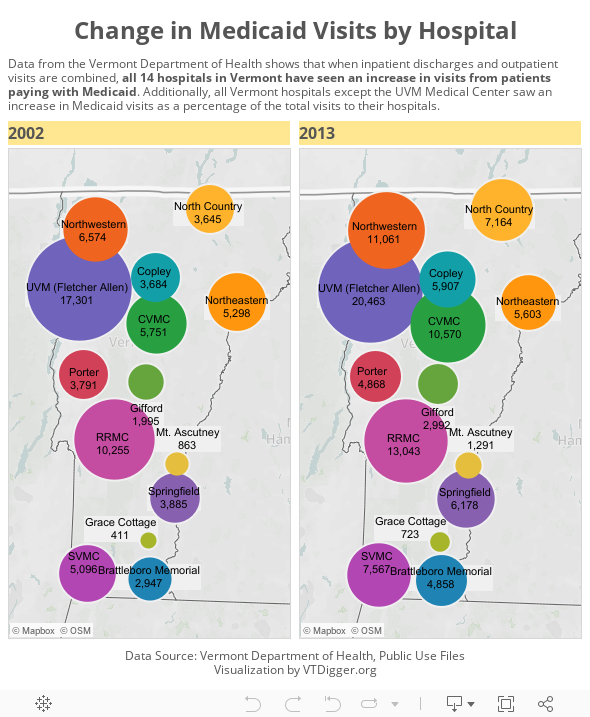


[N]otably, from 2002 to 2013, North Country Hospital in Newport saw its Medicaid transactions roughly double—from 3,600 to 7,100. Central Vermont Medical Center in Berlin saw an increase from about 5,800 to 11,000. Springfield Hospital saw Medicaid transactions increase from 3,900 to 6,000.
Andre Bissonnette, the chief financial officer of North Country Hospital, said Medicaid patients make up about 30 percent of the hospital’s patients. But he said Medicaid pays the hospital about half of what it costs to treat a patient, so Medicaid money only makes up 20 percent to 25 percent of total revenue from patient care.
“Since the expansion of Medicaid under the Affordable Care Act, we’ve seen a significant shift that more people are eligible,” said Claudio Fort, the chief executive officer of North Country Hospital. “We actually saw our volumes went up, and yet our revenues that we took in went down a little bit.”
Across Vermont’s hospital system, the Green Mountain Care Board estimates that Medicaid money—not necessarily Vermont’s Medicaid money—made up about 12 percent of revenue that hospitals make from seeing patients from 2013 to 2015. But that number doesn’t accurately represent how many Medicaid patients use the hospital.
“In terms of the revenue itself, the revenues only cover essentially 40 percent of our costs,” said Rick Vincent, the chief financial officer for UVM Medical Center. “Essentially every new Medicaid patient that we see, we’re actually incurring a loss from a net margin perspective on that patient.”
Vincent also said Medicaid visits to UVM Medical Center likely increased even more since 2013. That year, about 12 percent of UVM Medical Center’s business came from Vermont’s Medicaid program. By February 2016, he said, Vermont Medicaid revenue was 15 percent of their total. Out-of state Medicaid revenue was another 5 percent in February.
While UVM Medical Center provided VTDigger with data on in-state versus out-of-state Medicaid programs, it is not clear how much of Vermont’s Medicaid money is spent at Vermont hospitals. Information on hospital expenditures is available in two forms: data about how much Vermont pays hospitals, regardless of where the hospital is located; and data on how much Vermont hospitals make, regardless of which state’s Medicaid program is paying them.
Data from the Department of Vermont Health Access show the state tripled the amount it pays hospitals for inpatient and outpatient services between 2002 and 2013—from $79 million to $245.3 million. The numbers include any hospital Vermont has spent money at—even out-of-state hospitals like Dartmouth-Hitchcock Medical Center in New Hampshire.
The data also show that from 2000 to 2015, hospital spending as a percentage of the Department of Vermont Health Access’s spending has increased from 6 percent to 14 percent of the department’s gross program expenditures. The hospital portion of its program budget is rivaled only by the amount Vermont pays to nursing homes and the gross amount it pays pharmaceutical companies.
Data from the Green Mountain Care Board shows how much Medicaid and graduate medical education money that all Vermont hospitals make—regardless of which state is paying the Medicaid money. Medicaid and graduate medical education spending has also roughly tripled at Vermont hospitals—from $99.3 million in 2002 to to $288.9 million in 2013. But it’s impossible to decouple graduate medical education from Medicaid within the dataset.
Sean Sheehan, the spokesperson for the Department of Vermont Health Access, said the department increased how much it pays hospitals for inpatient procedures in mid-2008. It then started paying hosptials about $9 million per year for graduate medical education in mid-2012. And he said there is no room to give hospitals more money in the upcoming budget.
Steven Costantino, the commissioner of the Department of Vermont Health Access, added that increase in overall Medicaid spending at hospitals is in keeping with national trends. He also said the level number of overall inpatient visits is a good thing, and it might be a sign that more patients are preventing illnesses by seeing their primary care physicians.
Sen. Jane Kitchel, D-Caledonia, the chair of the Senate Appropriations Committee, pointed to two other explanations for the increases. New Medicaid patients who used to be uninsured may have higher health needs and need to use hospitals, she said, or the increased outpatient costs could be related to hospitals that are expanding.
“We’re seeing some shifting of where payments are being made, and that has to do with so many independent practices are being bought by hospitals, and that would impact where the money is going to,” Kitchel said. “We’ve seen more and more practices being acquired by hospitals.”


