


[L]AS VEGAS — In mid-January, on the PBS public affairs program “Vermont This Week,” host Stewart Ledbetter was quizzing the panel about the upcoming Vermont presidential primary when he asked me about “the third name” on the Democratic Party ballot: Rocky De La Fuente.
“Jasper, tell us,” Ledbetter asked, “what should we know about Mr. De La Fuente?”
Caught off guard, I smiled and nervously laughed.
“I have absolutely no idea who Rocky De La Fuente is,” I responded.
It’s likely I wasn’t alone.
Tuesday, while tens of thousands voted for Bernie Sanders and Hillary Clinton, a mere 80 people voted for De La Fuente. Martin O’Malley, who dropped out weeks ago, got 282 votes.
While I knew nothing about De La Fuente in January, that all changed in a matter of weeks. I was covering the Nevada caucuses when I spotted his campaign bus rolling down Las Vegas Boulevard.
A few hours later, after securing an interview, we met up inside the golden halls of The Wynn Casino and Resort for lunch at La Cave, an upscale, breezy restaurant overlooking the pool.
At 61, he’s in good shape with thinning white hair. He has a perfect politician’s smile: big, glistening white teeth, endearing, perhaps even a little bit sly.
He is as fluent in charm as he is in Spanish. A businessman, he grew up in California and Mexico. He built his wealth selling cars across the Golden State, from Audi to Volkswagen. De La Fuente has amassed 28 car franchises in 27 years. When he was 28, he was elected chairman of the National Dealer Council.
As proof of his appreciation for his country, his campaign website describes a nine-year legal battle with local officials over whether he could fly a 3,000-square-foot American flag over one of his Cadillac dealerships.
Eventually he was able to fly the flag from what his website says is the tallest freestanding flagpole in the United States.
He doesn’t waste a moment when we meet to start talking politics. He says he can sell his candidacy in “15 seconds or less.” After all, he’s sold thousands of cars over the years.
So, what will it take to get you to vote for Rocky today? Here’s the pitch:
“Sir,” he starts, “who is better-looking, Trump or me?”
Playing along, I answer, “You.”
“Right now, I’m batting 1.000, 1.000,” he excitedly explains. “For the next question, I’m only batting .820: Would you like Hillary to run this country for the next eight years?”
Citing my journalist objectivity, I demur. But he answers for me: “Eighty-two percent of Americans say, ‘Hell, no.’”
“So then,” he concludes, “I say, ‘Hi, I’m Rocky De La Fuente.’ I don’t even have to discuss issues.”
But he is indeed passionate about many issues, not all of them the usual campaign fodder. During nearly two hours at the Wynn, the most substantive policy proposal he discusses is how the national debt is too high, at more than $19 trillion.
His only other discourse on finance is when he brags that he won $18,000 in 20 minutes gambling on the Wynn casino floor.
“You’ve never met anybody like me,” he says, accurately. “When they made me they broke the mold.”
His website contains his major policy platforms — from foreign policy to education — but instead of policy statements, the site discusses the issues through a series of rhetorical questions, inviting the public to weigh in.
For example, under “Ministerial policy,” he asks: “What if we once again decided that the words ‘We the People’ were to mean exactly what they say?”
Under economic policy: “What if we divorced our federal government from the influence of lobbyists?”
His energy policy: “What if we rewarded creativity and success rather than regulating it with fines and fees?”
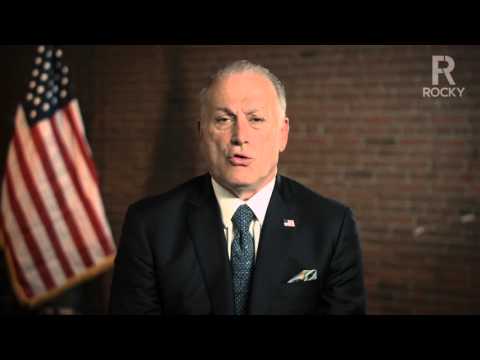
Weave them together, and he appears to be a moderate Democrat, concerned with out-of-control federal spending. Although many of his campaign videos are in Spanish, there is no policy section on his website on immigration.
While his policies are light on pronouncements, he says his wallet is heavy. And like a certain other candidate who is looking to ride a business background to the White House, he says he adores beautiful women.
While he orders his lunch — I’m already full from a cheap In-N-Out burger devoured before we met up — De La Fuente flirts with the server, a woman named Jessie. She displays poise as he tries a number of lines on her, telling me privately that she is good-looking, then “stunning.”
“How many times a day do they tell you that you are gorgeous?” he asks Jessie.
She responds with apparent discomfort, telling him she doesn’t normally receive such compliments from patrons.
“That means they don’t have confidence,” he counters. “But you truly are.”
After lunch, he walks by another woman on the way to his hotel room. “My mother used to say, ‘Looky looky, but no touchy touchy,” he says.
When describing his campaign strategy, he says the major challenge for him and his 80 staffers across the country has been to get his name on election ballots. He says he’s managed to get his name on 40 state ballots, though his website has him confirmed on just 33.
Although Sanders and O’Malley have accused the Democratic National Committee of tipping the scales in Clinton’s favor through superdelegate support and a problematic debate schedule, De La Fuente is even more critical.
He says it’s unfair that he never got to debate the front-runners, that the ballot rules in some states are stringent and polls don’t include him.
He is harshly critical of DNC Chairwoman Debbie Wasserman Schultz, saying that “she’s creating many illegalities that will put her behind bars.”
He likens his challenge of getting on ballots and earning votes and delegates to the missions in “The Legend of Zelda,” a retro Nintendo video game.
“If you don’t have a sword, and you are playing ‘Zelda,’ there’s not much you can do without a sword,” he says. “And if you need a cape, you can’t go to the next level without the magic cape. ‘Zelda’ is a good game about how to teach you about the U.S. president.”
He says he jumped into the race to counter Donald Trump’s comments against Latinos and other groups.
He doesn’t think Clinton or Sanders would make a good commander in chief but can’t explain why. His says his second favorite candidate is Republican Ben Carson, who has now dropped out.
“If we would have had Ronald Reagan, or Kennedy or Martin Luther King or Mandela or Gandhi, or some other good guy, I would have stayed home,” he tells me.
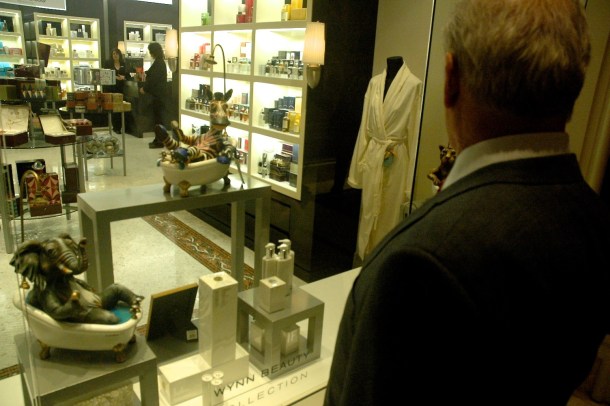
After eating, he walks around the Wynn, telling me he knows all the ins and outs of every casino game and knows how to win big. He stops in an upscale shop selling beauty products, and rubs expensive cream under his eyes to rejuvenate them.
He ends up buying the cream, as well as Tom Ford deodorant and aftershave. He guesses it will cost $200 or so, but it tops out over $300.
He tells me to come up to his hotel room, on the 26th floor.
The room is lighted by warm bulbs that are relaxing. His bed looks like a cloud, and he quickly lies down on top of the covers. He’s tired from a day of interviews and radio show appearances.
Danielle De La Fuente, his niece and campaign consultant, tells him he has a few more scheduled interviews later.
She is young, but incredibly smart and well-versed in foreign policy. She’s worked in the Argentine and British embassies and served in a contracting capacity for the U.S. Department of Defense, where she specialized on issues affecting the Middle East, including water and energy security.
After speaking with her, I find myself wondering why she isn’t running for president, instead of her uncle.
The candidate asks her to schedule him a massage, as he starts drifting off in bed. He tells me he is ready to win, that his message and life story will resonate with all the right voters.
“My whole life has been an uphill battle,” he says, his eyes closing. “My whole life has been tough.”
A minute later, Roque “Rocky” De La Fuente is asleep. I slip out, careful not to wake him.

