

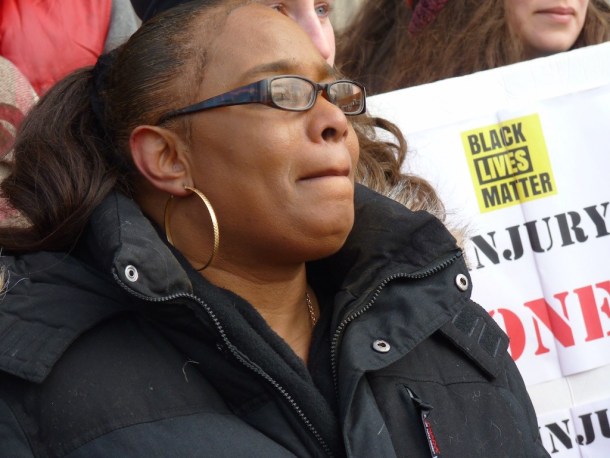
[S]T. ALBANS — Advocates for racial justice marched through the city Saturday calling for an end to the mistreatment that people of color say their children are experiencing in Vermont’s schools.
“The time has come in Vermont when systemic racism just won’t do,” said Ebony Nyoni, an organizer with Black Lives Matter Vermont, during a rally before the march.
The march drew close to 75 people from across the state. It was not met with the same angry response as a rally here in December.
Some passers-by honked or gave thumbs up. A few appeared frustrated with marchers who momentarily blocked traffic on Main Street. No police were present.
Nadine Morales, a 23-year-old biracial mother of three from St. Albans with Puerto Rican heritage, told the crowd of marchers that she spent years being ostracized by her peers and ridiculed with racial slurs at Missisquoi Valley Union High School.
Her daughter, a fourth-grader in St. Albans public schools, has already been teased for taking pride in her Puerto Rican heritage, Morales said, and she declared it’s time for that to change.
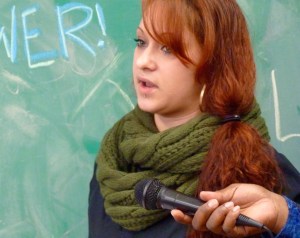
Morales described feeling bullied and alone, forced to constantly defend her identity, simply because she was the only Puerto Rican at her school and the other students had negative associations about her people.
“I was the only one fighting this fight,” Morales said.
Morales said the bullying pushed her in the wrong direction, leading to fights with other students, skipping class and drinking. She didn’t stop getting in trouble until a counselor saw potential in her and asked her to lead group counseling sessions, she said.
Now she’s a student at Champlain College and making a life for herself that she never imagined in high school when she felt completely isolated, she said.
Morales and the other organizers of Saturday’s march are calling on teachers and administrators in Vermont’s schools to work with people of color in their communities to develop cultural competencies they say are lacking, leaving schools unprepared to deal with racial bullying.
They also want public schools to end the use of suspension and expulsion as a disciplinary measure, because it disproportionately affects students of color and students with disabilities.
A Vermont Legal Aid report released in January found that African-American and Native American students were two to three times more likely to be suspended than white students. Students with disabilities were three times more likely to be suspended.
Mohamadou Ndione, a foreign language teacher who has worked in central Vermont public schools for more than a decade, said white children in Vermont have very little cultural awareness.
When students say things that are racially insensitive to Ndione, who is African-American, he said he tries to use it as a teachable moment, but he and others said there isn’t formal curriculum that teaches about race from a nonwhite perspective.
“Schools should create curriculum to teach about other cultures because the kids really want to know,” he said. Many of the hurtful things students say are simply parroted from what they hear at home, he said.
“Our children should read books by slaves, not books about slaves,” Morales said. She wants her children to learn about race and ethnicity before they’re checking a box on a job application declaring it.
Brigham Young, 31, of Essex, said he came to the rally to support Morales, who is a friend. Young, who is white, said he appreciates the work she is doing to bring about a dialogue about race in Vermont schools.
“They don’t teach any of this in school,” said Young. His oldest child is 11 and learns more about race from television than in school, Young added.
Part of the problem is that Vermont is so overwhelmingly white that the experiences of people of color are not visible, said many activists.

Stina Booth, 38, was in Taylor Park enjoying the city’s annual winter carnival, which was happening at the same time as the march. Her young children were drawn to the protest songs and accompanying band as they went by on Main Street.
Booth said her kids are too young to have raised questions about race, having not started elementary school, but she seemed unsure what she would tell her children when the time comes.
Booth, who grew up in St. Albans, said she was always more aware of economic inequality in her community and hadn’t given much thought to racial inequality.
There was only one black student in her class growing up, she said. “I didn’t realize he was black until an embarrassingly late age,” she confessed.
Charles Rainey, 18, is an African-American freshman at Middlebury College who grew up in Atlanta. He said he joined the march because he’s felt discriminated against a number of times on the campus of the elite educational institution.
It happens most frequently when white progressives won’t acknowledge that race still affects the lives of nonwhites, Rainey said. They want to believe Vermont is post-racial, he said, and that has not been his experience.
“We need to dismantle the white liberal power structure that isn’t hearing our voices,” Rainey said while addressing marchers.
Mark Hughes, with the group Justice for All, urged activists to take a broader view of institutional racism in Vermont. It extends well beyond the schools and plays an insidious role in housing and the criminal justice system, he said.
Institutions rely on the discretion of individuals whose perception is invariably colored by personal bias, he said. That leads to racial disparities, whether it’s suspensions in schools or sentencing in court.
“We need to shine a light on those decision points and demand accountability,” he said.

