

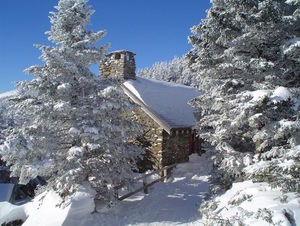
(Editor’s note: This story is by Tommy Gardner, of the Stowe Reporter, in which it first appeared Feb. 25, 2016.)
[A]fter the Stowe Reporter broke the story that the founder of Burton Snowboards had the popular Stone Hut atop Mount Mansfield reserved on Christmas Eve, the day it burned down, a social media firestorm erupted.
One of the oft-asked questions was just how the Carpenter family managed to get the hut reserved year after year during the holiday week, if the reservations were done using a lottery system.
The answer: just like anyone else.
Craig Whipple, the director of Vermont State Parks, is sensitive to allegations that one famous family or another can curry favor with the state.
“As far as we can tell, it’s above criticism,” Whipple said this week. “Far be it from us to have to be in a position to explain why we’re showing preferential treatment.”
The lottery rules are laid out on the Vermont State Parks website and detail the fairly intricate process people used when trying to snag a night or five in the popular hut.
People entering the lottery would list their first choice, anywhere from one night to five nights, and also list alternate dates. On the day of the lottery, the staff would separate the forms into piles, based on the length of stay of their first choice, assign each form a number, and plug all those numbers into a random number generator.
The staff members then worked their way through the requests, in order of preference and in order of stay, with five-night requests filled first, then four-night requests, and so on, down to the one-night requests last, to fill in the gaps.
According to Nick Caputo, a ranger supervisor for the region that included the Stone Hut, the state park staff takes great pride in leaving the lottery process up to chance, with only about 15 percent of requests filled each year.
And they don’t take bribes.
“People have tried dropping off gifts, and we sent them back,” Caputo said. “We accept nothing.”
That didn’t mean you couldn’t improve your odds, though, especially if you were very flexible and requested a lot of dates. According to Caputo, a person once filled out hundreds of alternate dates, using numerous forms.
Also, horse trading was allowed once you got your night, Caputo said, which might be why Burton founder Jake Carpenter and his family were able to get the hut during the Christmas week year after year. Also, Christmas week was just not a popular time of the year to rent the hut. What time of the year was?
“Periods of full moons are popular ones,” Whipple said. “The beginning and the end of the season aren’t.”
Even if it looks as if the same people were staying at the hut at the same time every year, that doesn’t mean they were gaming the lottery. Sharing the hut with friends was a common practice, Whipple said. The place slept 12, on four single- and four double-sized beds on wooden bunks, which meant large, often boisterous crowds over the years.
“Depending on how many people you know who are fans of the Stone Hut, you could be there practically all winter,” Whipple said.
Data supplied by Rochelle Skinner, the Vermont State Parks sales and service manager, show that a lot of different people reserved the hut, and the lengths of stay were dispersed variously. This winter’s numbers aren’t available, since all reservations since the fire have been canceled.
But according to reservation data for the last three winters, the majority of stays were five nights, spread out among a wide number of names. Last year, 22 different people reserved the hut for five-night stays. The patterns were similar for the 2013-14 season and the 2012-13 season, the last year a seven-night stay was allowed.
Durations of stay also varied over the past three winters, although maximum-night stays were the most popular option, with one-night stays the second most popular. Here’s last year’s breakdown, for example:
- 5 nights: 20 reservations
- 4 nights: 1 reservation
- 3 nights: 5 reservations
- 2 nights: 8 reservations
- 1 night: 13 reservations
Skinner, in sending along the reservation statistics, echoed Whipple’s assertion that the lottery system shows no favorites.
“Also, to be clear, the Carpenters don’t receive any preferential treatment whatsoever — no one does. For obvious reasons, we are very careful about this,” Skinner wrote.
Caputo even invited a reporter from this paper to watch the lottery system in progress. If that sounds like a man convinced the Stone Hut is going to be rebuilt, it is.
“Oh, it’s going to be rebuilt,” Caputo said “That was a gem of a place.”
Family’s role
Lisa Lynn of VT Ski + Ride magazine quoted Donna Carpenter during the weekend as pledging that the family will donate $100,000 to rebuild the hut, and more if needed.
However, so far that’s the only source. Donna Carpenter’s secretary said the family will not speak to the Reporter. Whipple said he’s seen no evidence of a pledge coming through official state park channels. State forests Commissioner Mike Snyder said previously he hadn’t heard from the Carpenters since the hut burned down. Deb Markowitz, secretary of Vermont’s Agency of Natural Resources, did not return a request for comment.
If the Carpenters do plan on donating $100,000, what effect would that have on donations through vermontparksforever.org, the foundation collecting donations to rebuild the hut? Would it encourage more donations, or fewer?
“I wouldn’t even venture to guess what the psychological aspect of that would be,” Whipple said.
As for the Christmas Eve fire, VT Ski + Ride contradicts aspects of the Vermont State Police report. For instance, the article says George Carpenter “accidentally left a log near a wood stove,” but the police report says he and friends “actually laid some of the wet wood directly against the stove.”
State Police Detective Sgt. Todd Ambroz conducted the investigation and interviewed the Carpenters. In a follow-up interview this week, Ambroz said the wood was, in fact, stacked up against the stove higher than the top of it, and another piece of wood was used to prop the door open an inch and a half to keep the fire drafting.
Ambroz also said he thought George and Timothy Carpenter were very forthcoming in accepting responsibility.
“They were very cooperative and extremely polite,” Ambroz said. “Two of the most polite people I’ve ever interviewed.”
Ambroz said that, when they realized the friends for whom they were warming the hut had not arrived, they could have called someone at the mountain, which has access to snowmobiles and groomers, but “common sense” doesn’t factor into a fire investigation if it’s been deemed an accident.
Vermont’s arson laws don’t differentiate between an accident and negligence, he said. Either a fire is caused by arson, which says a person “willfully and maliciously sets fire to or burns or causes to be burned” a structure, or it’s deemed an accident.
Ambroz said he believes the Carpenters’ story because it validated something he’d already noted before he interviewed them. He noted in his preliminary investigation that, when he found the wood stove under the rubble, he noticed the stove door was no longer attached.
Finding out it had been left open solved that mystery.
“The door was off the wood stove, and I was losing sleep” wondering how that could be, Ambroz said. “I’m actually glad I did my investigation before I talked to them.”
