

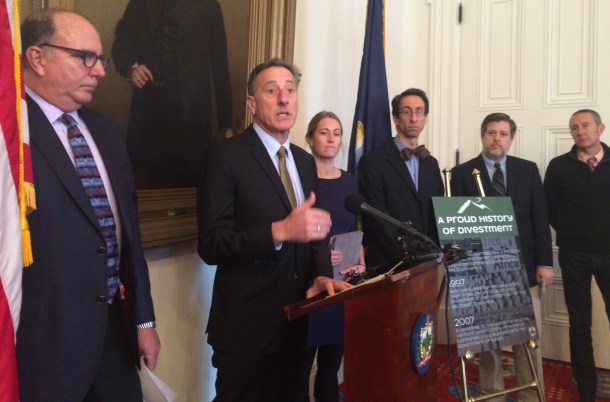
[G]ov. Peter Shumlin spent the better part of an hour Tuesday morning pleading with the board that oversees the state’s retirement funds to divest itself of investments in coal and other fossil fuels.
In an unprecedented appearance at a meeting of the Vermont Pension Investment Committee, Shumlin implored members of the group to abandon stocks in Exxon Mobil, other gas and oil companies, and the coal industry.
The state has a “moral responsibility,” Shumlin said, to use divestment as a tool to address climate change.
He urged the pension committee to pull out of coal and drop $200,000 in state Exxon Mobil stocks right away, and to consider dropping other investments in fossil fuels that are now managed through index funds.
The state pension fund supports 50,000 retired teachers, municipal workers and state employees. Its total assets are about $4 billion. Of that amount, $48 million is invested in energy stocks, excluding coal, according to the state treasurer’s office.
Shumlin says Vermont has an opportunity to piggyback on a California initiative and become the second state to divest from coal. The governor says he sees an opportunity to bring other states along as part of that effort.
“Coal is the leading cause of global warming,” Shumlin said. Investments in coal, he said, are bad for the environment and the economy.
In a 10-page speech that reads like an academic paper with extensive footnotes, the governor told the pension committee that the coal mining industry is stalling. “Mining is on the decline in the United States and around the world,” the governor said. Coal was once 50 percent of the nation’s power supply; today, it’s only 35 percent, he said.
State Treasurer Beth Pearce, a member of the pension committee, has resisted rapid divestment of fossil fuel stocks since Shumlin introduced the idea in his State of the State address in January. She says that while she, too, is concerned about climate change, her primary responsibility is to the retirees who rely on state pensions. She has said she must ensure that the pension funds don’t suffer losses as a result of changes in investments.
“I am committed to a full vetting of the answers,” Pearce said at the panel’s meeting. “What I don’t want to do is preconceive what the answer is. I would prefer to have a process that is objective. I promise you it will be a full vetting.”
The governor insisted that the committee must take action as soon as possible. Otherwise, Shumlin said, he will ask lawmakers to mandate that it take steps to divest itself of gas, oil and coal funds. He told the committee it must act before the end of the legislative session.
In an interview, Pearce said she wants to explore the matter as quickly as possible but that it is premature for the panel to commit to a timetable. While Pearce said she understands the urgency of climate change, she is opposed to the Legislature requiring fossil fuel divestment. “Legislating investments is a bad practice,” she said.
Shumlin cited state divestments from the tobacco industry, South Africa and Sudan as prior examples that he said compare with his current plan regarding fossil fuels.
Several members of the pension committee raised questions about the proposal. VPIC hires professionals to manage the pension funds and they cannot cannot easily separate out investments in fossil fuels from the indexed funds the money is now invested in without incurring $60,000 to $3 million in additional fees.
Shumlin chided committee members for following the wrong logic and urged them to pressure money managers to lower the fees by threatening to go to another investment company.
“If you do this, (California Gov.) Jerry Brown agreed with me we will get other governors to join us,” Shumlin said. “I can’t invite other governors to do it if I can’t get our board to do it.”
The state investments in coal are about $1.1 million, based on the Global Industry Classification Standards, the treasurer’s office said. However, under the definition California uses for coal investments, Vermont has only $615 worth of coal in its portfolio.
The Vermont Pension Investment Committee voted Tuesday to form a six-member subcommittee that will consider the divestment question. Three members will be from VPIC, plus one trustee each from state employee, teacher and municipal fund boards. Pearce said the subcommittee will involve activist groups, including the Sierra Club, VPIRG and 350.org in the process.
Robb Kidd, program manager for the Sierra Club said, the governor’s support for divestment “has created a new dialogue and that there is a greater willingness to an open and transparent process.”
“The question remains how do we get to yes on divestment, not how we can’t,” Kidd said.
Editor’s note: This story was updated with a quote with Kidd.
