


Keith Flynn needs a Bongo Board.
The governor’s Commissioner of Public Safety is attempting a high wire act these days on pot legalization that is as difficult as learning how to use a Bongo Board, a balancing game where you straddle a miniature surfboard atop a small cylinder of wood.
Sometimes you find the perfect balance.
Sometimes you fall.
Which in Flynn’s case means: fall one way and you get chewed out by your boss, Gov. Peter Shumlin. Fall too far the other way, you lose the respect of the troop(ers) who work for you and expect you to promote their position.
Call it the hot seat. Or in Flynn’s case, maybe the pot seat.
The challenge for Flynn is this: he works for and was appointed by Shumlin, who wants pot legalized. But as part of his job, Flynn also oversees the Vermont State Police, whose loyalty he needs and whose leader, as well as many rank and file, strongly oppose legalizing weed.
That tension came to a head when the director of the state police, Col. Matthew Birmingham, told a Senate committee recently the pitfalls he sees to legalization. Birmingham’s testimony caught the governor off guard and earned the state police head and Flynn a trip to the governor’s woodshed, where he let them know he was ticked they had strayed from the party line.
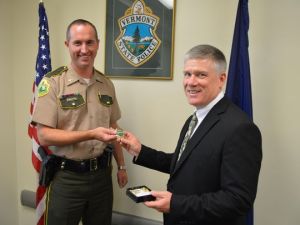
Birmingham spent more than a decade working on the Vermont Drug Task Force, including years of undercover work catching major cocaine, heroin and painkiller dealers.
“There are real public safety concerns surrounding the legalization of marijuana that cannot be ignored,” Birmingham testified. “I can tell you that we face incredible enforcement challenges regulating prescription drugs which have some of the most restrictive controls imposed by government. There are also real tragedies from drug abuse that stretch from traffic deaths to overdose deaths to homicides.”
The colonel then went on to tell members of the Senate Transportation Committee, whose chairman, Sen. Richard Mazza, D-Grand Isle, opposes legalization, about how legalized marijuana in Colorado “have harmed both public safety and public health in that state.” He cited statistics showing an increase in the Rocky Mountain state in marijuana-related traffic fatalities and emergency room visits, as well as numbers showing youth smoking rates higher than the national average.
Birmingham said there would be an increase in impaired drivers. Troopers, he said, spend little time on marijuana-related enforcement and are already “unable to keep up with the volume of opiates” coming into Vermont, as well as the associated crimes, particularly burglaries.
Vermont decriminalized possession of an ounce of marijuana in 2013; state police issued fewer than 500 civil fine tickets in 2015.
Here was Col. Birmingham’s blunt bottom line.
“Given our focus on the opiate epidemic, the Vermont State Police and law enforcement across the state do not have the resources to enforce regulations for legal marijuana and would be completely overwhelmed by the illicit market it would likely generate,” he said. “Because there is no ability to control multiple purchases of marijuana, individuals would be able to take advantage of the legal market and exploit it for illegal purposes.”
Birmingham had gotten the green light to testify from Flynn, who the colonel told others had “taken off the handcuffs” and knew he wasn’t going to repeat the administration view — that prohibition doesn’t work and that a regulated market is better than the black market, that at least you can raise money for education and treatment programs.
Flynn said: “He’s the head of the State Police and I think the law enforcement boots on the ground view has been that (opposed to legalization). Certainly that was an opinion that he felt. And I don’t tell people what to say when they go in and testify because I want it to be truthful testimony. I come at it from a different position in a way. I have to look at it more as an administrative position, more of the policy outlook.”
Hence, Flynn says he can support a legalization bill if the criteria set out by the governor are met.
But it’s hard, Flynn admitted, given his background. He was the Orleans County prosecutor when Shumlin tapped him in 2010. Before that, he was a state police trooper for six years. Not only is he trying to find the balance between keeping the governor happy and maintaining the troopers’ respect, he’s clearly trying to resolve the conflicting views he holds himself.
“It is (hard), especially for someone coming from my background. I come from a law enforcement background. This is what I’ve done my whole life,” Flynn said, “but it’s important that I look to the bigger picture and try to understand what’s the outside world looking at as far as, are we going to have it in Massachusetts, are we going to have it in the surrounding states.”
He continued: “This isn’t an easy issue. This is a tough issue. I think a lot of people in this building are struggling with it, but I think that the key is being very pragmatic in how we approach it.”
Flynn is aware of the situation he’s in and hopes to draw on his past experience.
“I have to be mindful of the position I’m in. I’m not an on the ground law enforcement person, I’m a policy person, so as I move forward one of the things I hope that I can do from my past experiences is to stop and say as a prosecutor what did I learn about these issues, as a trooper what did I learn when I was actually on the road,” Flynn said.
“I think all of us learn from our past lessons. You’re right it’s a challenge when you look at these issues and there have been times where I’ve sat there and said okay what is the right thing,” Flynn said during a break before he testified to lawmakers.
Sen. Jeanette White, D-Windham, said she understands the difficulty some in law enforcement have supporting legalization. White was one of the early proponents in the Senate for legalization.
“Sure, you’ve been a law enforcement officer for 30 years, you’ve been told this is a bad thing, you’ve been fighting against it. Now, suddenly you’re told ‘Wait a minute’ all those years, it wasn’t that bad, what was I doing, what was I doing enforcing those drug laws? I think that’s hard for anybody if you’ve been doing something for a long time and suddenly you’re told maybe that wasn’t the right approach,” White said.
But, she added: “I think there are a lot of law enforcement people out there who are conflicted” and said she believed there are many who support legalization who are afraid to say so. The sheriff in White’s county came out in favor of legalization.
Shumlin was not interested in talking about what he said to Flynn and Birmingham.
“There is a division whether this is the right thing to do among Vermonters, so it’s not surprising that law enforcement is divided, too,” the governor said.
Asked about the dispute, Shumlin said: “I’m thrilled Commissioner Flynn is supporting the bill,” adding later when asked about Col. Birmingham and his non-support: “I’m glad the State Police have a boss (Flynn) who gets it.”
The governor claimed he was “happy” Birmingham expressed his view and that it was all part of the “open and honest discussion” needed to make the bill better. Flynn confirmed he and Birmingham met with the governor after the colonel’s testimony but did not want to comment on the nature of the discussion.
Administration Secretary Justin Johnson said legalization of marijuana would allow law enforcement to target their limited resources more effectively and “focus on the things that really matter like the opiate crisis.”
Johnson understands the reluctance of some police.
“I think we’ve spent a lot of time and many years where this has been illegal and I think the idea that drugs, something that law enforcement spent a lot of time and effort to try and stop people from using, I just think there’s a bit of a cultural thing there,” Johnson said.
Meanwhile, a divide has opened in the upper echelons of law enforcement on legalization between the attorney general and the leading candidate to replace him.
Attorney General William Sorrell said this week that regulation was a better route than prohibition.
“Instead of subsidizing gangs and cartels with a failed prohibition policy, we believe Vermont should focus on reducing the harms associated with marijuana and other drug use through prevention, education, treatment and smart enforcement strategies,” Sorrell said.
On the other hand, Chittenden County State’s Attorney TJ Donovan, who wants to replace Sorrell, said legalization was inevitable, agreed prohibition didn’t work, but said that he wanted to take a cautious approach to legalization.
“I’m a go-slow guy,” he said. “Let’s get it right.”
Among his questions were how the state would catch impaired drivers and who would administer the program. A visit to Colorado, where the drug is legal, he said raised questions.
“The driving one really scares me as a father,” he said, acknowledging people were already driving stoned.
The issue of finding a reliable test for marijuana impairment is also at the heart of the challenge facing the Senate Economic Development Committee, which is trying to figure out workplace safety in a post-legalization world.
“If you’re on a construction site the last thing you want is somebody working two stories above you dropping a wrench because they’re under the influence of marijuana. We’re trying to figure it out and it’s not easily figured out,” said Sen. Kevin Mullin, R-Rutland, the committee chair.
The problem on marijuana impairment is that, unlike alcohol, the drug can stay in your system for weeks, which means you can test positive long after you’ve inhaled.
Mullin said he may have to “punt” and call for a study on workplace impairment because the pressure is on to get the bill on the Senate floor next week.
Informal discussions indicate the bill should pass the Senate, though the margin may be closer than expected. The prospects in the House look iffy, with a Speaker not making a big push and at least three committees having to review the legislation. Observers say there might not be enough support in the House committees; Speaker Shap Smith has said he doesn’t believe there’s a majority of House members right now that would vote yes.
In the meantime, Commissioner Flynn is trying to just keep his balance.
