

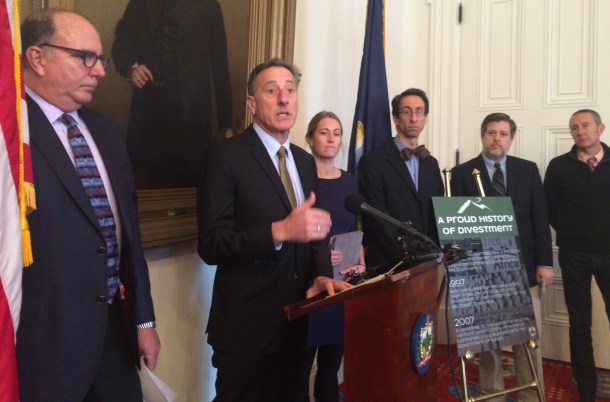
[G]ov. Peter Shumlin continued his push Wednesday for the state to dump investments in coal and ExxonMobil as a way to combat global climate change.
The governor, alongside leaders of several coal-free businesses, maintained the state has a long history of using divestment for social change. He also argued dropping the investments not only made moral sense, but financial sense, too.
Shumlin first called for Vermont to remove its coal and Exxon interests from public pension funds in his State of the State address last month. Then, he stressed the moral imperative; on Wednesday, he added financial gain as another big motive.
“We can make the argument that a lot of us were late to this party,” Shumlin said Wednesday. “We are. Absolutely. But what is not OK is to keep coming up with excuses of not joining the party when we know it’s the right thing to do.”
The governor wants to piggyback on a coal-divestment strategy begun by California, but he says Vermont’s motive was stronger.
“It makes absolutely no sense for Vermont to be owning coal stocks when we know that we are the tailpipe to the coal-burning states that have their emissions blow this way,” Shumlin said, adding the byproducts not only pollute the air, but waterways including Lake Champlain, too.
Shumlin’s call for partial divestment was greeted again by opposition from State Treasurer Beth Pearce, who tweaked the governor Wednesday for trying to change investment strategy “by press conference” and not through the state’s deliberative review process.
Pearce has said the $4 billion in state pension funds would lose money if fossil fuel investments were pared from the portfolios.
Vermont has approximately $1.2 million in coal-related investments and owns $207,000 in ExxonMobil stock. The pension funds provide income for about 50,000 public sector employees.
She warned the discussion could open a can of worms.
“Divestment becomes a slippery slope. Once you do one divestment, you start to take a look at other options to do divestment,” Pearce said. Giving investment decisions over to legislators or political leaders, she said, is “undermining the prudent process” put in place by statute.
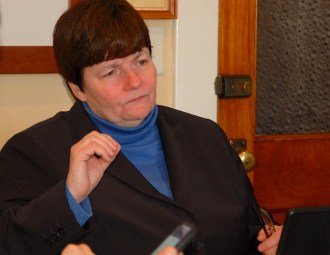
Pearce oversees the Vermont Pension Investment Committee, which manages the assets of the system. In July, the committee rejected the idea of fossil-fuel divestment, saying it would not be prudent financially. At the time, the VPIC chair Stephen Rauh said: “We were not created as an agent of social change.”
If the Legislature passes a resolution in favor of coal divestment, Pearce said she would ask the committee to review the portfolios again, this time specifically the impact of coal and not all fossil-fuel related investments. She said a complicating factor is that most of the coal investments were through mutual funds that invest in a variety of companies.
“I’m willing to evaluate it again and look at it in a more specific definition of coal,” she said, adding if lawmakers make a request, “and frankly if they do, I will urge the committee to re-evaluate this and give it a full hearing.”
Earlier, Pearce said the state funds would lose about $9 million a year if oil-related company stocks were dumped. Shumlin and others at the press conference Wednesday argued that analysis was flawed.
At the event, Shumlin ticked off the other times Vermont has divested for social change.
In 1986, Gov. Madeleine Kunin and the Legislature called on the board to divest from companies doing business with the government of South Africa to protest their policy of apartheid.
In 1987, Treasurer Jim Douglas pushed the investment board to unload $20 million in tobacco company stocks. Douglas said he did not want to micromanage the pension fund, but that public health concerns won out.
In 2007, Vermont divested from companies doing business with the government of Sudan because of the humanitarian crisis in that country.
“I have heard the argument it’s a bad precedent,” Shumlin said before he read off the list.
Pearce noted later that the tobacco and Sudan divestments went through the investment board.
House Speaker Shap Smith said he believed holding coal stocks was a financial risk but agreed with Pearce that “we should not legislate investment decisions.”
Smith said: “Those decisions belong with the treasurer and with VPIC. As someone who believes climate change is real, I am deeply concerned about whether energy companies are adequately factoring carbon risk into their business plans. Coal is the worst offender. I also believe that we need to continue to evaluate our portfolio’s overall fossil fuel position to ensure we are positioned for long-term investment success.”
Chris Miller of Ben & Jerry’s attended the Paris climate talks and supported the governor’s efforts.
“We believe that it’s incredibly important for policy makers, governments and businesses to send the right kinds of signals to the market and speed the transition to a low-carbon economy,” Miller said.
He joked the company saw no financial downside when it retired one of its flavors, Fossil Fuel, to the Ben & Jerry’s graveyard.

Other speakers at the event, including Eric Becker, chief investment officer of Clean Yield Asset Management of Norwich, said fossil fuel companies are bad investments because they may have to leave millions in “stranded assets” in the ground, like oil or coal, if efforts to fight global warming are successful.
Representatives of Seventh Generation, Sun Common and Sterling College also attended and said their company’s investment portfolios improved financially when they dumped fossil fuel stocks.
Shumlin said ExxonMobil stock should be dropped on principle.
“It has been clearly documented that since the 1980s, ExxonMobil’s own scientists have long known about the dangers of global warming, and chose to conceal that from the public,” Shumlin said in his State of the State.
“At the same time that they were building their oil rigs taller to account for rising sea levels, they were funding front groups of scientists to deny climate change is real. This is a page right out of Big Tobacco, which for decades denied the health risks of their product as they were killing people.”
Divestment is a hot topic in many communities across the country. In Burlington, a recent push was made to have the city look at dropping its fossil fuel investments.
