


What Burlington needs, by something close to common consent, is more housing. So there’s this whole chunk of the South End where there is no housing because it is (overstating the case just a tad here) banned by law.
It’s zoning. This chunk of the South End — the enterprise zone, in Burlington planning-speak — isn’t zoned for housing.
Simple solution, then: Rezone it.
It’s a solution supported by just about everybody who is anybody. Most politicians, including Mayor Miro Weinberger, developers, bankers, the business establishment — they all moved to rezone the zone. A no-brainer.
It will not happen. Or at least it does not seem likely to happen.
“It can pop back up,” said Amey Radcliffe, one of the people who fought the plan. “But I think it’s dead.”
Radcliffe is neither a politician nor a banker nor a developer. She co-owns a graphic design business. In other words, she’s an artist.
That’s who blocked the rezoning: artists getting involved in politics to protect their own well-being. They organized. They wrote letters to the editor. They packed public meetings. Why, one might have thought they were just like any other Vermont special interest group — dairy farmers, or loggers, or maybe even makers of high-speed computer chips.
They are. Why shouldn’t they be? Whatever else an artist is, he or she is in business. They are all trying to sell something: the paintings, sculptures, compositions, stories, performances, and installations they create.

Like other business people who prosper by selling their goods, the South End artists need reasonably priced places to produce those goods. And just as farmers have problems when new neighbors discover that farms can be noisy and smelly, artists need neighborhoods where some of them can be noisy and dirty.
“Studios are sort of industrial,” said Diane Gayer, an architect and planner (who happens to be a UVM professor) who supports the artists. “Forgers and sculptors do a lot of messy stuff that people don’t want to live next door to.”
So when they saw a threat to their way of living, the South End’s artists did what business people always do: They practiced politics.
They had some allies, because artists are not the only business people who benefit from the South End’s relatively low rents. So do small manufacturers, who worried that housing would gentrify the neighborhood, pricing them out of it.
“Once you open up to allow housing, landowners can get up to 10 times as much rent,” said Ibnar Avilix, a sculptor, performer and arts entrepreneur. “I’ve seen it elsewhere. People have to keep moving.”
(No, those are not the names he got at birth. “Ibnar” is an anagram of Brian, his original name. “Avilix” is also, he said, “altered.” But artists have been changing their names for centuries.)
Whether or not housing in the area would raise rents precisely by a factor of 10, Avilix is on the right track. Most housing is priced for the market, meaning what people will pay. In Burlington these days, the median house price, according to the Zillow real estate database, is $265,800, and that includes older homes. New housing as close to downtown Burlington as the South End enterprise zone would be far more expensive. It wouldn’t be long before the studios, foundries and storefronts the artists are renting got too expensive for them.
That’s a menace now apparently avoided. Weinberger and other officials who once favored rezoning no longer do. Score one for political action and for the power of self-interest.
Except in this case, self-interest is — well, not incorrect, but inadequate. Or maybe sometimes self-interest is in the public interest.
Because in fighting the rezoning the artists raised some interesting questions, not only about the South End, but about the future of the entire city, questions about how it will grow, about who will decide how it will grow, about what kind of city it will become.
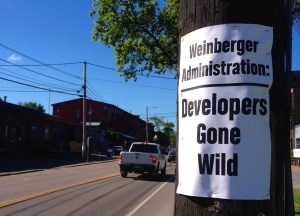
The artists and their allies are also concerned about development of the waterfront property once owned by Burlington College, proposals to allow taller buildings downtown, and the long-planned Champlain Parkway designed to provide a faster link between Interstate 189 and downtown. As they see it, in all these cases, the city’s business and political establishments are making decisions in their interests, but perhaps not to the long-term benefit of the city.
For instance, Radcliffe said the South End artists do not want to see South Pine Street, that area’s de facto main street, become “another Church Street.”
Hmmm. People from all over come to Burlington just to go to Church Street, to stroll its pedestrian mall, buy goods in its stores, eat in its restaurants. What’s not to like?
What’s not to like, said Radcliffe, is “more waitresses” — not because she has anything against waitresses, but because she and her allies do not want Burlington to become an urban theme park, a city whose affluent residents have plenty of places to eat and shop, but where nothing is manufactured and the waitresses and shop clerks cannot afford to live.
“I’d like to see Burlington be very diverse, not just beautiful restaurants and bars,” she said.
She and others also fear that city officials are “not looking at the whole picture,” as Gayer put it, as they plan to increase the housing stock.
Allowing taller buildings will enable developers to build more apartments. But are officials planning more bus service? If not, what are the implications for traffic? For climate change?
Then there is always the question of: housing for whom?
Here, the usual argument and the usual political dividing lines may be insufficient, suggests Joan Shannon, the Democrat who represents the South District on the City Council.
The argument over how much market-rate versus how much “affordable” (meaning subsidized) housing to build ignores what she called the “doughnut” of Burlington’s housing reality.
“We have luxury, low-income and nothing in the middle,” she said.
The comfortable but decidedly unfancy homes on the side streets off South Pine, built decades ago for working families, now cost something like $450,000, she said. Even in affluent Chittenden County, only a small minority of households can afford those prices.
The debate will go on, about housing and about the parkway, which many in the arts community want to block or at least alter. Whatever the outcomes, the South End artists have already made an important contribution by reminding Burlington that, done right, city planning is a work of art.
