


Editor’s note: Jon Margolis is VTDigger’s political columnist.
[H]e’s close in Iowa. He’s ahead in New Hampshire. He looked good in the last debate. He has terrified the Democratic Party establishment, embarrassed the pompous pundits who scorned him, and convinced his front-running opponent that she will have to fight him for weeks if not months.
Vermont’s own Sen. Bernard Sanders is on a roll. America is feeling the Bern.
And with it, another sensation, this one more familiar. It’s not a pain, nor exactly an itch. It’s more like that feeling that a bug is hovering about or a particle is wafting by.
The ad does not mention Clinton. For all we know it was directed at Marie of Romania, the Sultan of Brunei, or (always a possibility this year) Donald Trump. Except that none of them is a Democrat.
Ah, here’s what it is. It’s politics as usual.
Not, here, a condemnation. Politics as usual gets a bum rap. It’s really just another way of describing democracy, or at least democracy as actually practiced, which in turn means telling the voters what they want to hear.
Or not telling them what they don’t want to hear.
One thing they don’t want to hear is that the candidate they support has put out a “negative” political advertisement.
“I have never run a negative radio or television ad in my life,” Sanders said the other day in New Hampshire. “It is my very strong hope that I never will.”
He said this the very day that his campaign released a new 30-second campaign commercial called “Two Visions,” in which Sanders says there are “two Democratic visions for regulating Wall Street.”
One of them “says it is okay to take millions from big banks and then tell them what to do.” The second vision is his plan to “break up the big banks, close the tax loopholes and make them pay their fair share.”
OK, let’s see here. Since this is a Sanders campaign ad, it is reasonable to conclude that the commercial hopes the viewers have a positive reaction to his plan to “break up the big banks.”
And a not-so-positive reaction to that other vision – the one that includes taking millions (presumably in campaign contributions) from the banks.
Not-so-positive would be negative.
In the great tradition of politics as usual, the Sanders campaign pointed out that the commercial was not directed at former Secretary of State Hillary Rodham Clinton “exclusively.”
True. The ad does not mention Clinton. For all we know it was directed at Marie of Romania, the Sultan of Brunei, or (always a possibility this year) Donald Trump.
Except that none of them is a Democrat. There is really only one other Democrat in this race (Sorry, Gov. O’Malley; you had your chance and muffed it). That would be Clinton. She has taken campaign money from bankers and brokers.
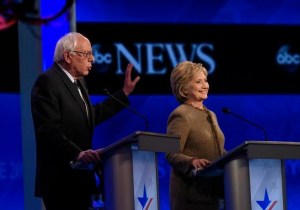
So did Franklin D. Roosevelt, who then did tell them what to do, as did his Cousin Teddy before him. But that’s all part of the debate over political strategy. What is not debatable is that the Sanders ad was negative. It was not dishonest. It was not a petty, personal attack. It was within the bounds of honorable political disputation.
But it was negative.
Not that Sanders started it. “People are distorting my record,” he said last week in New Hampshire. It wasn’t just random “people,” either. It was Clinton and her supporters, including daughter Chelsea who actually charged that Sanders “wants to dismantle Obamacare … dismantle Medicare (and) empower Republican governors to take away Medicaid.”
No, he does not. That was a dishonest, petty, personal attack, beyond the bounds of honorable political disputation. But then the Clinton people never said they wouldn’t go negative.
Besides, Sanders had given them something of an opening. For months, he had been promoting a “Medicare-For-All,” single-payer universal health system, but without details. He had a concept. He had a slogan, But he didn’t have a plan.
There were only two problems with Sanders Medicare-for-all plan: (1) it didn’t really qualify as a plan;(2) The system it (minimally) described was not Medicare for all.
Last Sunday evening, just two hours before the Democratic candidates debated, Sanders finally released his “Medicare-For-All” plan.
There were only two problems with it: (1) it didn’t really qualify as a plan;(2) The system it (minimally) described was not Medicare for all.
Five partially filled pages was enough for only about 1,600 words, which – even with a few links to supporting data – is not nearly enough to explain the health care system Sanders envisions.
A system, judged by the information he provided, which would be far more generous than Medicare. Expensive though it may be, Medicare is something of a bare bones system. It doesn’t cover everything. That’s why almost all Medicare recipients buy a supplemental “Medigap” policy. It covers most of what Medicare does not.
The system Sanders proposes would cover just about everything without co-pays or deductibles, and “no more fighting with insurance companies when they fail to pay for charge.”
He didn’t promise no more fighting with the government health insurance agency when it fails to pay for a charge. The suggestion is that it would never fail, that it would pay for everything.
No system in the world does that, not even the many universal health care systems which Sanders praises (accurately) as providing better coverage with better health outcomes at lower costs. They all have limits. They all have other cost-control measures (their doctors earn a lot less, for instance). As outlined so far, the Sanders plan has none.
That could explain why even some analysts who start off as sympathetic to the idea of a government-run health care system wonder if the total cost would be even more than the $1.38 trillion a year the Sanders campaign estimates. Forget for a minute that the $1.38 trillion gets added to taxes, even if two of those new taxes get labeled “premiums” to soften the blow, and even if most of the new tax burden would be borne by the very wealthy.
Sanders claims that most households would pay less; their tax bills would be higher but their health insurance premiums would disappear. That’s a tough argument to make, especially when, on the surface, the plan as outlined sounds like some of those Republican budget-and-tax proposals, the ones with big tax cuts for the rich offset by spending cuts to be determined later and higher revenue assumed from creative accounting.
Politics as usual. You can’t beat it.

