

For the second year in a row, state revenues will come up short of projections, and this time the lag hits both the current fiscal year and next year’s budget.
The state’s economists downgraded general fund revenue forecasts by $9.1 million for fiscal year 2017 and $4.7 million for fiscal year 2016. Last year’s revenue shortfall was $18.6 million.
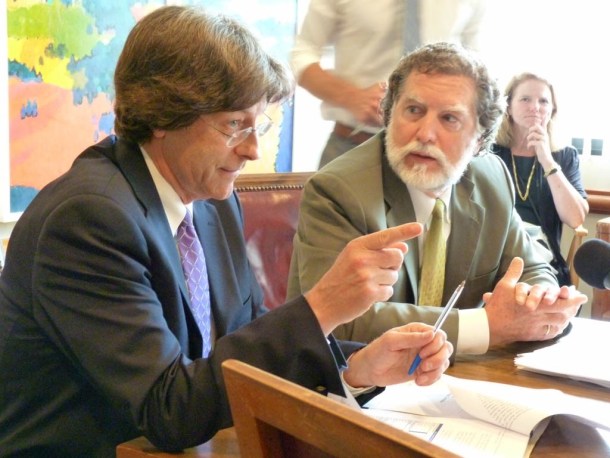
Tom Kavet, the economist for the Vermont Legislature, and Jeffrey Carr, the Shumlin administration’s economist, delivered their consensus forecast to the Emergency Board on Tuesday. The fiscal analysts said the current year projection is 0.25 percent below the July forecast and that the figure for fiscal year 2017 is 0.44 percent below previous estimates.
“This represents a change that is minuscule,” Kavet said. “This is a very slight downgrade in a macroeconomic forecast.”
The economists said three main factors are at work: a slow start to the winter ski season due to unseasonably warm weather; a sluggish world economy; and lower-than-expected revenues from new taxes implemented during this fiscal year.
The news comes just two days before Gov. Peter Shumlin announces his budget priorities. The governor said he would incorporate the shortfalls in his proposal. “While this news makes our job a bit more difficult, it is manageable,” Shumlin said.
The state already faces a $58.9 million general fund budget gap in fiscal year 2017 and a $14.7 million shortfall for the current fiscal year, which ends June 30.
The downgrades effectively widen the gaps in both years — to $68 million in 2017 and $19.4 million in 2016.
Revenue projections for fiscal 2016 depend heavily on a record April tax season. Total tax receipts for personal income are estimated at $760 million — a record high.
Kavet and Carr, however, warn that income tax changes implemented this year “introduce considerable uncertainty” and may result in totals that are lower than projected. That’s because wealthy people may find ways to sidestep higher tax payments, Kavet told lawmakers. Lawmakers put a cap on deductions for itemizations such as mortgage interest and property taxes at 2.5 times the standard deduction, or about $30,000. (The law exempts charitable deductions and medical expenses.) The tax changes also include a 3 percent alternative minimum tax on income-earners who make $150,000 or more.
Unemployment rates remain low in Vermont, but wages continue to be flat. Housing values have increased by only 5.8 percent since the 2009 peak in values. Gas prices are also at an all-time low, saving Vermonters thousands of dollars in annual travel and home heating costs. Kavet said, however, that fuel savings have not translated into more consumer spending.
While the national economy is vulnerable to “widespread global weakness, led by China,” Kavet wrote in his analysis that “major imbalances that could lead to a U.S. recession in 2016 are not evident.”
Details of the changes:
- There is a $2 million drop in meals and rooms taxes in fiscal 2016 so far, due to the sluggish start to the winter ski season.
- Corporate tax revenues are up $6 million.
- Telephone property tax revenue will drop from $7.2 million to $3.1 million in fiscal 2016. Revenues in fiscal 2017 will be $6.5 million.
- Lottery sales are up $1 million due to the Powerball jackpot.
- The bank franchise tax is down $500,000 due to a change in consumer trends. More Vermonters are using out-of-state banks for electronic transactions.
- The state is making a net $3 million from rental of prison beds to the federal marshals.
