

After Bernie Sanders’ dustup with advocates from Black Lives Matter, Salon.com declared the presidential candidate “is a white politician from the whitest state in the union.”
That sparks the Martin Luther King Jr. Day question: Is the Green Mountain State actually the whitest?
The U.S. Census Bureau reports that Vermont is 95.1 percent white — the exact same rate as Maine, according to the most recent American Community Survey five-year estimates.
But the census determines the unofficial “whitest state” ranking by considering residents classified as both Caucasian and non-Hispanic, of whom Vermont’s percentage is 93.9 percent — barely below Maine’s national high of 94 percent, according to the website www.census.gov.
Vermont, diversity experts say, is more multicultural than stereotypes would suggest. But summarizing the state’s changing demographics isn’t as simple as black and white.
The census shows the number of black Vermonters has doubled in the past 15 years. Then again, the actual figures rose from 3,063 in the year 2000 to 6,435 today — up from 0.5 percent to 1 percent of the state’s roughly 626,000 residents.
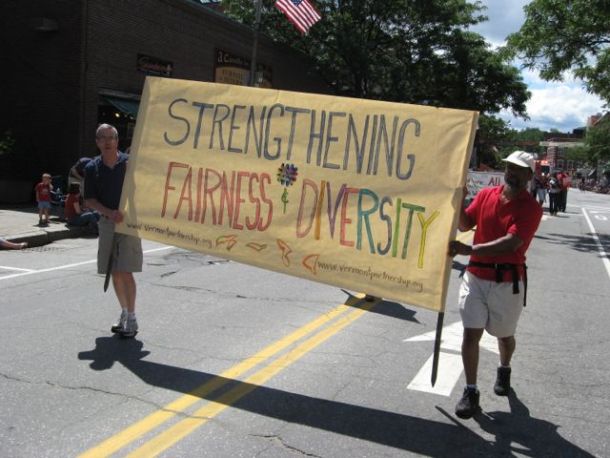
“The people you see on the street don’t seem to change that much,” says Curtiss Reed Jr., executive director of the Vermont Partnership for Fairness & Diversity. “But go into the schools — that’s where you see the emerging demographic pattern.”
Vermont’s diversity is increasing most among residents under age 18, census figures show. Blacks, for example, total 1.7 percent of the state’s youth, compared with 1 percent of all ages; Hispanics are 2.2 percent of youth, compared with 1.6 percent of all ages; and Asians are 1.5 percent of youth, compared with 1.3 percent of all ages.
Vermonters who identify themselves as Hispanic are the state’s largest minority group, rising from 5,504 in the 2000 census to 10,226 today — 1.6 percent of the state population compared to 16.9 percent nationally. The count includes 3,015 Mexicans, 2,808 Puerto Ricans, 498 Cubans and 3,905 who choose the classification “other Latino.”
Asians make up the state’s second largest minority group, up from 5,217 in 2000 to 8,200 today — 1.3 percent of the state population, compared with 5 percent nationally. Among them, 1,976 are Chinese, followed by 1,245 Indians, 1,114 Vietnamese, 830 Koreans, 688 Filipinos, 270 Japanese and 2,077 who choose the classification “other Asian.”
Native Hawaiians and other Pacific islanders have risen from 141 to 214 in 15 years.
And the number of Vermonters who classify themselves as American Indian or Alaska Native has dipped from 2,420 to 2,008 — the only drop in all reported racial and ethnic groups.
Reed sees the greatest growth in diversity in the state’s most populous county of Chittenden.
“There’s a much higher concentration of folks migrating or being born there,” he says.
But a comparison of 2000 and 2010 census figures — the most recent to include numbers for all Vermont communities — shows the population is changing statewide.
All but 34 of the state’s 251 cities and towns now record at least one resident who is black, although only four communities tally that population as more than 2 percent: Winooski at 6.9 percent, Burlington at 3.9 percent, Vergennes at 3 percent and Stannard at 2.3 percent.
(Vermont’s four localities that, as of the last census, were 100 percent white: Averill, population 24; Glastenbury, population 8; Somerset, population 3; and Warrens Gore, population 4.)
In comparison, 26 localities are at least 2 percent Hispanic, with most clustered in Addison County (Addison, Bridport, Middlebury, Panton, Shoreham and Vergennes), Chittenden County (Burlington and Winooski), the capital region (Barre, Montpelier, Northfield and Stowe) and Windham County (Brattleboro, Marlboro, Putney, Townshend and Vernon).
Nearly a dozen communities are at least 2 percent Asian, with Winooski at 6.2 percent, South Burlington at 5.4 percent, Middlebury at 4.3 percent, Burlington at 3.6 percent, Essex at 3.2 percent and, in alphabetical order, Brattleboro, Colchester, Montpelier, Norwich, Sandgate and Williston at between 2 and 3 percent.
Two towns are at least 2 percent American Indian: Highgate at 2.7 percent and Swanton at 2.5 percent.
In Winooski, a combination of students, refugees and new residents has made the municipality the state’s most diverse, with its 7,267 people being 17.4 percent nonwhite.
Reed, who travels the state to educate about shifting demographics “and the need for fair and welcoming communities,” says people who want to see the future need only look in local classrooms.
“Go into the schools — places like Brattleboro, Rutland, Burlington — and you’ll see young people of color,” he says. “That’s Vermont years from now.”
