

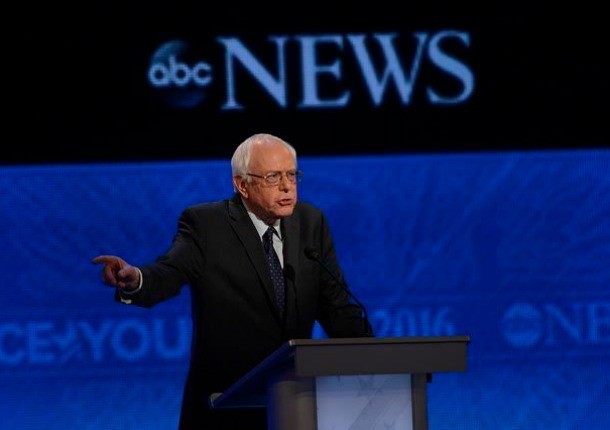
[M]ANCHESTER, N.H. — Terrorism dominated the final Democratic Party debate here Saturday night while a data-breach scandal that lit up the end of the week faded to the background.
Presidential hopeful Bernie Sanders opened the debate with a nod to the controversy, apologizing to Hillary Clinton, saying a staffer who improperly viewed some of her voter data was not representative of “the type of campaign we run.”
“Not only do I apologize to Secretary Clinton — and I hope we can work together on an independent investigation from day one — I want to apologize to my supporters,” Sanders said at the debate, broadcast on ABC News and held at St. Anselm College.
On Friday, the campaign fired data director Josh Uretsky for accessing the Clinton data, and late Saturday, announced the suspension of two additional staffers.
Sanders’ comments at the Saturday showdown were conciliatory, and represented a stark shift in tone from hours earlier, when multiple Sanders staffers questioned the motives of the Democratic National Committee publicizing the glitch incident on the eve of the debate.
For example, Tad Devine, the campaign’s senior strategist, said: “I think, for a while now, we have believed that some of the decisions made by the party were made to benefit Secretary Clinton and her campaign. For example, the fact that we are having a debate on the Saturday night before Christmas. Our last debate in Iowa was on a Saturday night, as well.”
Devine bemoaned the timing of the data breach story, saying, “On a day when the campaign is showing the kind of momentum that an insurgent campaign only dreams about, sometimes, it just so happens we have the big squabble.”
On Saturday, in his first public remarks on the matter, Sanders didn’t want the data story to be a big distraction during debate and apologized early on.
“I very much appreciate that comment, Bernie,” Clinton replied.
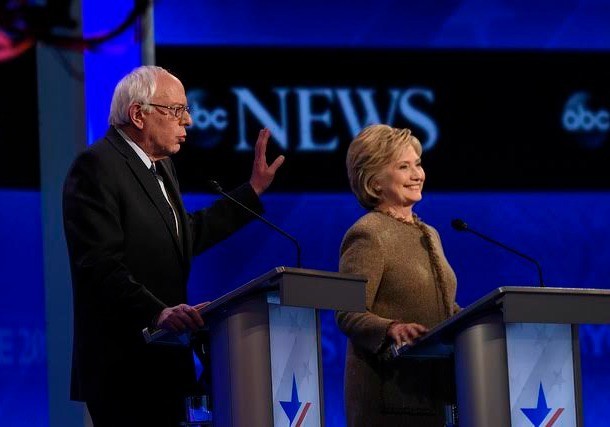
A few hours earlier, Clinton campaign manager (and Sharon, Vermont, native) Robby Mook said he was “disturbed” by the Sanders data breach, and told reporters “our data was stolen.”
While some politicos predicted that the data story would drive the debate, things quickly turned to foreign policy following the short, civil exchange over the data issue.
Sanders seemed more willing than in past debates to discuss foreign policy particularly after the terror attacks in Paris and San Bernardino. He appeared more animated and engaged during the half hour of back and forth on questions about how to combat terrorism.
Sanders promised to crush the terror group the Islamic State (ISIS), but he argued against direct intervention with troops. He said the United States “cannot be the policeman of the world” and criticized Clinton as a supporter of “regime change.” He pointed to her work as secretary of state in the toppling of Libyan President Muammar Gaddafi.
“I worry too much that Secretary Clinton is too much into regime change and a little bit too aggressive without knowing what the unintended consequences might be,” he said.
Clinton defended her position and took aim at Sanders.
“I think it’s only fair to put on the record, Senator Sanders voted in the Senate for a resolution calling for ending the Gaddafi regime and asking that the UN be brought in,” she said.
Sanders said Muslim nations in the Middle East must lead the effort to destroy ISIS. He pointed to recent comments of King Abdullah II in Jordan, who has said Muslim nations must do the nitty-gritty work on the ground.
Clinton said she agreed with Sanders that coalitions were critical. She touted her credentials as secretary of state as proof of her experience building them.
“We do need to form a coalition,” Clinton said. “I know how hard that is, I have formed them.”
Clinton’s almost encyclopedic knowledge of the political landscape in the Middle East was on full display during the debate, and she rallied for a two-pronged approach in Syria: destabilize ISIS while also removing Syrian President Bashar al-Asaad from office.
“We now finally are where we need to be,” Clinton said, defending her tenure in the State Department. “We have a strategy and a commitment to go after ISIS, which is a danger to us, as well as the region.”
In an implicit acknowledgement of Clinton’s foreign policy muscle, Sanders said she made “interesting and good points” on a number of issues.

Later, the questions shifted to the economy and Sanders went on the attack. He issued a scathing critique of Clinton’s Wall Street ties and her super PAC, and said she has “gotten a whole lot of money over the years from Wall Street.”
“Hillary and I have a difference,” Sanders said. “The CEOs of large multinationals may like Hillary. They ain’t going to like me and Wall Street is going to like me even less.”
“We’ve got to deal with the elephant in the room,” Sanders added, “which is the greed, recklessness and illegal behavior on Wall Street.”
Clinton defended her ties to big banks while saying she would impose strict regulations to rein in Wall Street excesses.
“I have said I want to be the president for the struggling, the striving and the successful,” Clinton said. “I want to make sure the wealthy pay their fair share, which they have not been doing.”
The third participant in the debate, former Maryland Gov. Martin O’Malley, who is trailing in the polls, went after Sanders on gun control and criticized his Senate votes opposing the Brady bill and giving legal immunity to gun dealers.
“Senator Sanders voted against even research dollars to look into this public health issue,” said O’Malley.
Sanders fired back in one of his most heated comments of the night.
“Excuse me,” Sanders said. “Do not tell me that I have not shown courage in standing up to the gun people.”
Sanders said he supported an assault weapons ban, instant background checks and an end to a “gun show loophole.”
Clinton followed O’Malley’s attack with a subtle ding on Sanders’ gun record, saying he “has really moved in face of the facts about what we’re confronting in our country.”
Much of the debate focused on foreign policy. In addition to gun control, other domestic topics included health care, racial justice and college affordability.

Sanders, who is leading in the New Hampshire polls, received two key endorsements this week: the Howard Dean super PAC Democracy for America and the Communications Workers for America. Late Saturday, his campaign announced they had collected more contributions than any other candidate at this stage of a White House bid, beating President Barack Obama’s record.
The Pre-Show Hype Around the Data Server
While the data scandal did not dominate the debates, the buzz in the hours leading up to the showdown was all about the Democratic National Committee, a vendor’s technical glitches and the improperly viewed voter data.
A bit of background: Sanders filed a lawsuit against the DNC Friday after the committee suspended Sanders’ access to the key voter data Thursday afternoon. As the deadline for a motion on the emergency injunction loomed late Friday, the DNC restored Sanders’ access to a voter database.
The DNC’s move came after a technology glitch allowed a Sanders staffer to see the voter information that has been collected by the Clinton campaign.
But while campaign manager Jeff Weaver acknowledged Saturday the peeping was unethical, he said cutting off access was a draconian punishment by the DNC, one that if sustained would be a “death penalty for the campaign.”
He said that field offices were barely able to function for the two days they did not have access to the database.
“It looks like a lot of empty chairs,” he said, describing the scene at one the Granite State’s Bernie Bases during a day without data.
The restricted data included supporter rolls, volunteer lists, phone bank information and other key demographic data collected by Team Sanders.
A senior staffer said volunteers knocked on 15,000 doors last weekend in the Granite State, and staffers stayed up until 2 a.m. Saturday using the small amount of offline data they had to coordinate 130 canvass shifts throughout the state for Saturday and Sunday.
“We were pulling paper out of trash cans, in some cases,” said New Hampshire field director Julia Barnes.
But while the temporary restriction meant volunteers were turned away and phone banks were canceled, the campaign viewed the news event as a chance to further enrich Sanders’ outsider status.
“If a political establishment is trying to get between us and voters, we are going to stand up to them,” Devine said.
The campaign raised more than $1 million Friday from a campaign email assailing the data shutdown, and Weaver said more than 550,000 people signed a campaign petition demanding the DNC reinstate access to the voter files.
He said the backlash came not just from grassroots party members, but also from the establishment wing.
“I had a call from a national committeeperson out in the world who said, ‘Put me on as a co-plaintiff,” Weaver said. “I had a super delegate in Nevada who joined the campaign. There was a national committeewoman in Maryland who posted on her Facebook page that if we didn’t get our data back she was going to resign from the DNC.”
For many grassroots members, the embodiment of the Democratic Party establishment is U.S. Rep. and DNC Chairwoman Debbie Wasserman Schultz. She has been accused of being biased for Clinton, such as scheduling debates at times fewer voters are watching.
Schultz talked about the scandal to a media scrum before the debate in the press filing center, which was located in the college’s cold ice hockey arena. (Hot coffee generously provided by ABC News quickly grew cold).
“We are certainly not in any candidate’s pocket,” Wasserman Schultz said. “We are for the eventual nominee and it’s our job to manage the primary nominating contest neutrally and fairly, which we are doing.”
The only substantive non-data related question in the Wasserman Schultz media gaggle came from Stone Chen, an 11-year-old who was covering the debate for Scholastic News.
Reporter of the night — 11 year old Stone Chen is covering tonight’s #DemDebate for Scholastic News @KidsPress pic.twitter.com/kqKQbRMfEj
— Julianna Goldman (@juliannagoldman) December 20, 2015
“I have just one question,” Chen said, national reporters towering over him with cameras and microphones. “So, um, what are you expecting for this debate?”
“Well,” Wasserman Schultz said, smiling, “I’m expecting our candidates for president of the United States to talk about their vision for America.”

