

Editor’s note: This piece from the SCOV Law Blog is by Thomas M. Kester.
Kirkland v. Kolodziej, 2015 VT 90

[I] think the Doobie Brothers summed this case up somewhat in their song “Divided Highway,” when they sang “divided highway stranded at the crossroads, of what’s wrong and who’s right, divided highway cuttin’ through the darkness.” But the question arises: is this a highway? Or is this case of a highway to the danger zone? Or a highway to hell? More specifically (and on point), is it a public highway under Vermont law?
I’ve copied the hand-drawn map that is included in the opinion for ease of knowing specific landmarks and for those of us that are geographically illiterate.
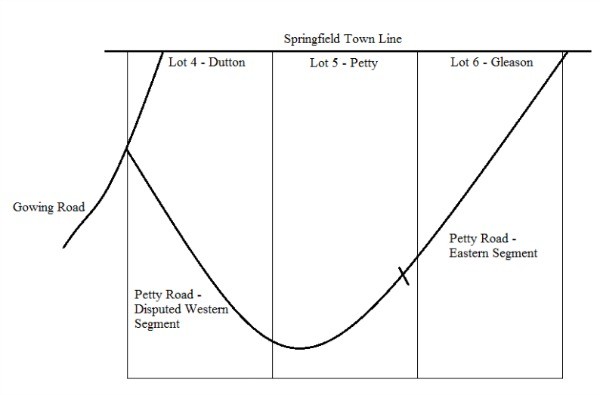
So the parties here are neighbors in Rockingham and like all good neighbors, don’t get along. Petty Road crosses the Kolodziejs’ property and the Kirklands use it to get to their property (Kirklands don’t have an easement from Kolodziejs, by the way). Petty Road goes from an intersection with Gowing Road and heads easterly (I sound like a ship captain saying that aloud) to the Springfield town line. In the early 1800s Petty Road (at least based on the Kirklands’ argument) was a public highway while the Kolodziejs argue that only the easterly portion was a public highway. The Kirklands basically use Petty Road and cross through the Kolodziejs’ property to get to their property.
Everything is hunky-dory until the Kolodziejs take it upon themselves (thinking Petty Road is a private road) to limit public access to Petty Road. Where do the Kolodziejs get this crazy notion? In their deed to the property, it describes Petty Road as “a discontinued pent road.” What the heck is a “pent road”? At first I thought they meant a “pit road” like NASCAR and I got excited. But when I used the Google-machine, a “pent road” is defined (oh God, the dictionary again) as “a public road that may be barred or enclosed by gates or bars especially at its terminal points” and Merriam-Webster even indicates that it is a term originated in New England (like the terms “wicked sweet,” “ayah” and “Allen’s Coffee Brandy”). So the Kolodziejs do all this so they can build a new house and a new driveway, and in the process close off the “existing driveway—the segment of Petty Road running through their property and used by plaintiffs.”
The Kolodziejs got a permit to do all this and during construction make a mess, including dumping stuff all over Petty Road. In an unintended “you shall not pass” gesture like Gandalf the Grey, the Kirklands try to access their property (I can only imagine they were smiling and listening to John Denver’s ‘Take Me Home, Country Roads”) and are unable to due to the construction. Now, if a tree falls in the woods and no one is around to hear it, does it make it sound? While it might sound like a metaphysical argument for infallible conjecture, it does act as the preface for a lawsuit in this case. Since 2007, the Kirklands have accessed their property from their northern neighbors. Further, there are steep ledges making it difficult to traverse the property from other sections … then again maybe it’s because the Kirklands are afraid of the possible “Bridge of Death” (even I do not know the air speed velocity of an unladen swallow).
The Kirklands sue seeking to quiet title to Petty Road, stop the Kolodziejs from obstructing Gowing Road, and recover damages for nuisance due to the obstruction. The trial court concluded that, in regards to Petty Road, that “Plaintiffs’ predecessors and the public had acquired rights by dedication and acquiescence to use the road and traverse the land now owned by Defendants.” Now defendants don’t give a hoot about the argument that the eastern segment has been always used as a public highway since its dedication but, instead, “(t)he dispute here centers on the segment of Petty Road that extends west to its intersection with Gowing Road near the western edge of Lot 4.” Remember that map from earlier? Go look at it for a second. I’ll wait …
The SCOV goes on to state that just because people do donuts in your front yard doesn’t make your front yard a “public highway” without the landowner and town being kosher with it.
And you’re back. So the parties got some land surveyors to look at the deeds, the property, and historical records. Apparently, the legal status of Gowing and Petty roads weren’t built on rock ‘n roll but by conveyances and town resolutions. The trial court looked at an 1825 conveyance deed that “strongly implies the recognition of Petty Road as a public highway along its entire length, including the disputed western segment,” and found similar references in other old and dusty deeds. There was also some local town resolutions that established the pent road. After a lot of boring legal jargon, the trial court concluded that Petty Road was a public highway and granted the Kirklands’ request for an injunction.
Unlike Tom Cochrane, the Kolodziejs didn’t interpret the trial court’s decision to mean that “life is a highway” and that they should “ride it all night long.” So the Kolodziejs appealed on numerous grounds, but mainly that Petty Road was deemed a public highway where it extended across their land.
The high court begins by stating that “We have identified three possible methods for establishing a public road in Vermont: (1) statutory condemnation; (2) dedication and acceptance; and (3) prescriptive easement.” Someone should tell those apocalyptic people in “Mad Max: Fury Road” about how to set up public roads because those private roads aren’t working out for them. To the SCOV, the trial court “found the road had been established through statutory condemnation, but it is not entirely clear which law it applied in concluding that the road otherwise had been established through ‘long acquiescence.’” It makes sense — just like how all my previous girlfriends did it to me, relationships can be established through “long acquiescence.”
Back when the Jeffersonian Party had a foothold in Vermont, the legal requirements for creating a road included: “(1) an official survey to be recorded in the town clerk’s office; (2) a formal act by the selectboard; and (3) a certificate of opening.” Even through determining whether roads are abandoned “stems from inconsistent, and sometimes incomprehensible, town records dating back two centuries or more,” the court has “consistently [] required proof of such records when considering whether the town undertook the proper statutory formalities in laying out a road.” With respect to the western segment of Petty Road, there was “no recorded survey covering that segment, no recorded act of the selectboard establishing that section as a public road, and no certificate of opening of that segment,” like baseball, three strikes and you’re out.
Because “brevity is the soul of wit” and I’m lazy, the three rationales the trial court used and the SCOV’s analysis will be tersely analyzed. The three rationales are (1) circumstantial evidence; (2) reinstatement of Petty Road; and (3) the selectboard’s statutory power to extend an already established highway. The high court’s responses are: (1) none of the circumstantial evidence complied with the necessary statutory elements and you need actual records; (2) you cannot discontinue a highway what didn’t exist as a highway and you cannot reference surveys that don’t exist; and (3) the statute is “actually the determination of the width of a road, rather than its length.”
The next part of the analysis is something called “dedication and acceptance.” Initially, I thought this meant whether or not the town had smashed a champagne bottle on the newly opened road. Then I read the next sentence and it meant whether there was “intent to dedicate on behalf of the landowner and proof of acceptance on behalf of the town” (there was also something called “prescription”). Unfortunately, the trial court never articulated whether they actually were going to be using “dedication and acceptance.” The record was devoid of any evidence of dedication and acceptance. The SCOV equated the trial court’s use of “dedication and acceptance” to someone yelling “Yahtzee!” when a landowner asks why you did donuts in their front yard. To drag this dumb analogy out further, the SCOV goes on to state that just because people do donuts in your front yard doesn’t make your front yard a “public highway” without the landowner and town being kosher with it.
The final section of the analysis deals with “prescriptive easement.” The requirements for a prescriptive easement are a “showing that the use was ‘open, notorious, continuous for fifteen years, and hostile or under claim of right.’” Much like placing a china shop next to an overfilled pen of seeing-red bulls, public highway establishment through prescriptive easement under Vermont law is “generally hostile.” After a lot of case references, the court “conclude[s] that the state of our law is that a nonpublic road cannot become public through a prescriptive easement.”
In the end, the Kirklands will not be blasting Willie Nelson’s “On The Road Again.”
