


[W]hen the second Democratic debate in Iowa occurred a day after the terror attacks in Paris, CBS News switched the format from a focus on economic issues to include the foreign policy questions of the moment.
Presidential hopefuls Hillary Clinton and Martin O’Malley dedicated their entire opening statements to the mass murders in France while passionately denouncing terrorism.
Sanders spent just 18 seconds (or 37 words) of his opening remarks on the Paris attacks before quickly shifting to the economy, for 45 seconds (117 words).
“I’m running for president because as I go around this nation I talk to a lotta people,” Sanders said. “And what I hear is people concerned that the economy we have is a rigged economy.”
Pundits were puzzled by Sander’s decision to shift so quickly away from foreign policy to the economy.
For the Vermont senator, that pivot was nothing new.
On Sept. 21, 2001, then-Rep. Sanders walked up to the dais on the House floor to talk about the fresh wounds inflicted on the American people following the terror attacks of Sept. 11, describing an “emotional shock from the terrible loss of life.”
The representative then paused for a moment, and turned his attention to economics, warning of a coming recession and criticizing a $15 billion airline bailout bill.
“[Americans] do not want to read in the papers that they are providing taxpayer dollars so that CEOs can end up with tens and tens of millions of dollars in executive compensation,” he said.
The bill, which was quickly passed into law, did not provide assistance to any of the 100,000 airline workers who had been laid off before and after 9/11, instead funneling billions in direct compensation to the biggest air carriers, according to the Wall Street Journal.
Sanders ignored calls that the industry was in need of assistance following the attacks, and voted against the bailout because it didn’t help airline workers.
Sanders after 9/11
Sanders has been an outspoken opponent of foreign entanglements in the Middle East — he was one of few members of Congress that voted against the Persian Gulf War authorization under President George H.W. Bush — but it’s clear from a review of his public statements and votes that his passion lies more in the prism of economic justice than military conflicts, even after significant events such as Paris and 9/11.
The pattern shows Sanders believes the real “battle” is fighting the ideology of greed.
“If we really want to go to war then let us stand up against the grotesquely unfair distribution of wealth which exists in this country,” Sanders said Jan. 22, 1991, in a speech opposing the war in the Persian Gulf. “Now that’s a fight – that’s a battle — I would like to engage in.”
Sanders on Persian Gulf War
In a speech at Georgetown University on Thursday that was focused primarily on his view of democratic socialism, Sanders went into some detail about his approach to defeating ISIS.
“Our response must begin with an understanding of past mistakes and missteps in our previous approaches to foreign policy,” Sanders said, roundly criticizing American’s role in regime changes in countries like Iran and Chile. “Unilateral military action should be a last resort, not a first resort,” he said.
“I will never hesitate to defend this nation, but I will never send our sons and daughters to war under false pretense. ISIS must be destroyed, but it cannot be defeated by the United States alone,” Sanders said.
Sanders said a coalition of nations must work to destroy militant group, and that Muslim nations must lead the charge. He pointed to the defense budget of Saudi Arabia, the third largest in the world, and said Gulf nations have the military capacity to squelch extremism.
Campaign spokesman Michael Briggs said the recent terror attacks had not changed Sanders’ main message, adding that economic issues would remain at the forefront of the presidential campaign.
“He’s making clear that he thinks [Paris] should not be a reason for us to divert attention from important issues in this country,” Briggs said. “He can talk about both foreign policy and the economy.”
Sanders, the dove
Sanders often crafts his opposition to military intervention in a way that sheds light on the economic issues that drive him.
In October 2002, when Congress was debating a resolution to invade Iraq, Sanders voiced his opposition to the war in a Capitol Hill news conference before talking about one issue “that doesn’t get enough attention.”
He then spoke about many issues.
Medicare cuts. A growing debt. A Veterans Administration overflowing with patients.
Sanders has used these same tactics when urging cuts in the military budget, quickly segueing to point out that government programs like Medicare and Medicaid need more funding.
“While we now spend $94 billion more on defense than three years ago, poverty and hunger are increasing, 47 million Americans lack health insurance, and an entire generation of young people wonders how to afford college,” Sanders said in 2008.
While Sanders declared himself a pacifist when he applied for conscientious objector status during the Vietnam War, he has voted for the authorization of force throughout his congressional career.
Sanders voted against the Iraq War resolution in 2002, but supported military action in Afghanistan the year before to track down the terrorists responsible for 9/11. He voted against the Persian Gulf War in 1991, but supported a NATO air campaign in Yugoslavia in 1999 to stop human rights abuses in Kosovo.
He is a firm believer in the power of diplomacy, and has stressed in his foreign policy platform that as president he would move “toward a policy of emphasizing diplomacy, and ensuring the decision to go to war is a last resort.”
While diplomacy might seem unrealistic to some in the current Syrian conflict, University of Vermont political science professor Melissa Willard-Foster disagreed.
“There are simply too many outside actors involved in the Syrian civil war, each with its own agenda, allegiances and enemies to resolve this conflict without diplomacy,” said Foster, who specializes in conflict and cooperation. “Research shows that foreign intervention in civil wars tends to prolong them, especially when there is more than one party intervening on more than one side.”
In addition to diplomacy, Sanders has often touted economic sanctions as a tool that can cause real harm against belligerent countries.
In 2007, Sanders co-sponsored the Burma Democracy Protection Act of 2007, which imposed sanctions against the country in order to curb a government crackdown on dissidents.
And in his opposition to the first Persian Gulf War, Sanders said Iraqi President Saddam Hussein could be hobbled and the conflict could “be resolved in a non-violent manner through the continuation of strong economic sanctions against Iraq.”
A review of the national security bills Sanders has drafted or supported points to two passions: providing benefits for veterans and protecting civil liberties.
Sanders recently served as chairman of the Senate Committee on Veterans Affairs, and has rolled out legislation throughout his career to enhance military dental and chiropractic care, raise salaries for soldiers, and address sexual assault in the military, among other issues.
He has also unveiled legislation to curb government military power, serving as a strong critic of the USA PATRIOT Act, enhanced interrogation techniques and the Foreign Intelligence Surveillance Court, among other programs.
He unveiled the Freedom to Read Protection Act in 2003 to eliminate the PATRIOT Act provision that allows the government to obtain customer information from bookstores and libraries.
“All of us are determined to do all that we can to protect the American people from another terrorist attack,” Sanders said after unveiling the bill, which never passed. “But the threat of terrorism must not be used as an excuse by the government to intrude on our basic constitutional rights.”
Freedom to Read Protection Act
Brendan Nyhan, a professor political science at Dartmouth College, said Sanders’ lack of foreign policy experience and relative pacifism could hurt him in a race against Hillary Clinton.
“I doubt the issue is favorable to Sanders, it’s a tough time to be a dove,” Nyhan said. “The public is opposed to sending ground troops to fight ISIS, but a significant majority want more aggressive action.”
Nyhan argued that while Clinton might benefit from the renewed anxiety over national security, the Paris attacks would be unlikely to reshape the race drastically.
In a New York Times article, Nyhan pointed to a Gallup poll from earlier in the month that showed just 3 percent of voters said terrorism was the most important problem facing the country.
“If the Paris attacks hadn’t happened, some other rationale would have probably been used to force [Sanders and O’Malley] to the sideline,” Nyhan wrote.
Sanders has opposed ground troops in Syria while acknowledging the group must be snuffed out. He has said Middle Eastern nations must lead the charge against the extremist group, and his foreign policy platform for president stresses diplomacy.
Following the Paris attacks, Sanders ramped up his rhetoric, calling on the world to “eliminate the stain of ISIS from this world.”
Briggs said Sanders is now developing a plan to defeat ISIS as well as a “long-term strategy to promote a safer and more peaceful world.”
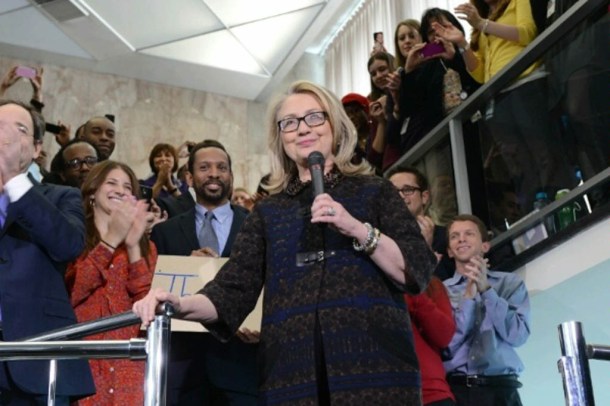
Hillary the hawk
As a U.S. Senator from New York, Clinton voted for the invasion of Iraq in 2002, a move that distinguishes her from Sanders. Clinton now says her support for the war was a mistake.
Nevertheless, the Iraq vote was indicative of how Clinton would act as Secretary of State, where she was seen as a hawk.
Clinton pushed to topple President Moammar Gadhafi in Libya, supported troop escalation in Afghanistan and has advocated for a more active American role in Syria.
Sanders was a critic of U.S. involvement in Libya, noting there was no congressional approval for the military action.
“Everybody understands Gadhafi is a thug and murderer,” Sanders told Fox News in 2011. “We want to see him go, but I think in the midst of two wars, I’m not quite sure we need a third war.”
Clinton said in September she would be more aggressive against Russia’s annexation of Crimea, asserting the Kremlin’s objective is “to stymie, to confront, to undermine American power whenever and wherever they can.”
A New York Times article on Clinton’s foreign policy legacy further reported Clinton as a pugnacious proponent of military action:
“Two dozen current and former administration officials, foreign diplomats, friends and outside analysts described Mrs. Clinton as almost always the advocate of the most aggressive actions considered by Mr. Obama’s national security team,” the article said.
Clinton’s tenure as secretary of state was hardly flawless, and Republicans have focused specifically on the attacks in Benghazi, Libya, that left an American ambassador dead. In addition, American support during the Arab Spring was seen by some as lackluster, and peace talks broke down between Israel and Palestine during Clinton’s time at the State Department.
But in the wake of the Paris terror attacks and amid threats from ISIS that similar assaults are coming to America, Clinton’s knowledge of how the world works, and her experience on the global stage could further bolster support among the Democratic base, some experts say.
“I think her foreign policy experience at State may help her during times of national insecurity,” said Rosella Capella, a Boston University professor who specializes in national security. “She is experienced in the foreign policy realm and has dealt with the Europeans regarding use of force.”
A recent Reuters poll put Clinton as the top Democrat capable of fighting terrorism, and a New York Times/CBS survey found 53 percent of respondents very confident Clinton could handle an international crisis. Only 16 percent said the same of Sanders.
“Republicans will certainly challenge Clinton’s record in the general election, but Democrats have already settled on her as their nominee,” Dartmouth’s Nyhan said in an interview. “It’s especially hard to imagine anyone making the case that Sanders would be more electable than Clinton after the Paris attacks.”
Whether Sanders will put more focus on foreign policy issues because of the Friday attacks remains to be seen.
“Our country and the world can and will defeat ISIS,” Sanders said Monday in Cleveland. “And at the same time we will rebuild our disappearing middle class.”

