

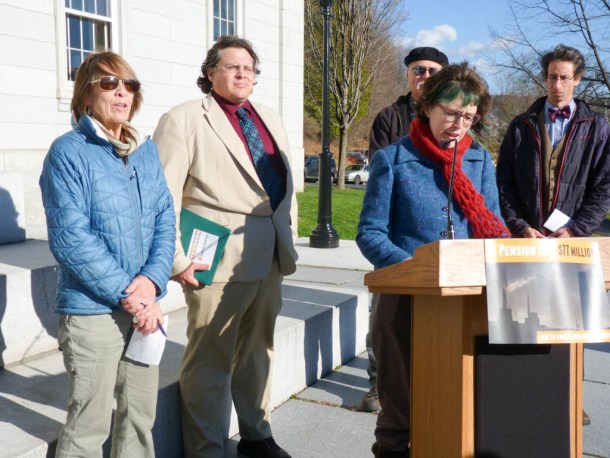
[V]ermont’s pension fund would have made $77 million more over the past three years had state officials removed fossil fuel companies from its investment portfolio, activists and investors claimed Monday.
That finding supports environmental groups’ calls for the state to divest its retirement investment accounts of fossil fuel assets, they said.
But such a move would jeopardize millions of dollars that state workers and retirees depend on, Vermont Treasurer Beth Pearce said.
“The likely impact of divestment would be significant, in the millions of dollars, one-time and ongoing annual losses as a result of implementing such a strategy,” Pearce wrote in an email.
Pearce is mistaken for several reasons, said Eric Becker, chief investment officer at Norwich-based Clean Yield Asset Management.
“The key thing to look at here is … over the last three years, with the decline in oil prices, that oil, gas and coal stocks significantly underperformed the rest of the market,” Becker said. “The fact that Vermont’s pension fund continued to invest in fossil fuels cost $77 million.”
Becker was among a group on the Statehouse steps Monday that included representatives from the Sierra Club and the advocacy organization 350Vermont.
The figure cited was arrived at by a new online tool called Decarbonizer that lets users analyze what the financial performance of their portfolios would have been without fossil fuel investments.
Divestment advocates used this tool to see what would happen if investments in the top 200 fossil fuel companies were subtracted from the state’s pension fund and reinvested into the other companies in the fund.
Becker said the resulting $77 million underperformance shown by fossil fuel companies undermined the credibility of consultants who claim the state’s fossil fuel assets would actually make millions of dollars. Pearce and other public officials are mistaken to rely on those consultants, whose predictions have now been disproven, he said.
Anticipated environmental regulations affecting countries across the globe increase the future risk associated with fossil fuel investments, Becker said. Consultants the state relies on for investment decisions haven’t taken that fact into account, he said.
Further, divesting the state pension fund of fossil fuel companies would contribute to a growing stigma against such companies, he said.
Efforts spent on divestment might be better used elsewhere, one University of Vermont professor said.
This is, in part, because state officials are acting on sound financial principles when they retain fossil fuels in the pension fund’s portfolio, said Dr. Charles Schnitzlein, who holds the Steven Grossman Endowed Chair in Finance at UVM.
Fossil fuel investments have performed worse than expected, particularly over the last year, Schnitzlein said, but even three years of poor yields aren’t enough to rule out fossil fuels as a safe investment bet.
And since it was cheap oil that caused recent poor yields on fossil fuel investments, activists would be wiser to pursue a carbon tax than portfolio divestments, he said.
“We should be taking advantage of the fall in oil prices,” he said. “It’s a relatively opportune time for a carbon tax.”
A tax on carbon pollution would hurt consumers much less when fossil fuels are cheaper, he said.
Such a tax would encourage other forms of energy production, and the transition would cost consumers less when fossil fuels costs are low, he said.
A carbon tax could have the added benefit of reducing other taxes, such as payroll taxes, Schnitzlein said.
Lawmakers are preparing legislation this year that would create a statewide tax on carbon pollution.
Schnitzlein said it’s important to note that divestment of fossil fuel assets in individual funds doesn’t harm fossil fuel producers’ bottom line.
He pointed to a study of the boycott on South African investments during apartheid, which showed that it had negligible effects. A boycott on South African sports teams was far more effective, he said.
