

That day, they served 100.
“Course, not all those people are homeless, but they’re people in need,” Clifford said. “And the need is growing every year.”

While Burlington has a long history of sheltering the homeless, towns in rural parts of the state are dealing with the issue for the first time.
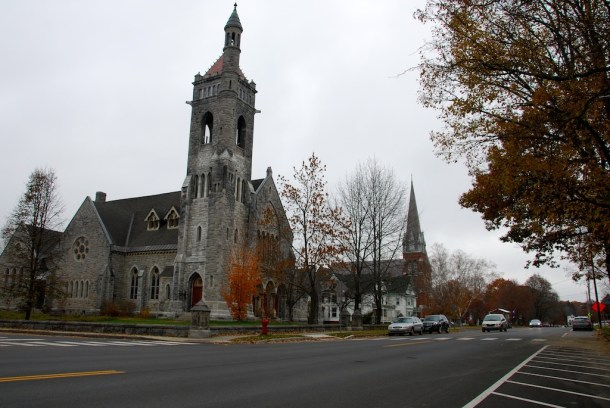
Last month, a proposal to use part of the North Church as a 10-bed warming shelter fizzled in the face of zoning ordinances, with town officials changing policies to allow such a shelter to be sited only in the district by the hospital, which is well outside the downtown area.
St. Johnsbury is not the only town struggling with how to accommodate the homeless. As winter closes in, regions across the state are attempting to balance the need for temporary accommodation for the homeless with local laws, concerns and priorities. The result? In many communities, plans for shelters have stalled.
Warming shelters are “a better Band-Aid”
Generally speaking, Erhard Mahnke, coordinator of the Vermont Affordable Housing Coalition, does not advocate for warming shelters. The group would rather see long-term solutions, such as more options for affordable housing and subsidies to help folks afford a stable place to live year-round.
But pressures are such that warming shelters are a necessity. “We have a homeless emergency in the state of Vermont,”’ Mahnke said.
Warming shelters are a temporary fix — facilities open only during the nighttime hours that provide those in need with a cot and a spot out of the cold. They are not ideal, Mahnke said, but they are “a better Band-Aid than motels.”
Emergency shelters are a cheaper alternative to the motel voucher system that the state has relied upon in recent years to shelter homeless individuals when temperatures drop and there is no space in existing shelters.
“It is life-threatening to be out in the cold in a Vermont winter,” Mahnke said.
For many reasons, it can be hard to get an exact count on Vermont’s homeless population. But trends seem to indicate that homelessness is on the rise in the state.
According to numbers from Vermont’s Emergency Solutions Grants program, 4,303 Vermonters stayed in some sort of publicly funded shelter in fiscal year 2015, with an average length of stay of 36.8 days. That’s the highest number since 2002, when there were 4,380.
In 2002, people spent a total of 66,732 nights in shelters. In 2015, it was a total of 153,361 nights.
The 2015 annual point-in-time count, carried out at shelters across the state one night in January, found that 1,523 Vermonters were identified as homeless. Chittenden County saw a decrease from the previous year by 11.6 percent, but the rest of the state had an increase of 2.4 percent.
Rita Markley, executive director of the Committee on Temporary Shelter (COTS) in Burlington, said that there are a growing number of Vermonters across the state who are struggling to afford a home. The rental market is very tight — with some parts of the state at a vacancy rate of less than 1 percent — and pensions and other sources of income are not keeping pace with the cost of rent, she said.
Meanwhile, Vermonters are struggling with complex needs related to mental health and substance abuse. The result, Markley said, is that the number of Vermonters who need help finding shelter “has gone up and up.”
How towns address that need varies, however.
When it comes to serving the needs of the homeless across Vermont, the state takes the lead from communities, according to Department for Children and Families Commissioner Ken Schatz.
The department, which encompasses the economic services division that works with the homeless, tries to be flexible. While one community may have a high rate of homeless single people, another community may have many homeless families.
“Really, there are differences in communities around the state, and certainly there are differences in urban areas versus smaller towns,” Schatz said. “That is why we have taken the approach of asking the local communities to inform us about what they need and what is the best approach to addressing that need.”
Pushback in St. Johnsbury
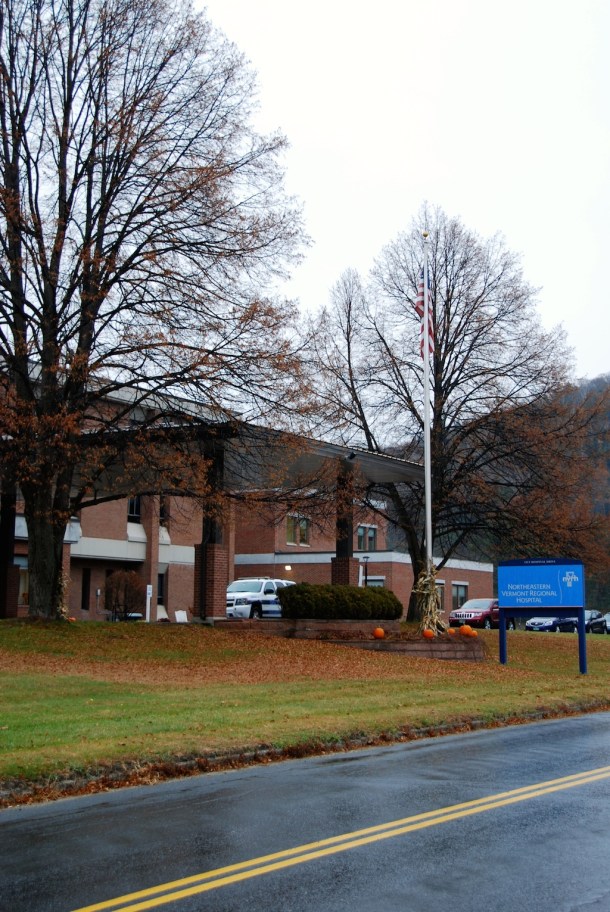
Last month, the St. Johnsbury selectboard OK’d a change to zoning in the town that now stipulates that only one area in town can host a warming shelter — the health services district, located about 3 miles from downtown.
The zoning change came after three proposals for siting a warming shelter floundered in the space of year, including the most recent proposal to put about a dozen cots in the basement of the North Church — located across the street from the Fairbanks Museum in the heart of the town.
Shaun Donahue, field services director for the Agency of Human Services, said that he was “surprised” by the reaction of the town to the proposals.
“What I know is there are homeless people here in town, just like there are in any other town,” Donahue said.
Some 120 single people in the St. Johnsbury area used the emergency motel voucher program last winter, according to Donahue. Because there are no motels in St. Johnsbury that accept the vouchers, those people need to travel to Lyndonville for accommodation that night.
“Putting people in motels, all that does is serve them for that night,” Donahue said.
When people stay at an emergency shelter, it can be an opportunity to get them enrolled in other services. A warming shelter is not a permanent fix, Donahue said, but it is “a starting point.”
But others in town question the need for the shelter at all.
Selectboard member Jamie Murphy said that the debate over the shelter “cast St. Johnsbury as a town that didn’t want to help where there’s a problem, or potentially a problem.” He argues that the town was being very thoughtful about siting a shelter.
“We’ve tried to listen to our residents, and thought hard about where a shelter should be located rather than just green-lighting the first proposal that came through,” Murphy said.
One concern for the town was whether the shelter would impact efforts to revitalize the downtown area — a priority for Murphy, who is a partial owner of the Tap Room.
For many in St. Johnsbury, Murphy said, there is a perception that the community where the Caledonia County courthouse is located has become “a dumping ground” for state services. The Northeast Regional Correctional Facility is also located there, along with probation and parole services and a number of other state services. Many feel the town bears an unfair burden, which Murphy said is linked to wariness about siting the warming shelter.
One other factor in changing the zoning ordinance was an attempt to put the homeless population in close proximity to services that they require.
According to Paul Bengtson, chief executive officer of Northeastern Vermont Regional Hospital, plans are in the works to get a warming shelter set up near the facility. Two locations are being considered, he said.
Donahue, however, contends that the more pressing needs among the homeless are for services related to mental health and substance abuse, and they require support from agencies that are not located in the health services district.
By siting the shelter out by the hospital, it creates an issue of how to get there. Many people who are homeless also do not have a car or access to public transportation.
“These are just vulnerable people who are grateful to be out of the weather for the night,” Donahue said.
Other towns facing challenges
In Morrisville, many see a need for a shelter, but plans stalled when a proposal ran up against zoning laws.
A steering committee from Patchworks Place, a program of Capstone Community Action, working with a local property owner, picked a site to locate a shelter.
The Rev. Rick Swanson, a priest with St. John’s in the Mountains Episcopal Church and a member of the steering team, said that the site was selected based on its proximity to public transit lines, its size and because it was ready to use.
Swanson said the committee was aware that there could be issues with zoning — the proposed location was in an industrial area — but they felt the site was worth fighting for.
“We were hopeful, but we knew that the zoning was going to be an issue,” Swanson said.
At a meeting of the Development Review Board last month, local officials rejected the proposal, saying that it would be too complex to change the zoning ordinance to allow a shelter in that area. But, Swanson said, town officials had been encouraging about finding another space.
The steering committee is in the process of scoping out other locations, and Swanson is optimistic that they will find a solution in time for the coldest nights of the coming winter.
Town Planner Todd Thomas agrees that many in Morrisville regard homelessness as an issue that the town needs to address. As the downtown area has grown in recent years, so has the presence of homeless people, Thomas said.
“There’s a majority agreement that a shelter would probably be well-used,” Thomas said.
Thomas is also optimistic that the town will be able to approve a plan for a shelter in the coming months. However, he noted that it’s part of a broader issue of housing in the area.
“There’s a big housing crunch, and people who have means and want to be in the community can’t find a place to live,” Thomas said.
Meanwhile, in Rutland, the city has come out staunchly against proposals to open a warming shelter.
When discussion about opening a low-barrier shelter, which would take in people who use alcohol or other substances, began, the city’s response was “swift and immediate,” according to Rutland Mayor Chris Louras.
Open Door Mission, a permanent shelter that operates on a strict policy of sobriety, already serves the city, Louras said.
Data showed that the greatest need in terms of homelessness was among families and victims of domestic violence, according to the mayor.
“Therefore, I have been very clear in my message that we shouldn’t be turning our backs on families and victims of domestic violence and irresponsibly address, (or) focus our effort, on the needs of single young men,” Louras said.
So across the state, the struggle to locate places for the homeless to stay continues.
Back in the kitchen of the North Church, Kay Clifford’s colleagues checked in with her as they finished tidying up.
Clifford said that the selectboard’s decision to change zoning regulations to restrict warming shelters to the area around the hospital, thereby barring the church from taking people in, disappointed her. She was surprised by the attitudes of her neighbors in the town that has been her home since 1945.
“I couldn’t see any great problem,” Clifford said. “But the town fathers did not think so.”
For now, as temperature drops, Clifford is worried about the people who need shelter.
“It takes a community to survive,” she said.
