

[D]OVER — Curtiss Reed Jr., executive director of the Vermont Partnership for Fairness and Diversity, was back in his hometown of St. Louis when he told a big city crowd of his small state’s mission: “Our vision is Vermont becomes the epicenter of inclusive thought and practice.”
The response: “People said, ‘Are you crazy?’”
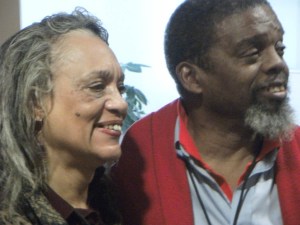
That’s why Reed invited 80 people of various backgrounds — from the director of Vermont State Police to the commissioner of the Department of Tourism & Marketing to the human resources head at Burlington’s Seventh Generation cleaning products company — to discuss a range of issues involving race, ethnicity, religion, socioeconomic status, age, gender, and physical or mental ability.
The Vermont Vision for a Multicultural Future Conference at Mount Snow’s Grand Summit Resort Hotel on Thursday and Friday sought ways to both curb discrimination and celebrate differences.
“Part of what we’re doing is looking at the challenges surrounding implicit bias,” Reed said. “Because this isn’t crisis-driven, it doesn’t catch people’s attention, but it’s a very useful exercise for Vermont leaders. We need to have a network of folks who can work with each other so when something does happen, you have willing partners on equal footing.”
Participants ranged from students to the event’s “birth mother,” 66-year-old Sha’an Mouliert, originally from New York and, since 1983, Vermont’s Northeast Kingdom.
“I’m looking for genuine, sustainable, collaborative efforts,” said Mouliert, a member of the group NEK Allies for Racial Justice. “We don’t have resources in the Northeast Kingdom. This is a room full of resources.”
Several people spoke of moving to the state from more stereotypically conservative areas, only to face surprising prejudice.
“Being a person of color can be really lonely in Vermont,” said one black woman, “even in the Burlington area.”
“We think we’re so progressive,” added a woman with a female partner, “but I’m here to say, ‘Not so much.’”
Several white attendees said it was important to speak out, as many of their peers don’t feel comfortable doing so.
Said one: “I love this because it gives me more language for talking about these issues.”
And a second: “I want to talk ‘with and for,’ not ‘to and about.’”
And a third: “As a white male, I’m well versed in having all I want. I hope some day everyone else’s grandchildren will have that.”
Conference organizers aim not only to stop problems but also to promote the need to embrace diversity, as minorities accounted for nearly 60 percent of the state’s population growth in the 2010 census.
“These demographic shifts will bring with them pressures for change in long-held social mores and expectations,” says the Partnership’s website, www.vermontpartnership.org. “These changes also bring with them unexplored economic opportunity.”
Tabitha Pohl-Moore, a counselor at Mill River Union High School in Clarendon as well as the child of a white mother and black father, understands the obstacles and opportunities.
“It’s really difficult work trying to help people feel seen and heard and valued,” she said. “Being here helps me know I’m not alone — there are other people feeling the same way and encountering the same issues.”
Kevin O’Connor, a former staffer of the Rutland Herald and Barre-Montpelier Times Argus, is a Brattleboro-based writer. Email: kevinoconnorvt@gmail.com
