

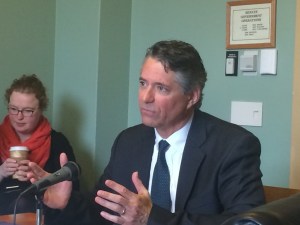
The argument was sparked by a public letter last week from David Sunderland, chair of the Vermont GOP, who said Democrats were “unleashing another assault on working Vermonters” through a proposed carbon tax that could raise gas prices by as much as 88 cents over 10 years.
The Legislature’s Joint Energy Committee reviewed two draft bills in late October aimed at reducing carbon emissions through taxation while offering measures to counteract the expense, including reducing the state’s sales tax by 1 percent.
Sunderland called the proposed carbon tax “dangerous,” citing Vermont’s geography, which often requires logging many miles to get to work.
VPIRG responded to Sunderland on Sunday, claiming he “misled the public” and that the legislation would also create an Energy Independence Fund to help Vermonters finance energy-efficient home projects such as installing rooftop solar panels and weatherization efforts.
About 10 percent of the money taken in from the carbon tax would go toward energy-saving measures, legislators said.
“Mr. Sunderland has no evidence to support the false claims he made in his statement yesterday,” Paul Burns, Executive Director of VPIRG, wrote in the letter. “But if he’s serious about wanting to discuss this with the public, then I challenge him to do so.”
Sunderland shot back Monday, calling into question VPIRG’s status as a nonpartisan group after Burns vehemently defended the Democratically backed legislation.
“When you, your organization and Democrats say ‘make polluters pay’ everyone knows what you really mean is make working Vermonters pay,” Sunderland said.
Sunderland said he would like to debate the carbon tax with Dottie Deans, chair of the Vermont Democratic Party, and not an advocacy group like VPIRG.
Sunderland said Tuesday that Deans had not responded to his debate request, and the party leader did not return calls seeking comment.
But Conor Casey, executive director of the Vermont Democratic Party, said Sunderland’s claims on the tax were distorted and said the Republican chair’s challenge was “one of the weirdest press releases I’ve ever read in my time in politics.”
“It sounded like David Sunderland was challenging our chair to a fight in a parking lot with chains and knives,” Casey said. “The truth is we are not going to give Sunderland another opportunity to spew more of his nonsense.”
Burns said that Sunderland should still debate VPIRG, as Democrats remain unlikely to debate publicly.
“I’m disappointed that Sunderland has not chosen to engage publicly on these issues,” Burns told VTDigger. “But instead he sends out really bombastic and inaccurate press releases about the whole idea.”
The Ethan Allen Institute, a conservative think tank, entered the fray Tuesday, with President Robert Roper announcing that he would like to debate Burns on the merits and drawbacks of a carbon tax in the state.
“The people of Vermont would benefit at this time from a thorough, public airing of the Carbon Tax and the issues surrounding it,” Roper said in a letter. “Therefore, the Ethan Allen Institute, a fellow 501c3, would be happy to pick up the gauntlet you threw down and engage in such a debate.”
Burns said he formally accepted Roper’s invitation Tuesday, and said he looked forward to a thorough debate on climate issues. No date has been set.
Sunderland said that while he was unlikely to get a response from the Democratic Party, Republicans would work hard to ensure that the tax does not pass the legislature.
“We are going to do everything we can to make sure that working Vermonters never see this 88 cent gas tax increase,” he told VTDigger.
While the battle over the past several days has been harshly partisan, Burlington Rep. Kesha Ram, who is running as a Democrat for lieutenant governor, reversed her support for the bill last week. Ram originally supported the bill, and was a cosponsor.
“If this hurts Vermont’s working families without relieving the pressure somewhere else, then it’s not something I can support,” Ram told VPR.
Sunderland said Ram’s change of heart was merely a political calculation.
“It’s interesting in a non-election year that she can sponsor a gas tax,” Sunderland said. “But running statewide in an election year, she has a change of heart.”

